
Tag Archives: plant

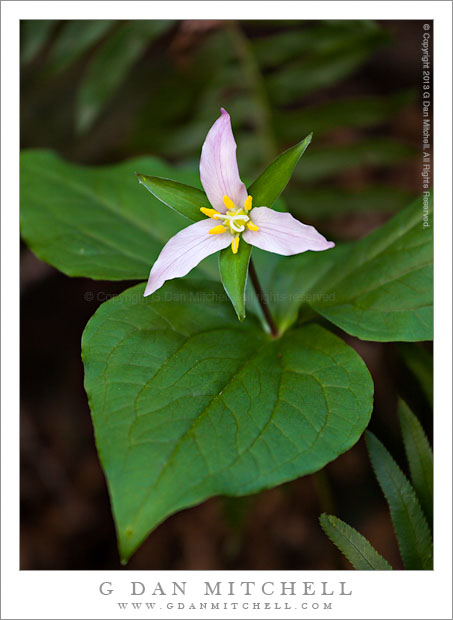
Trillium Flower and Leaves

Trillium Flower and Leaves

Trillium Flower and Leaves. Coast Redwood Forest, California. March 24, 2013. © Copyright 2013 G Dan Mitchell – all rights reserved.

A single trillium flower grows in the redwood forest of Muir Woods National Monument

I was brought up mostly in the San Francisco Bay Area. (I like to describe myself as a “virtual native” of California, since I’ve lived here since I was four years old.) When I was a child my parents would often – or so it seemed to me – bundle us into the family car for day trips to many of the nearby areas where I photograph on day trips today: Point Lobos, Pinnacles National Monument (now National Park), San Francisco, Big Basin State Park. One of the main attractions of Big Basin is the presence of coast redwood trees. I suppose that because I’ve always known trees this large that they don’t shock me the way that they do visitors who haven’t seen them before – but every once in a while I realize just how remarkable their size is.

However, with all of my youthful visits to redwood forests, it seems odd to admit that I never saw the trillium flowers there until I was much older. In retrospect, I’m pretty certain that visiting such places was a warm weather event in my family – and trillium blossoms appear at a time of the year when things are still distinctly wet and chilly. Now I try to see them every late winter and early spring, and to photograph them if possible. With this goal, I made a one day trip to the redwoods of Marin County north of San Francisco last week, making sure to arrive very early, before the hordes of tourist buses would arrive from nearby San Francisco. I managed to get a couple of hours in the deep early morning shade of the redwood forest to photograph these flowers before the sun and the other visitors arrived, making photography less appealing. Those who may not have seen the plant in the wild might be surprised at its form. Beneath the three trios of leaves/flowers that you see in this photograph, the whole affair is supported on a single long and bare step that rises vertically from the forest floor. The flowers, which can range in color from pure white through pink to a sort of dark and dusty burgundy, don’t last long, and if you aren’t there during the short interval when they blossom you might not notice them at all.

G Dan Mitchell is a California photographer and visual opportunist whose subjects include the Pacific coast, redwood forests, central California oak/grasslands, the Sierra Nevada, California deserts, urban landscapes, night photography, and more.
Blog | About | Flickr | Twitter | FacebookGoogle+ | 500px.com | LinkedIn | Email

Text, photographs, and other media are © Copyright G Dan Mitchell (or others when indicated) and are not in the public domain and may not be used on websites, blogs, or in other media without advance permission from G Dan Mitchell.
Slot Canyon Walls

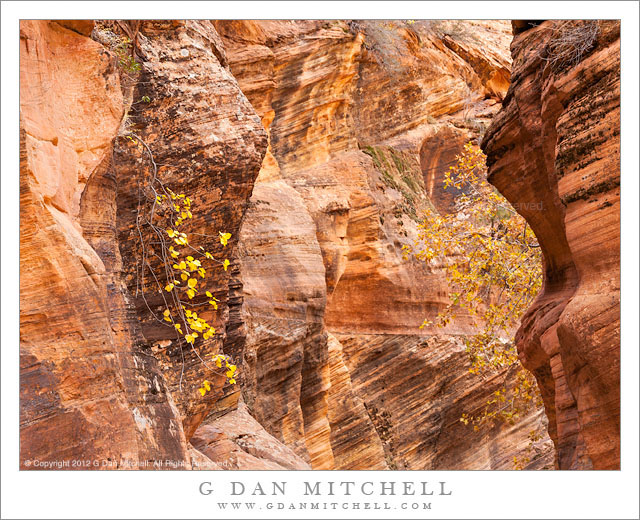
Slot Canyon Walls - The sculpted walls of a narrow and curving slot canyon, Zion National Park
The sculpted walls of a narrow and curving slot canyon, Zion National Park

Slot Canyon Walls. Zion National Park, Utah. October 22, 2012. © Copyright 2012 G Dan Mitchell – all rights reserved.

The sculpted walls of a narrow and curving slot canyon, Zion National Park

On the first non-travel day of my most recent Utah visit, since we were passing through Zion National Park on our way to points beyond, we decided to spend the better part of the day shooting there. For a few reasons, including that it was a bit early for fall color there, we chose to not go to Zion Canyon, but to instead spend the time along the Mount Carmel Highway that cuts through the park from west to east. Our object was to photograph the wide range of interesting subjects found there: sandstone of all shapes, textures, and colors; trees, both evergreen and those with fall foliage, and more.

We ended up spending most of the day along this route. An observer might have wondered a bit about us. We would drive slowly along the road in one direction, frequently slowing down and pulling over, looking around a bit, then either getting back on the road or piling out and heading off in various directions – either up into rocks or down into a wash or canyon. Eventually we worked our way to one end of the road’s passage through the park… and we turned around and headed back. We did this loop several times. Why? First, things that you might miss while driving one direction become easier to see when you head the other way. Second, and perhaps most important, light is not a static thing. It changes in may ways – intensity, color, angle, direction, what it strikes and what it misses – as the day goes on, so while the <i>landscape</i> might have been, arguably, “the same,” the <i>lightscape</i> was in constant flux. I made this photograph in a short section of slot canyon, contriving to find a point of view from which almost nothing but the twisting and overlapping forms of the rocks would be visible, along with just a bit of foliage.

G Dan Mitchell is a California photographer whose subjects include the Pacific coast, redwood forests, central California oak/grasslands, the Sierra Nevada, California deserts, urban landscapes, night photography, and more.
Blog | About | Flickr | Twitter | FacebookGoogle+ | 500px.com | LinkedIn | Email

Text, photographs, and other media are © Copyright G Dan Mitchell (or others when indicated) and are not in the public domain and may not be used on websites, blogs, or in other media without advance permission from G Dan Mitchell.
Reeds and Reflected Sky

Reeds and Reflected Sky

Reeds and Reflected Sky. San Joaquin Valley, California. January 21, 2013. © Copyright 2013 G Dan Mitchell – all rights reserved.

Reeds and blue sky reflected in the surface of a San Joaquin Valley pond

This image could serve an example of how puzzlement, patience, and good luck can lead to a photograph. I have looked at precisely this clump of reeds perhaps a half-dozen times, thought about how I might photograph them, but could not make it work. They grow in a marshy pond in a San Joaquin Valley wildlife refuge, near a spot where I almost always stop at least once each time I visit. The usual reason for stopping at this precise spot has little or nothing to do with these plants, and more to do with the wildlife that might be around or with the interesting light that often appears here at certain times of the day.

When I have stopped here to photograph those other things, or perhaps just to look around, I have noticed the reeds and wanted to photograph them, but remained puzzled about how to make the photograph work. It may seem odd that such a simple subject would be challenging, but it is hard to find a sight line to one clump that isn’t interrupted by others, the water is often a bit stirred up by wind and birds, and getting the right reflections and light on the water is a challenge. But each time I think about it, and I had even tried a few previous photographs. But this time I had some luck on my side. First, it was a very calm and still morning, so the surface of the water was almost glass smooth, with just very subtle ripples. Second, the morning fog and haze distinctly muted what could otherwise be an overpowering blue in the reflection from the sky. (I’m almost embarrassed to admit it, but I didn’t even go back to my vehicle to get a tripod to make this shot, instead just shooting it handheld.)

G Dan Mitchell is a California photographer and visual opportunist whose subjects include the Pacific coast, redwood forests, central California oak/grasslands, the Sierra Nevada, California deserts, urban landscapes, night photography, and more.
Blog | About | Flickr | Twitter | FacebookGoogle+ | 500px.com | LinkedIn | Email

Text, photographs, and other media are © Copyright G Dan Mitchell (or others when indicated) and are not in the public domain and may not be used on websites, blogs, or in other media without advance permission from G Dan Mitchell.

Sandstone Patterns, Dried Plant

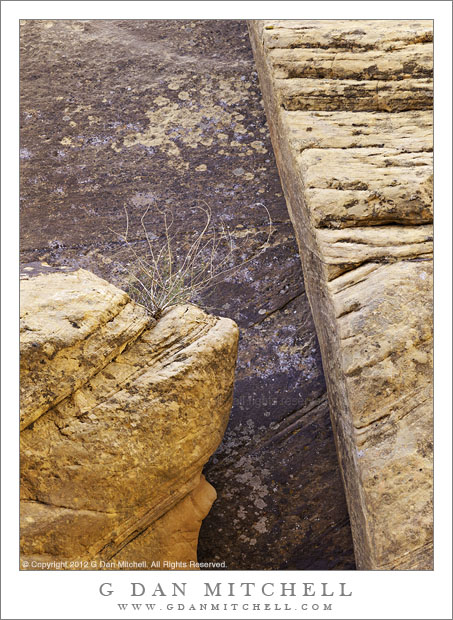
Sandstone Patterns, Dried Plant - A dried plant and sandstone patterns in a southwest desert canyon, Utah
A dried plant and sandstone patterns in a southwest desert canyon, Utah

Sandstone Patterns, Dried Plant. Grand Staircase-Escalante National Monument, Utah. October 23, 2012. © Copyright 2012 G Dan Mitchell – all rights reserved.

A dried plant and sandstone patterns in a southwest desert canyon, Utah

I was in Utah twice this fall, most recently with my friends Charlie and Karl to photograph a range of desert canyons and similar terrain. I’ve written before that I’m very new to photographing Utah, having seriously shot there for the first time only this past spring. But I’m trying to make up for lost time! Overall, I have spent something like a total of more than five weeks there this year! Yes, I like shooting in Utah. :-)

On the previous visits, I went to quite a few of the well-known locations – largely the national parks – and began the process of getting to know and understand that place a bit. On the most recent visit I was fortunate to be traveling with people who have shot there for decades, and I benefited from their long experience. Getting a bit more off the beaten track, we barely touched national parks – passing through Zion and visiting some remote areas of Capitol Reef. Instead we poked into a range of little canyons and valleys and so forth that don’t have the prominence of the parks. The specific locations are perhaps not that important since the state seems to be filled with similar places. This was my first real experience with the intimate desert canyons and river/creek courses that carve deeply into the landscape, where midday light bounces and reflects into the deep landscape in ways that are utterly unlike the California locations where I most often photograph.

This photograph was made in such a place, the first narrow canyon that we visited. Parking in an inauspicious spot along a gravel desert road, we dropped into a wash and wandered upstream, soon entering a narrow canyon as the sandstone walls rose beside us. Before long the canyon was narrow enough that we had to continually cross back and forth across the creek or simply wade straight up its course. As the canyon narrowed, direct sunlight no longer made it down to the creek – instead the light reflected from the higher cliff faces and bounced down into the canyon, toning the light red from the sandstone surface. In this photograph the cliff and two large pieces of sandstone contain angled strata and reflect the light in various ways as a small and seemingly dead plant sits in a crack in the rock.

G Dan Mitchell is a California photographer whose subjects include the Pacific coast, redwood forests, central California oak/grasslands, the Sierra Nevada, California deserts, urban landscapes, night photography, and more.
Blog | About | Flickr | Twitter | FacebookGoogle+ | 500px.com | LinkedIn | Email

Text, photographs, and other media are © Copyright G Dan Mitchell (or others when indicated) and are not in the public domain and may not be used on websites, blogs, or in other media without advance permission from G Dan Mitchell.