Tag Archives: range

Exposure Blending – A Quick Overview

(This is a slightly modified version of something I wrote as part of a discussion on Google+)

The author of the post that I read before writing this mentions two alternatives for dealing with dynamic range issues in landscape scenes – the use of graduated neutral density (GND) filters or the use of a similarly-named post process technique in Lightroom. (Similar processes are available in other software including Photoshop/ACR.) Another alternative is to use HDR (High Dynamic Range) techniques that allow computer algorithms to combine source images in ways that are not the same as what I describe in this post. I almost always use a different approach, exposure blending, and I’d like to share a few ideas on this topic.

When the scene contains an extremely large dynamic range – a common situation in landscape photography – it is possible to end up with shadow areas that are nearly black and devoid of detail, along with bright areas that are blown out and also completely lack detail. (The latter is especially an issue with digital capture in which overexposed areas can simply become pure white. Film failed more gracefully in this situation.)

One traditional method for dealing with such scenes is to attach various types of graduated neutral density (GND) filters to the front of the lens. These filters include a clear area and an area darkened by a few stops. A typical use might be to position the dark portion over the sky and the clear section over a darker foreground, effectively reducing the dynamic range of the light reaching the sensor by reducing only the brightness of the sky. With film, especially positive transparency film, this was just about the only realistic way to handle the situation in many cases.

A second method is to make a single exposure and use features in Photoshop/ACR, Lightroom, or other software to simulate the effect of the GND, lightening (or darkening) a portion of the photograph. This can often help quite a bit when it comes to balancing out dark and light areas in the image, and the fact is that most savvy landscape photographers do this sort of thing and more in post. But it has its limits. For example, darkening a bright area cannot put detail back in blown out areas, and lightening underexposed shadows can lead to problems with noise and posterization. The bottom line is that this technique works well when the overall range 0f brightness in the scene does not exceed the dynamic range of the camera – here it may be used to adjust the relative levels of the areas – but it does not work well when the dynamic range is actually too great for a single normal exposure.

There is a third method, sometimes called exposure blending, that can often be used when making the exposure. The idea is to make more than one exposure, with each exposure optimized for different parts of the scene by varying shutter speed, and then selectively blend the two exposures during post-production.* Two exposures are sufficient in almost all cases, with one for the shadow detail and the other for highlight detail – though in very complex or wide dynamic range situations more exposures can be used.

Continue reading Exposure Blending – A Quick Overview
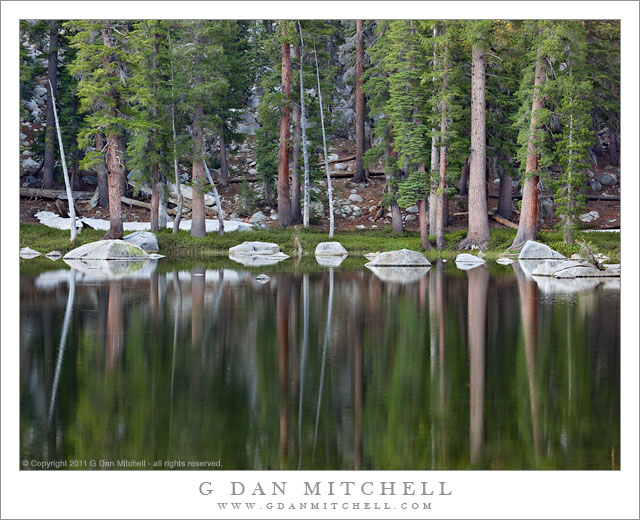
Morning Reflections, Unnamed Lake

Morning Reflections, Unnamed Lake

Morning Reflections, Unnamed Lake. Yosemite National Park, California. July 29, 2011. © Copyright 2011 G Dan Mitchell – all rights reserved.

The still early morning surface of an unnamed subalpine lake reflects the boulders and trees along its rocky shoreline, Yosemite National Park.

This is yet another of those little places in Yosemite that is both surprisingly accessible and surprisingly neglected. Since keeping it that way may be a good thing, I’ll refrain from locating it more specifically than to say that it is along the Tioga Pass Road through the park.

I have photographed here before, and I am intrigued by the good-sized granite boulders along the shoreline and out into the water of this shallow lake surrounded by forest. Because of the surrounding terrain, morning light does not reach down to th lake right away, so I was able to shoot in this soft and indirect light and include both some details in the shadows of the forest and their beautifully blurred reflections in the still surface of the water.

The photograph includes one indication of what an unusual year this has been in the high country. The horizontal white area beyond the shoreline trees at the left side of the frame is a melting snow bank. Normally that might not be a big deal, but this photograph was made near the very end of July. It is a very unusual year when we can still find snow at this elevation near the beginning of August!

G Dan Mitchell Photography
About | Flickr | Twitter | FacebookGoogle+ | 500px.com | LinkedIn | Email

Text, photographs, and other media are © Copyright G Dan Mitchell (or others when indicated) and are not in the public domain and may not be used on websites, blogs, or in other media without advance permission from G Dan Mitchell.

(Basic EXIF data may be available by “mousing over” large images in posts. Leave a comment if you want to know more.)

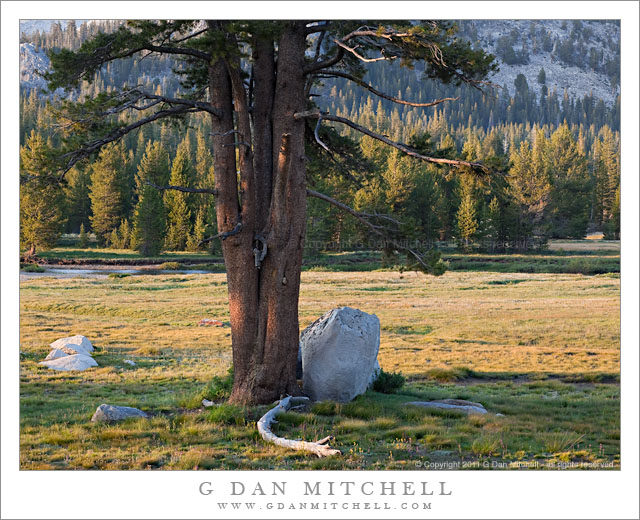
Trees and Boulder, Sunset

Trees and Boulder, Sunset

Trees and Boulder, Sunset. Yosemite National Park, California. July 27, 2011. © Copyright 2011 G Dan Mitchell – all rights reserved.

A large boulder against the base of lodgepole pines at sunset in Tuolumne Meadows, Yosemite National Park.

After finishing up an earlier evening shoot in a place that might be described as a mosquito-infested hell, but a very beautiful one, I left that location with as much haste as I could muster. Having done so, I found myself with a bit of extra time just as the final light of the day approached. Since I wasn’t too far away, I headed towards Tuolumne Meadows, figuring that I might just catch the last light that slants across the length of the meadow right below sunset.

When I arrived there I had very little time to carefully consider where and what I might shoot since the light was within minutes of disappearing for the day. So as I drove along the road through past the meadow, I kept my eyes open for any trees or boulders that might be catching this final light. As luck would have it, as I passed the RV holding tank dumping station – pretty rustic, no? – I saw this combination of lodgepole pine and boulders against the background of the sunlit trees across the meadow on the other side of the river and the ascending slopes beyond. I quickly pulled over, got out the tripod and camera, and made a few exposures here as the last light left the tree.

G Dan Mitchell Photography
About | Flickr | Twitter | FacebookGoogle+ | 500px.com | LinkedIn | Email

Text, photographs, and other media are © Copyright G Dan Mitchell (or others when indicated) and are not in the public domain and may not be used on websites, blogs, or in other media without advance permission from G Dan Mitchell.

(Basic EXIF data may be available by “mousing over” large images in posts. Leave a comment if you want to know more.)

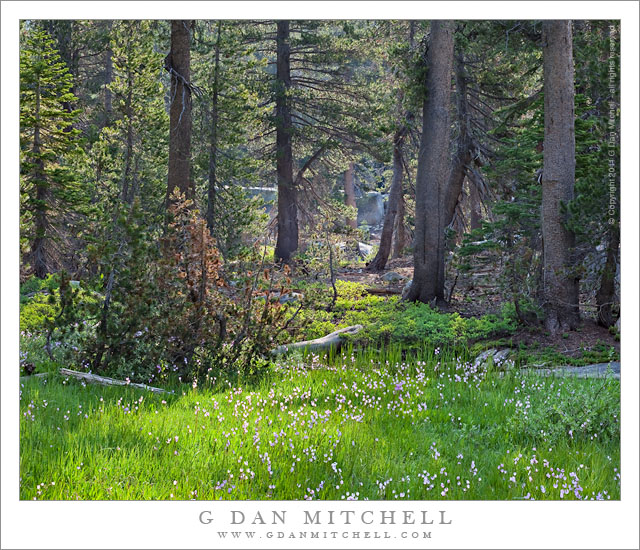
Forest Meets Meadow, Yosemite

Forest Meets Meadow, Yosemite

Forest Meets Meadow, Yosemite. Yosemite National Park, California. July 28, 2011. © Copyright 2011 G Dan Mitchell – all rights reserved.

A small sunlit meadow filled with shooting star flowers meets the edge of a dense lodgepole pine forest, Yosemite National Park.

For some reason many of the photographs I made on my recent trip to the Yosemite high country seemed to focus on the trees and the forests, and perhaps a bit less on the rocky peaks and prominences of the park. This photograph was made in a place that is not “special” in the ways that specialness is often measured in this park. As far as I know, it has no name, though it is not too far from Olmsted Point. It is simply a little area like so many others in this part of the Sierra, but one that I feel a connection to now that I have revisited it on several occasions and gradually pushed out the boundaries of my familiarity with it.

I first stopped near this spot along Tioga Pass Road several autumns ago on an evening when fog blanketed the nearby ridges. Very close to this spot there was a break in the fog, and I could see the sunset light and its effect on the fog clouds, so I pulled over and made some photographs. A year or so later, now having an actual awareness that there was a pull-out at this spot in the road, I stopped again on a summer morning for no particular reason and saw that a faint trail headed off into the lodgepole forest that was mixed with glacial boulders. I walked a short distance out on this path and found a small pond that I photographed, and I filed the location away as one to investigate again later.

On this July’s visit, I put this spot on my agenda and made a plan to visit it early on morning after photographing first light on a nearby ridge. Because there is no single attention-grabbing icon at this spot, rather than leaving my car with a target in mind I wandered slowly into this forest and simply kept my eyes open. (And I tried not to think about the mosquitos that are always thick in the lodgepole forest at this time of year!) First I stopped at the pond that I had previously photographed; then I picked up that trail and followed it through the forest, past other ponds, and across some glaciated granite near the edge of this small meadow filled with shooting star flowers, with the light coming through the forest beyond.

G Dan Mitchell Photography
About | Flickr | Twitter | FacebookGoogle+ | 500px.com | LinkedIn | Email

Text, photographs, and other media are © Copyright G Dan Mitchell (or others when indicated) and are not in the public domain and may not be used on websites, blogs, or in other media without advance permission from G Dan Mitchell.

(Basic EXIF data may be available by “mousing over” large images in posts. Leave a comment if you want to know more.)