
Tag Archives: season

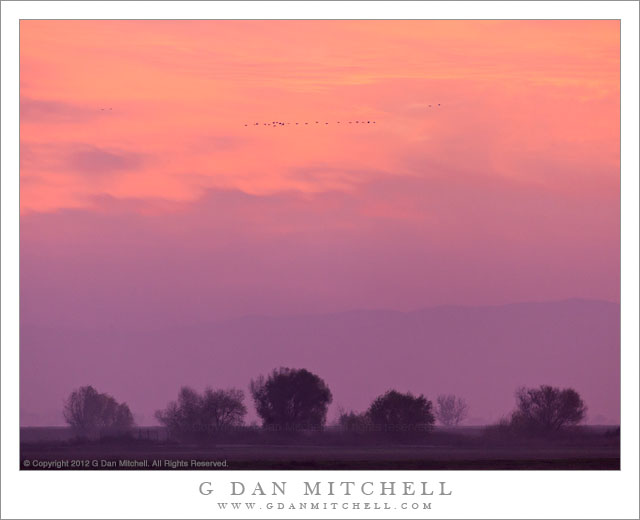
The Cranes Return, Evening

The Cranes Return, Evening

The Cranes Return, Evening. San Joaquin Valley, California. January 21, 2013. © Copyright 2013 G Dan Mitchell – all rights reserved.

The sandhill cranes return to the marshes of the San Joaquin Valley at dusk on a mid-winter evening.

For reasons I can’t quite put my finger on, the evening return of the sandhill cranes is one of the magical things among a host of magical things about central California’s winter migratory bird population. I think I was primed to regard these birds this way by reading about them many years ago, though I never quite new what sandhill cranes actually were and I presumed that they were only found in far-off places. Then when I first began to photograph birds seriously – which was only a few years ago – one of my first encounters with the winter bird popular involved finding sandhill cranes in fields south of Sacramento. Then, perhaps last winter, there was an evening at a wildlife refuge in the Central Valley when I was photographing geese with a small group of friends. There had been many, many Ross’s geese around that evening and as dusk approached the goose photography gradually came to an end as the geese departed. After the intense focus of shooting those birds, once they were gone we sort of looked up and realized that the sun was gone and that the world was quieting down. It seemed like the show was over. And then I heard a sound from over the trees to the southeast, a sound I now immediately recognize as the distinctive call of the cranes, and within moments huge flocks of these birds began to coast overhead and look for landing spots.

That is now how I expect to see them – at some point during the dusk period when most everything else has started to quiet down, the cranes appear. Their sound is a distinct contrast with the wild and raucous cackling of the geese, an altogether calmer and quieter call. And their mode of flight is also different. While the geese often launch loudly into the sky in huge, flapping clouds, the cranes coast in slowly and rather quietly, often in long lines, and their motion is slower and smoother. On this evening, at a point when there was barely enough light left to make photographs, they appeared to my left and crossed in front of me with the western dusk sky as a backdrop.

G Dan Mitchell is a California photographer and visual opportunist whose subjects include the Pacific coast, redwood forests, central California oak/grasslands, the Sierra Nevada, California deserts, urban landscapes, night photography, and more.
Blog | About | Flickr | Twitter | FacebookGoogle+ | 500px.com | LinkedIn | Email

Text, photographs, and other media are © Copyright G Dan Mitchell (or others when indicated) and are not in the public domain and may not be used on websites, blogs, or in other media without advance permission from G Dan Mitchell.
Ross’s Geese, Dusk Sky

Ross's Geese, Dusk Sky
Ross’s Geese, Dusk Sky

Ross’s Geese, Dusk Sky. San Joaquin Valley, California. January 21, 2013. © Copyright 2013 G Dan Mitchell – all rights reserved.

A row of Ross’s geese stretches into a line as they fly in front of dusk sky on a winter evening above California’s San Joaquin Valley.

The post-sunset twilight period is one of the most special of the day in these Central Valley wildlife refuges. There is a transformation at this point that fascinates me, even after seeing it a number of times. During the day, it often seems that not much is going on. The larger flocks of birds are mostly settled in somewhere, with only small numbers flying from place to place, albeit with an occasional momentary eruption of geese. As sunset approaches, the geese become more active, taking flight and moving from location to location. On this evening, the process was mostly one of leaving rather than arriving, as the flock nearest to us gradually left the pond where they had been settled and then flew off to more distant points. As the sun sets the wildlife seems like it is going to settle down. But then, as darkness comes on, special things happen. In this particular location, just as things quiet, the cranes return. Unlike the geese, who flap and squawk, the cranes have a distinctive and less raucous cry and then float in with much less flapping of wings. And at close to this same time, I often begin to notice that geese are flying in smaller groups all throughout the sky. At this San Joaquin Valley location, it can seem that they stretch all the way to the Diablo Range to the west. Simultaneous with this, if there are clouds in the sky, they take on the rich post-sunset colors that can perhaps be seen better by the camera than the eye.

The idea of this photograph was simple. I wanted to find and photograph a line of geese in front of a colorful section of the dusk sky. To make this work, I have to become aware of cloud patterns and where the most colorful portions of the sky are, and both clouds and colors are in a constant state of change. As groups of birds fly into view I try to guess which of them might follow a path across these areas of the sky, at which point I pick up a group in the viewfinder and follow it as it crosses into the scene. I am probably less attentive to the birds than to the non-bird portions of the scene that slide across my viewfinder, and I wait until the birds appear against a particular pattern or color of sky and clouds to make exposures. Obviously, little of this is in my control beyond the timing of my attempts to take advantage of whatever the sky and the birds happen to provide to me! In some ways, it still amazes me that it is possible to capture a simple scene like this one. Both technique and equipment play an important role here. In order to work with birds that may be a good distance away and in order to constrain my field of view to small sections of the sky, I work with a 400mm focal length. I must hand hold the camera rather than using the tripod, adding an additional challenge. By this time the light is so low that I find myself shooting at ISO 3200, something that would have been darned near impossible even a few years ago. And somehow, in light that is rapidly fading toward darkness, it is possible to photograph a moving flock of birds against a dusk sky.


G Dan Mitchell is a California photographer and visual opportunist. His book, “California’s Fall Color: A Photographer’s Guide to Autumn in the Sierra” (Heyday Books) is available directly from him.

G Dan Mitchell: Blog | Bluesky | Mastodon | Substack Notes | Flickr | Email


All media © Copyright G Dan Mitchell and others as indicated. Any use requires advance permission from G Dan Mitchell.
Autumn Leaves, Sand

Autumn Leaves, Sand
“Autumn Leaves, Sand” — Autumn oak and box elder leaves lie on the pink sand in the bottom of a wash, Zion National Park

The thing that most often first catches my attention in the bottom of slot canyons, such as this small one in the Zion National Park high country, is the way that they twist between closely spaced vertical walls. There is virtually nothing quite like this in our experience. But the thing I notice first is not necessarily the thing I remember most. I often wonder how others might regard my photographs, since I know that they cannot share the full context of the images that I know from being in these places. (I’ve often said that we, as the photographers, are perhaps the least able to see our own work objectively, since we cannot easily put aside these non-photographic things that are no longer present in the purely visual medium within which we work.) When I think of these canyons I think of the sound, often deadened by the sand and perhaps by vegetation, and of the feeling of the air, which always different from the feeling of the air outside the canyon – most often cooler when the “outside” air is warm but also warmer when the canyon provides shelter from cool-season winds. And it those canyons with water flowing through them, there is the constant, though often gentle sound of water flowing and trickling.

I also usually end up slowing down and looking at many small things that might not first be seen – the leftover pattern of water than may have flowed through weeks or months earlier, place where the sand has been marked by the passage of a small animal or by grass moving across its surface in the breeze, the mixture of rocks that must have come from distant places, plants growing in odd cracks in the rock, patterns in the rock walls, the passage from one rock layer to another, and more. On this fall day it had been windy and lots of autumn “stuff” was littering the canyon floor, which here was pink sandstone sand, further colored by the glowing light reflected from the red rock canyon walls.


Leave a comment or question using the form. (If you are reading this on the home page, click the article title to see the full article and the comment form.

G Dan Mitchell is a California photographer and visual opportunist. His book, “California’s Fall Color: A Photographer’s Guide to Autumn in the Sierra” (Heyday Books) is available directly from him. Blog | Bluesky | Mastodon | Substack Notes | Flickr | Email

All media © Copyright G Dan Mitchell and others.

Single-Leaf Ash, Green and Yellow Leaves

Single-Leaf Ash, Green and Yellow Leaves - A single-leaf ash in a narrow sandstone-walled canyon begins its autumn transition from green to yellow, Grand Staircase-Escalante National Monument
A single-leaf ash in a narrow sandstone-walled canyon begins its autumn transition from green to yellow, Grand Staircase-Escalante National Monument

Single-Leaf Ash, Green and Yellow Leaves. Grand Staircase-Escalante National Monument, Utah. October 24, 2012. © Copyright 2012 G Dan Mitchell – all rights reserved.

A single-leaf ash in a narrow sandstone-walled canyon begins its autumn transition from green to yellow, Grand Staircase-Escalante National Monument

Now, coming back to this photograph quite a while after I made it, I distinctly remember that the gradient from yellow to green of these leaves caught my attention when I saw this small plant growing out of a crack in the water carved sandstone of this canyon wall. I’m often attracted by dark trunks and branches like those on this specimen, especially when they are seen against a background such as this pink sandstone with the patches of darker, lichen-covered rock.

The photograph was made in the same canyon in this national monument where I made a number of other photographs on this same very productive day – productive despite the difficult weather conditions, which were cold, windy, and a bit cloudy. Deep in the canyon and against this canyon wall, the best light is often that from completely clear daytime sky, since that sort of light reflects the best off of the canyon walls and carries with it the warm colors of the rock. Given that this was a tremendously windy day, the lack of leaf blur in this photograph indicates that it was made in a slightly sheltered area of the canyon and, no doubt, by waiting to shoot between the gusts.

G Dan Mitchell is a California photographer and visual opportunist whose subjects include the Pacific coast, redwood forests, central California oak/grasslands, the Sierra Nevada, California deserts, urban landscapes, night photography, and more.
Blog | About | Flickr | Twitter | FacebookGoogle+ | 500px.com | LinkedIn | Email

Text, photographs, and other media are © Copyright G Dan Mitchell (or others when indicated) and are not in the public domain and may not be used on websites, blogs, or in other media without advance permission from G Dan Mitchell.