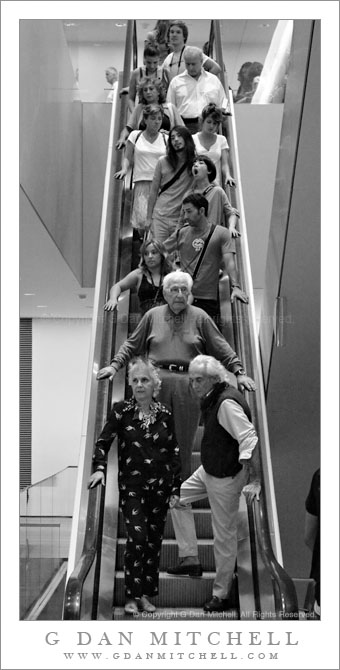
A group of people on the “down escalator” at the Museum of Modern Art, New York City.
I couldn’t resist the idea of photographing the steady stream of distracted people coming down this escalator at the Museum of Modern Art in New York City. I employed a technique that I often use when shooting on the street, namely to find an interesting structural subject (in this case, the escalator) and then wait for the right person or people to occupy the frame. I made a series of photographs of people on this escalator, and ended up liking this one the most. There are a number of specific things about the people in the scene that attract my attention, but I’ll let you discover them on your own, should you be so inclined.
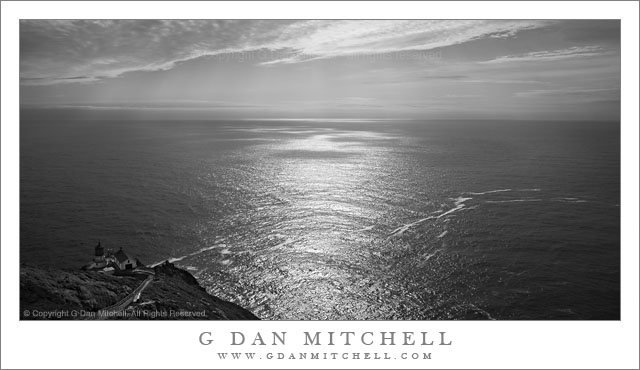
Afternoon light reflects on the surface of the Pacific Ocean beyond the Point Reyes lighthouse.
(Some of the following is repeated from a previous post of the same photograph in a color version.) Although our trip to Point Reyes was not primarily to do photography, somehow I ended up bringing back quite a few photographs! This photograph was made from the iconic overlook at “the point” and right above the long stairway down to the historic lighthouse. On this afternoon high clouds were streaming in from the Pacific and casting a mottled pattern of light and shadows on the surface of the Pacific Ocean.
This spot is often completely socked in by clouds and/or extremely windy and cold. However, this was perhaps the most benign afternoon I’ve experienced there. The temperatures were very comfortable – we were a bit too warm on the walk to the point. The sun was out, and the wind was nearly still at times.
I wasn’t certain when I made the exposure of whether it would end up being a black and white or a color photograph. I’m still not sure! I’m sharing the color version first, but a black and white rendition will follow shortly.
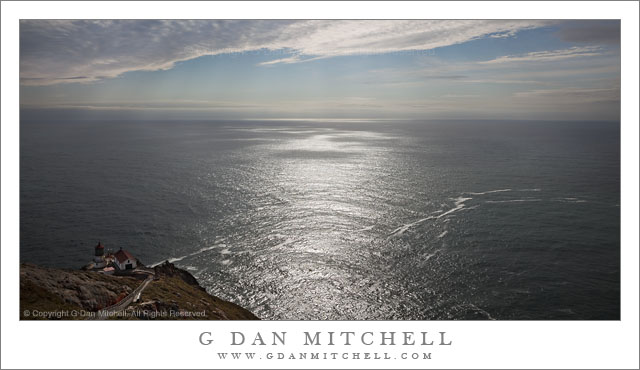
Afternoon light reflects on the surface of the Pacific Ocean beyond the Point Reyes lighthouse.
Although our trip to Point Reyes was not primarily to do photography, somehow I ended up bringing back quite a few photographs! This photograph was made from the iconic overlook at “the point” and right above the long stairway down to the historic lighthouse. On this afternoon high clouds were streaming in from the Pacific and casting a mottled pattern of light and shadows on the surface of the Pacific Ocean.
This spot is often completely socked in by clouds and/or extremely windy and cold. However, this was perhaps the most benign afternoon I’ve experienced there. The temperatures were very comfortable – we were a bit too warm on the walk to the point. The sun was out, and the wind was nearly still at times.
I wasn’t certain when I made the exposure of whether it would end up being a black and white or a color photograph. I’m still not sure! I’m sharing the color version first, but a black and white rendition will follow in tomorrow’s post.
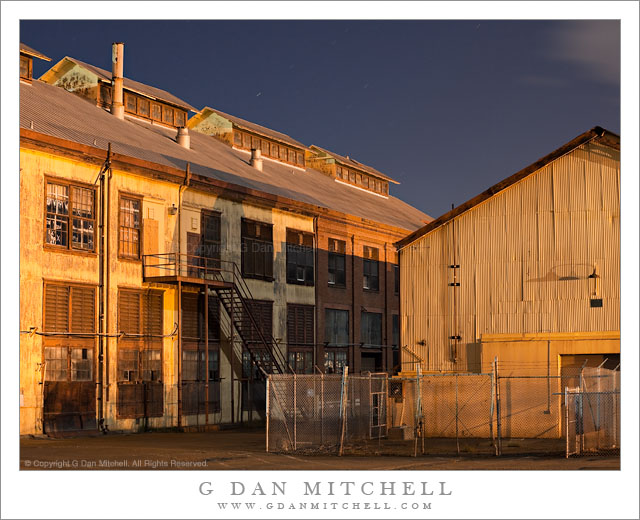
Night photograph of abandoned industrial buildings from the historic Mare Island Naval Ship Yard.
The building on the left is sometimes known as the “UFO Building” – not because of anything that might be stored inside, but because of a shadow in the shape of a “flying saucer” that forms on one of its walls. I thought it was the only one until I took this photo in which you might spot another saucer-shaped shadow on the wall of the building at the right.
This scene is not a particularly unusual one at the historic Mare Island Naval Ship Yard, a place that is full of old industrial buildings left over from the long ship-building history on this island. Many of the old buildings are now in a state of somewhat arrested development, but they certainly show the signs of age and lack of care – lots of boarded up buildings, peeling paint, warnings about hazards of various kinds, and so forth.
Most of the light in this photograph comes from a bank of strong security lights on the exterior of a more modern nearby building, and the yellow color is a result of the type of lighting that is used. There is also a bit of full moon light in the shadows and on the bit of cloud at the upper right, and this also explains the lighter coloration of the sky. When making night photographs in a place like this, I feel comfortable about not really trying to “capture” an objective reality of the place. To be blunt, that is pretty much impossible. First of all, it is actually so dark in many of these places that it takes a while for your eyes to get used to it. Secondly, there are so many varied light sources with so many different colorations that it is essentially impossible to “color correct” the scene – though I’m not even quite certain what it would mean to do that in a scene that we really can’t “see” with our own eyes.
The idea in my night photography is not often to capture the scene as it “is,” but instead to reflect the way “the camera sees,” a way of seeing that is quite different from our native modes of seeing. Things that occur over long periods of time (exposures measured in minutes) appear in a single frame, sometimes objects lose their definition as shadows move and wind blows, stars create streaks in the sky and passing clouds blur, and the colors are far from “natural.”
Photographer and visual opportunist. Daily photos since 2005, plus articles, reviews, news, and ideas.
Manage Consent
To provide the best experiences, we use technologies like cookies to store and/or access device information. Consenting to these technologies will allow us to process data such as browsing behavior or unique IDs on this site. Not consenting or withdrawing consent, may adversely affect certain features and functions.
Functional
Always active
The technical storage or access is strictly necessary for the legitimate purpose of enabling the use of a specific service explicitly requested by the subscriber or user, or for the sole purpose of carrying out the transmission of a communication over an electronic communications network.
Preferences
The technical storage or access is necessary for the legitimate purpose of storing preferences that are not requested by the subscriber or user.
Statistics
The technical storage or access that is used exclusively for statistical purposes.The technical storage or access that is used exclusively for anonymous statistical purposes. Without a subpoena, voluntary compliance on the part of your Internet Service Provider, or additional records from a third party, information stored or retrieved for this purpose alone cannot usually be used to identify you.
Marketing
The technical storage or access is required to create user profiles to send advertising, or to track the user on a website or across several websites for similar marketing purposes.