
Tag Archives: sunset

Red Rock at Dusk

Red Rock at Dusk
Red Rock at Dusk

Red Rock at Dusk. Capitol Reef National Park, Utah. October 8, 2012. © Copyright 2012 G Dan Mitchell – all rights reserved.

Red rock sandstone cliffs at dusk in the Fruita area of Capitol Reef National Park, Utah.

The farther mesa or tableland is a prominent feature of the Fruita District area of Capitol Reef National Park as seen when approaching from the west – though here it is photographed from a slightly different point of view that is more to the south. There is a prominent feature – not seen in this photograph – along the upper rim of these cliffs that is known as “The Organ,” and which is pointed out in guides and maps to the area. However, I’m surprise that the spectacular cliff and mesa itself seems to either not have a name or else have a name that is not widely known. I asked about this when I was there, and several people who should know did not know of a name for it, and one suggested a name that comes from another feature that is more general.

Nonetheless, these cliffs certainly impress me, named or not! The photograph was made rather late in the day, as the sun was just about to drop above the edge of the higher country to the left/west of here. Thin clouds somewhat diffused and softened the evening light, but not so much as to remove the warm coloration of the light. Among the strata visible here is one along the low ridge at front right that contains starkly differentiated layers of lighter and darker rock. Near the far lower left corner is a small area of trees that is not far from the campgrounds of the Fruita area.

G Dan Mitchell is a California photographer and visual opportunist whose subjects include the Pacific coast, redwood forests, central California oak/grasslands, the Sierra Nevada, California deserts, urban landscapes, night photography, and more.
Blog | About | Flickr | Twitter | FacebookGoogle+ | 500px.com | LinkedIn | Email

Text, photographs, and other media are © Copyright G Dan Mitchell (or others when indicated) and are not in the public domain and may not be used on websites, blogs, or in other media without advance permission from G Dan Mitchell.
Central Valley, Winter Dusk

Central Valley, Winter Dusk

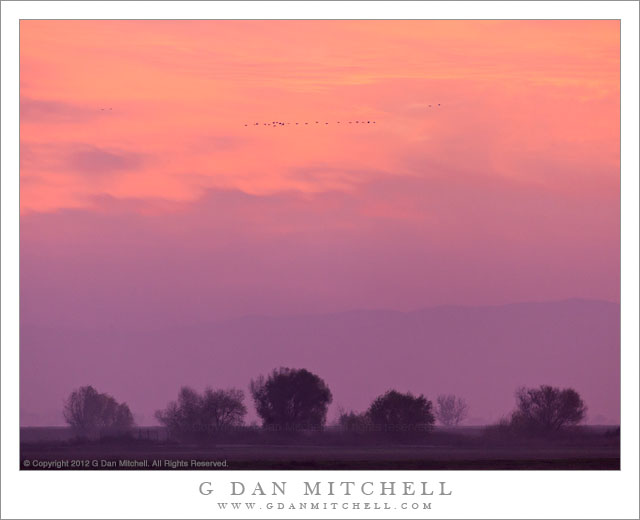
Central Valley, Winter Dusk. Merced National Wildlife Refuge, California. December 11, 2012. © Copyright 2012 G Dan Mitchell – all rights reserved.

A line of geese fly in front of the first clouds of an approaching winter storm front above California’s Central Valley.

This photograph was made at a late enough time in the evening that it was becoming hard to see in the same detail that the camera has. The sun had gone down and the light reflected up into the clouds was beginning to fade, and Central Valley haze filled the air, partially obscuring the details on anything more than a few hundred feet away.

We were surprised and pleased to have a spectacular sunset as the clouds of an incoming weather system that had early blocked the light were now lit up from below as the sun dropped to the horizon. The intense colors of the red clouds were almost too bright to photograph. Here I used a long lens to isolate a small section of the terrain to the west that held a group of silhouetted trees, with the Coast Range mountains beyond, and the sky turning all shades of purple, orange, and red. Although it may be difficult to see in this small jpg, a long line of geese is traveling from right to left high in the sky.

G Dan Mitchell is a California photographer and visual opportunist whose subjects include the Pacific coast, redwood forests, central California oak/grasslands, the Sierra Nevada, California deserts, urban landscapes, night photography, and more.
Blog | About | Flickr | Twitter | FacebookGoogle+ | 500px.com | LinkedIn | Email

Text, photographs, and other media are © Copyright G Dan Mitchell (or others when indicated) and are not in the public domain and may not be used on websites, blogs, or in other media without advance permission from G Dan Mitchell.
The Cranes Return, Evening

The Cranes Return, Evening

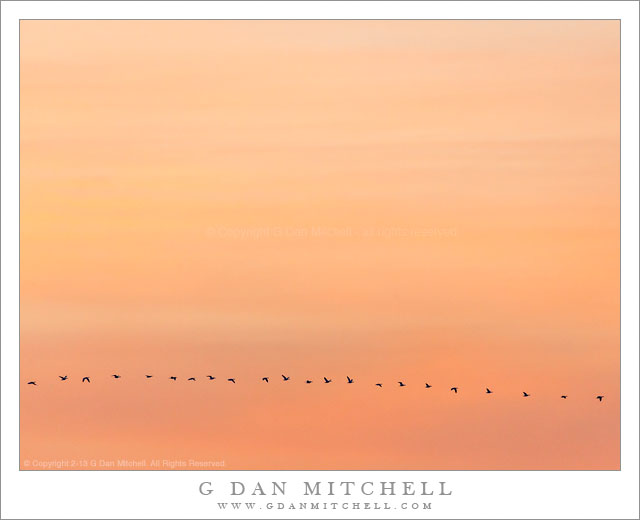
The Cranes Return, Evening. San Joaquin Valley, California. January 21, 2013. © Copyright 2013 G Dan Mitchell – all rights reserved.

The sandhill cranes return to the marshes of the San Joaquin Valley at dusk on a mid-winter evening.

For reasons I can’t quite put my finger on, the evening return of the sandhill cranes is one of the magical things among a host of magical things about central California’s winter migratory bird population. I think I was primed to regard these birds this way by reading about them many years ago, though I never quite new what sandhill cranes actually were and I presumed that they were only found in far-off places. Then when I first began to photograph birds seriously – which was only a few years ago – one of my first encounters with the winter bird popular involved finding sandhill cranes in fields south of Sacramento. Then, perhaps last winter, there was an evening at a wildlife refuge in the Central Valley when I was photographing geese with a small group of friends. There had been many, many Ross’s geese around that evening and as dusk approached the goose photography gradually came to an end as the geese departed. After the intense focus of shooting those birds, once they were gone we sort of looked up and realized that the sun was gone and that the world was quieting down. It seemed like the show was over. And then I heard a sound from over the trees to the southeast, a sound I now immediately recognize as the distinctive call of the cranes, and within moments huge flocks of these birds began to coast overhead and look for landing spots.

That is now how I expect to see them – at some point during the dusk period when most everything else has started to quiet down, the cranes appear. Their sound is a distinct contrast with the wild and raucous cackling of the geese, an altogether calmer and quieter call. And their mode of flight is also different. While the geese often launch loudly into the sky in huge, flapping clouds, the cranes coast in slowly and rather quietly, often in long lines, and their motion is slower and smoother. On this evening, at a point when there was barely enough light left to make photographs, they appeared to my left and crossed in front of me with the western dusk sky as a backdrop.

G Dan Mitchell is a California photographer and visual opportunist whose subjects include the Pacific coast, redwood forests, central California oak/grasslands, the Sierra Nevada, California deserts, urban landscapes, night photography, and more.
Blog | About | Flickr | Twitter | FacebookGoogle+ | 500px.com | LinkedIn | Email

Text, photographs, and other media are © Copyright G Dan Mitchell (or others when indicated) and are not in the public domain and may not be used on websites, blogs, or in other media without advance permission from G Dan Mitchell.

Ross’s Geese, Dusk Sky

Ross's Geese, Dusk Sky
Ross’s Geese, Dusk Sky

Ross’s Geese, Dusk Sky. San Joaquin Valley, California. January 21, 2013. © Copyright 2013 G Dan Mitchell – all rights reserved.

A row of Ross’s geese stretches into a line as they fly in front of dusk sky on a winter evening above California’s San Joaquin Valley.

The post-sunset twilight period is one of the most special of the day in these Central Valley wildlife refuges. There is a transformation at this point that fascinates me, even after seeing it a number of times. During the day, it often seems that not much is going on. The larger flocks of birds are mostly settled in somewhere, with only small numbers flying from place to place, albeit with an occasional momentary eruption of geese. As sunset approaches, the geese become more active, taking flight and moving from location to location. On this evening, the process was mostly one of leaving rather than arriving, as the flock nearest to us gradually left the pond where they had been settled and then flew off to more distant points. As the sun sets the wildlife seems like it is going to settle down. But then, as darkness comes on, special things happen. In this particular location, just as things quiet, the cranes return. Unlike the geese, who flap and squawk, the cranes have a distinctive and less raucous cry and then float in with much less flapping of wings. And at close to this same time, I often begin to notice that geese are flying in smaller groups all throughout the sky. At this San Joaquin Valley location, it can seem that they stretch all the way to the Diablo Range to the west. Simultaneous with this, if there are clouds in the sky, they take on the rich post-sunset colors that can perhaps be seen better by the camera than the eye.

The idea of this photograph was simple. I wanted to find and photograph a line of geese in front of a colorful section of the dusk sky. To make this work, I have to become aware of cloud patterns and where the most colorful portions of the sky are, and both clouds and colors are in a constant state of change. As groups of birds fly into view I try to guess which of them might follow a path across these areas of the sky, at which point I pick up a group in the viewfinder and follow it as it crosses into the scene. I am probably less attentive to the birds than to the non-bird portions of the scene that slide across my viewfinder, and I wait until the birds appear against a particular pattern or color of sky and clouds to make exposures. Obviously, little of this is in my control beyond the timing of my attempts to take advantage of whatever the sky and the birds happen to provide to me! In some ways, it still amazes me that it is possible to capture a simple scene like this one. Both technique and equipment play an important role here. In order to work with birds that may be a good distance away and in order to constrain my field of view to small sections of the sky, I work with a 400mm focal length. I must hand hold the camera rather than using the tripod, adding an additional challenge. By this time the light is so low that I find myself shooting at ISO 3200, something that would have been darned near impossible even a few years ago. And somehow, in light that is rapidly fading toward darkness, it is possible to photograph a moving flock of birds against a dusk sky.


G Dan Mitchell is a California photographer and visual opportunist. His book, “California’s Fall Color: A Photographer’s Guide to Autumn in the Sierra” (Heyday Books) is available directly from him.

G Dan Mitchell: Blog | Bluesky | Mastodon | Substack Notes | Flickr | Email


All media © Copyright G Dan Mitchell and others as indicated. Any use requires advance permission from G Dan Mitchell.