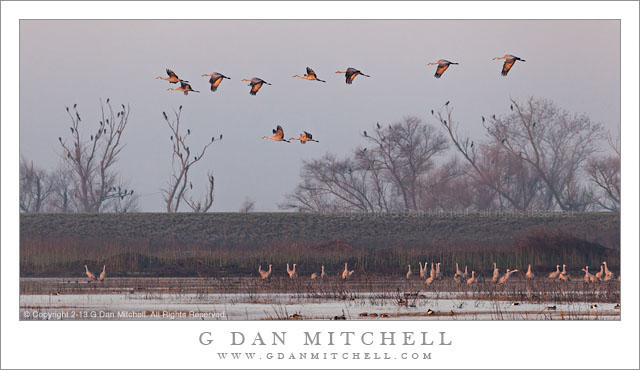
A group of sandhill cranes takes flight in foggy dawn light as others stand in a marsh with blackbird-filled trees beyond.
I almost feel like I know this group of sandhill cranes, as we have found them on several occasions in the same San Joaquin Valley location – and by this I mean in precisely the same spot along a levee and at the same time of day… and often in fog. The first time I “saw” them here I actually heard them more than saw them. It had been an extremely foggy morning, so thick that it was difficult to see any distance into the murk. We could hear lots of birds and certainly recognize the distinct call of the sandhill cranes. Occasionally a small group of them would momentarily emerge from the fog to pass overhead and just as quickly disappear.
On this January morning it was again foggy, but not quite that thick. When we arrived before dawn we were able to make out the large flock of the birds on the ground near the levee, though it was a bit too murky and they were too far away to get clear photographs. But as sunrise arrived, the cranes began to take to the sky in small group, sometimes passing over or near our position before departing. As this group flew across the scene, above other birds still on the ground, the faint light of sunrise managed to pierce the fog and case a bit of warm light on the flock.
G Dan Mitchell is a California photographer and visual opportunist whose subjects include the Pacific coast, redwood forests, central California oak/grasslands, the Sierra Nevada, California deserts, urban landscapes, night photography, and more. Blog | About | Flickr | Twitter | Facebook | Google+ | 500px.com | LinkedIn | Email
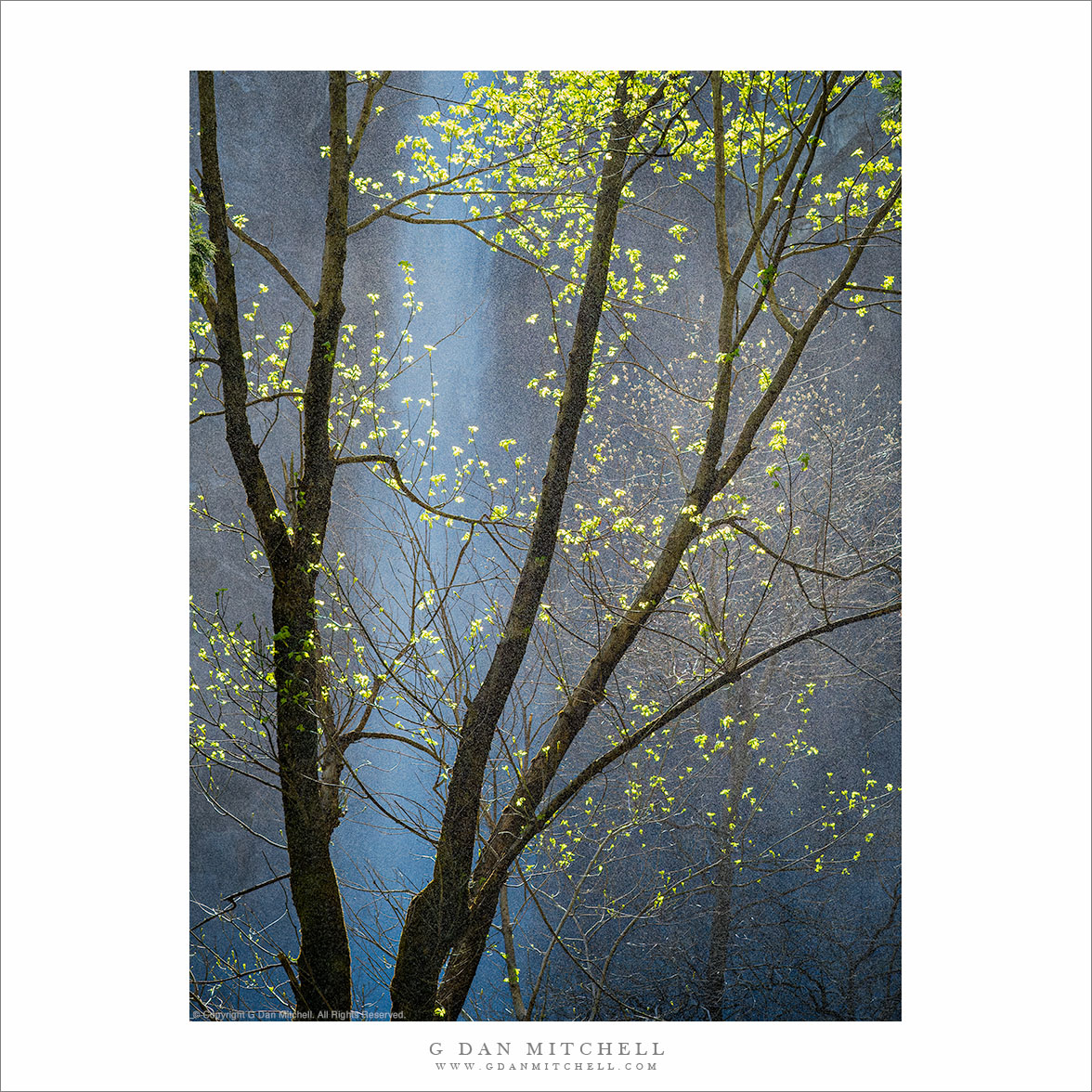
“Spring Trees, Waterfall Mist ” — Waterfall mist fills the air around sunlit maple trees with new spring leaves, Yosemite National Park
There are at least two stories behind this photograph. The first involves a family tradition that I started when I began taking my kids to The Valley quite a few years ago when they were small. Each spring we would take a “waterfall trip” as close as possible to the time of peak runoff – sometimes going up to the Valley and back in a single day. As part of this event, it was also my tradition that we would “say hello to summer” in the Sierra by making the first stop at Bridal Veil falls, then hiking as close to the base of the fall as possible, in order to stand in the tremendous wind-blown clouds of spray, usually getting thoroughly soaked. This year we were there without our kids, who are now “all growed up” and off living their own lives, but I still had to make a ritual visit to the spray at the base of this fall. Yes, I got soaked. :-)
The second story might actually be a continuation of the first. Sometimes I go to experience something rather than to photograph it. That was my intention when we walked to the fall this time, so I left my “big camera” gear behind. But as we rounded a corner on the trail and I looked up into the morning light from the sun that had just cleared the top of the cliff, I saw this wonderful silhouetted maple tree standing in mist-filled air with the still-shaded waterfall beyond. But I did not have my “big camera” nor did I have a tripod — I had my small Fujifilm X-E1, but with the wrong lens for this shot. I turned to my wife, who also had an X-E1 but usually attaches a 60mm macro lens (she is passionate about photographing small things!) and asked if I could borrow her camera/lens to try to squeeze off a couple of shots. She agreed, and I made two exposures on her camera, shooting handheld in the spray and wind.
Leave a comment or question using the form. (If you are reading this on the home page, click the article title to see the full article and the comment form.
The Colorado River winds through rugged country beyond the White Rim, Canyonlands National Park
On our second visit to Canyonlands National Park (the first had been back in April of the same year, when we briefly visited the “Island in the Sky” highlands of the park) we were somewhat stymied by less than astonishing light. Overall the skies were sort of partly cloudy, but that “partly” portion seemed to line up almost perfectly with where we were, and from afternoon on a large mass of clouds sat above us and to the west. For this photograph, that might have actually been a bit of a blessing, in that trying to photograph the tremendously intricate and detailed landscape visible from the “Grand View” overlook in full sun at this time of day would have been challenging, to say the least. This landscape, lit that way, would have contained some extremely bright features along with very deep shadows in the canyons, and the result probably would not have been all that great. The clouds, however, somewhat mute the contrasty light, making the bright areas a bit less bright and allowing diffused light down into areas that would otherwise be dark. At least there was a bit of light on the buttes in the far distance at the upper edge of the frame.
This scene is one of those “iconic” views that, well, everyone photographs. Generally, I’m not that much about photographing icons. In fact, often when I go to places like this I try to not know what the iconic shots are or where to find them, preferring to instead just sort of guess, follow hunches, poke around, and see what I discover. This may not be the most effective way to find the “cool stuff” in a new location, but it does let me start to develop my own relationship with a landscape from the very beginning. So when we went into Canyonlands the first time I basically had almost no idea what I was “supposed” to see and photograph. (For example, I had no idea that iconic “Mesa Arch” is in this park – drove past the road to it and said, “Ah, that’s where Mesa Arch is!” And, no, I did not photograph it.) However, as we wandered about and looked at stuff, we somehow managed to end up at several of “those places” – especially the Green River overlook (which I now recognize as one of the iconic views of this park) and Grand View. In addition, I’ve often advised others to not eschew icons in certain situations. One, of course, is when you find yourself in front of such an icon and have never photographed it before. But another is when one visits a location for the first time and does not yet have a deeper knowledge of the place. For example, I’ll occasionally get asked by first time visitors to Yosemite or Death Valley (places where I shoot a lot) about where the “secret spots” are that not everyone shoots. I tell them that getting to know a place to such an extent that you can find, “see,” understand and photograph the non-iconic subjects is not a reasonable goal for a first visit. Often that takes many visits, perhaps in different seasons, and the time to let the place “get under your skin” to the point that you have a real feel for it.* But everyone has to start somewhere, and photographing icons is a fine place to start when you are new to a place. They are, after all, usually quite spectacular spots – as I say, “They are icons for a reason.”
*For my part, during my first year photographing in Utah I spent over 30 days there during three long visits. It wasn’t until well into the third visit that I really began to feel that I was moving past the “Oh, wow, Utah!” state and starting to really understand the place.
G Dan Mitchell is a California photographer and visual opportunist whose subjects include the Pacific coast, redwood forests, central California oak/grasslands, the Sierra Nevada, California deserts, urban landscapes, night photography, and more. Blog | About | Flickr | Twitter | Facebook | Google+ | 500px.com | LinkedIn | Email
Motion-blurred photograph of a flock of Ross’s geese taking flight in dusk sky above the San Joaquin Valley, California
This is another example of what I’ve taken to referring to my “blurreds in flight” photographs. (Yes, a bad pun on the common subject of “birds in flight,” also known as “bif” photographs.) Very early morning or dusk seem like good times to experiment with this, as the very dim light often pushes the ability of photographer and gear to continue to shoot as ISOs rise, apertures enlarge… and eventually one runs out of maneuvering room. Just lower that ISO and let the birds blur!
But that’s not really why I do these. While I suppose that I’m just as interested in trying to produce very sharp images of birds frozen in flight by high shutter speeds and accurate autofocus, I sometimes feel that this more clinical approach isn’t the only way to capture or express the qualities of these animals and what I can observe of their lives. In a sense, the still camera “lies” about what we can actually see of these birds when we are there and watching them. In low light, often observing from a distance, when a group of Ross’s geese suddenly takes flight in a wild maelstrom of honking and flapping wings, we really cannot see all of the specific details of each feather and the impression we have is more often one of wild motion and surprise. While I don’t think a photograph can ever fully or accurately depict this, allowing the motion to become visible by using slow shutter speeds might evoke a sense of these animals that the razor-sharp, stop-action photographs might miss.
G Dan Mitchell is a California photographer and visual opportunist whose subjects include the Pacific coast, redwood forests, central California oak/grasslands, the Sierra Nevada, California deserts, urban landscapes, night photography, and more. Blog | About | Flickr | Twitter | Facebook | Google+ | 500px.com | LinkedIn | Email
Photographer and visual opportunist. Daily photos since 2005, plus articles, reviews, news, and ideas.
Manage Consent
To provide the best experiences, we use technologies like cookies to store and/or access device information. Consenting to these technologies will allow us to process data such as browsing behavior or unique IDs on this site. Not consenting or withdrawing consent, may adversely affect certain features and functions.
Functional
Always active
The technical storage or access is strictly necessary for the legitimate purpose of enabling the use of a specific service explicitly requested by the subscriber or user, or for the sole purpose of carrying out the transmission of a communication over an electronic communications network.
Preferences
The technical storage or access is necessary for the legitimate purpose of storing preferences that are not requested by the subscriber or user.
Statistics
The technical storage or access that is used exclusively for statistical purposes.The technical storage or access that is used exclusively for anonymous statistical purposes. Without a subpoena, voluntary compliance on the part of your Internet Service Provider, or additional records from a third party, information stored or retrieved for this purpose alone cannot usually be used to identify you.
Marketing
The technical storage or access is required to create user profiles to send advertising, or to track the user on a website or across several websites for similar marketing purposes.

 G Dan Mitchell is a California photographer and visual opportunist whose subjects include the Pacific coast, redwood forests, central California oak/grasslands, the Sierra Nevada, California deserts, urban landscapes, night photography, and more.