Tag Archives: valley

The Impossible Trip: Yosemite in Seven Hours?

That was the question that someone posed today in a photography forum I read:

We will be visiting Yosemite for approximately 7-8 hours one day the 2nd week of October as part of a weeklong trip to Tahoe (we live on the East Coast). I have been to Yosemite before (many years ago), she has not. Although we know it would take much more time to truly experience Yosemite this is the maximum time we can spend so we are looking for the top spots so we can make the most of the short time we have there.

(There was a bit more that I haven’t included here – the poster also would be staying in Mariposa the night before, and needed to drive across Tioga Pass and be in Tahoe that evening… and wanted to do photography along the way!)

Having visited the park for decades, and for an amount of time perhaps totaling well over a year altogether, and still getting to know the place, my first reaction was to ignore the question or respond with a wise-crack one-liner. Frankly, I don’t think it is really possible to do real photography of “the park” during a seven-hour visit. (With careful planning it would be possible to photograph a subject or two perhaps, but that is a different issue.) In any case, I suppressed my instinct to respond along the lines of “are you kidding!?” and instead tried to provide a realistic outline of what this experience might entail. While I’m spoiled, living only hours from the park, I do understand that others may find themselves in the area and not want to miss at least having a brief experience with such a place. And perhaps the way-too-brief visit might be enough to encourage such visitors to find a way to return for a longer visit.

So, with all of that in mind, here is what I wrote, slightly modified for this post:

You are asking quite a lot here… for a seven hour visit that will include at least 3-4 hours of driving… from Mariposa, into and around the Valley, and then up and over Tioga Pass… plus leaving enough time for the remaining hours-long drive to Tahoe.

Too bad, I’m afraid.

To be honest, the odds that you’ll be able to do much beyond “record-my-quick-visit” photography in the park are slender given the amount of time you’ll be there, your tight schedule, and the fact that you’ll be there mostly during the “blah light” time of day. To some extent, I’m inclined to recommend that you not make photography your primary goal – one reason being that trying to “get those photographs” will distract you even more from you brief opportunity to actually see and experience the place a bit. I photograph in the park frequently, so I know where and how to shoot, and I would not try to do real photography under the conditions you describe.

Having said all of that, the broad outlines of your visit must be: Continue reading The Impossible Trip: Yosemite in Seven Hours?

Reader Question: Yosemite in October

“Tom” recently sent me a question about visiting Yosemite in October, and I thought I would reply here where others can see the information, too.

I will be in CA in October and was planning on going up to Yosemite for a few days. Any advice you’d care to share would be greatly appreciated. :)

California’s Fall Color: A Photographer’s Guide to Autumn in the SierraBefore I answer your question below, you might be interested in my book, California’s Fall Color: A Photographer’s Guide to Autumn in the Sierra, available from Heyday Books and from Amazon. It shares a lot of what I have learned about locating and photographing Sierra Nevada fall color, along with a large collection of my autumn photography in locations from the eastern Sierra to Yosemite Valley.

October may be my favorite time of the year to be in the Sierra in general and in Yosemite in particular. While some things that draw people to Yosemite (waterfalls, for example) are not likely to be at their best, there are many other wonderful attractions at this time of year. October is a transition month in the Sierra, with early October often having the character of late summer and late October often feeling more like early winter. Conditions can change quickly, and warm and sunny days may be followed by a day of rain or snow.

Autumn Light, Yosemite High Country

I have divided the following description geographically to separately describe Yosemite Valley, the Yosemite high country, and the east side of the Sierra Nevada range.

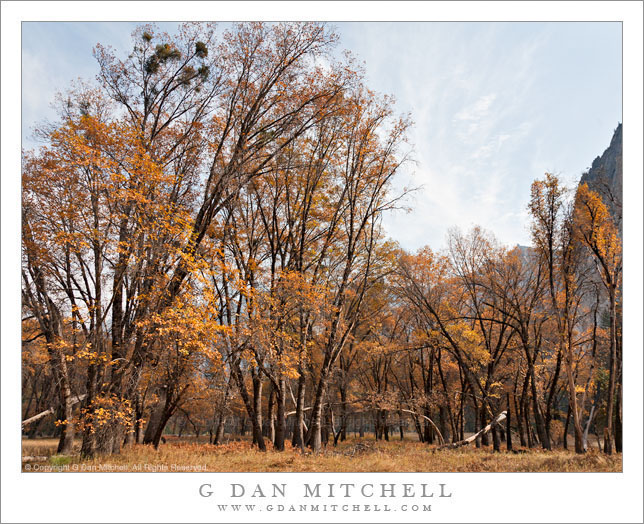
Yosemite Valley – The busy summer tourism season winds down in September after the Labor Day weekend, and by October the Valley is no longer quite the crowded, urbanized, noisy zoo that it can be on the worst days during the summer. (I generally steer clear of the Valley in June, July, August, and early September.) The meadows will have turned golden brown already, and real autumn colors begin to appear later in the month. While some are subtle, such as the transition of the oak tree leaves, others are quite striking, including brilliant fall colors of maples and dogwood trees. I make a habit of shooting autumn colors in The Valley every fall right around the end of October or beginning of November. (You’ll often find me there on Halloween!) Continue reading Reader Question: Yosemite in October

Mist, Trees, and Boulders – Cascade Creek

Mist, Trees, and Boulders - Cascade Creek

Mist, Trees, and Boulders – Cascade Creek. Yosemite National Park, California. June 18, 2011. © Copyright G Dan Mitchell – all rights reserved.

Mist and spray from spring runoff fill the air in the boulder-strewn canyon of Cascade Creek, Yosemite National Park.

Making this photograph was an “interesting” experience! I visited Cascade Creek on June 18, probably near the peak flow of the spring runoff season, and the creek was a full-blown torrent. After photographing some familiar rock formations below the bridge that crosses the creek, I decided to try a photograph from the upstream side of the bridge. In this direction, the creek is more or less half waterfall and half cascade as it plunges down a very steep and narrow section of the hillside. The whole scene was in deep shade and mist and spray filled the air.

I made a guess that a 135mm lens might give me a tight enough framing of the scene, so I briefly stepped away from the creek and the spray-filled air to switch lenses. Leaving everything else behind, I took the camera, tripod, and this single prime lens and walked to the wet side of the bridge. There was enough spray that I and my gear began to get wet pretty fast, so I worked quickly. I got everything in what I figured would be about the right position before I uncovered the lens, then quickly uncovered and finalized the composition and manually focused. I knew that I couldn’t really stay in this spray all that long so I spent a couple minutes bracketing a series of exposures as the mist surrounded me, hoping that water on the lens and in the air in front of the camera would not interfere with the shot.

The main decision was about shutter speed and with other decisions regarding aperture and so forth to follow on that. The idea was to use a slow enough shutter speed to allow the water to blur a bit, but not so slow as to turn it to formless mist. I managed to get to a 1/5 second exposure by shooting at f/20, an aperture a bit smaller than I would typically want to use, as apertures smaller than about f/16 can begin to introduce a bit too much diffraction blur. But in a shot like this one where mist is obscuring a great deal of the detail anyway, that seemed like a reasonable compromise that let me lengthen the shutter speed just a bit.

G Dan Mitchell Photography
Flickr | Twitter (follow me) | Facebook (“Like” my page) | LinkedIn | Email

Text, photographs, and other media are © Copyright G Dan Mitchell (or others when indicated) and are not in the public domain and may not be used on websites, blogs, or in other media without advance permission from G Dan Mitchell.

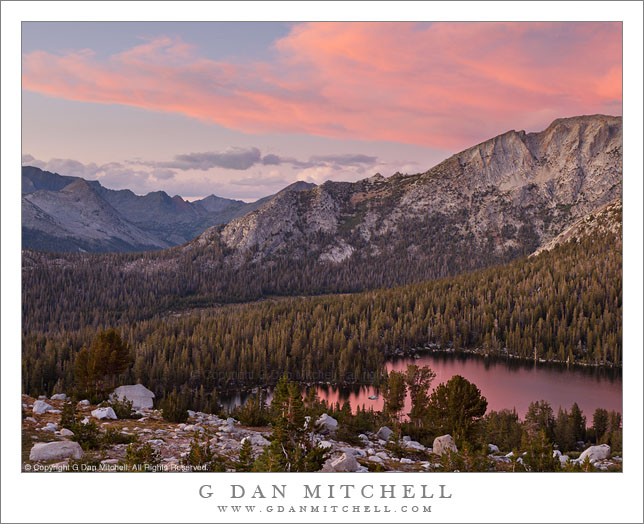
Alpenglow Clouds, Mount Conness

Alpenglow Clouds, Mount Conness

Alpenglow Clouds, Mount Conness. Yosemite National Park, California. June 18, 2011. © Copyright G Dan Mitchell – all rights reserved.

Clouds lit by alpenglow drift across the face of Mount Conness beyond the Tenaya Creek drainage, Yosemite National Park.

Earlier this week I posted another photograph of the same evening. This one was shot a bit earlier (believe it or not!) than the other photograph, as the intense and perhaps unexpected color display was just getting started. I’ll have more to write about the phenomenon in a future blog post that uses this evening as an example, but it almost seem like the sunset progressed backwards (oxymoron alert!) as it went on. It had begun with very boring and low contrast light, somewhat flattened by a haze that took on an increasingly ghastly blue-green hue as the light began to fade. Although the surroundings were spectacular on this opening day of Tioga Pass Road, the light and atmospheric conditions seemed to be conspiring to show them it their worst (literal and figurative) light.

But just at dusk a hint of pink appeared in some of the clouds ringing Mount Conness, the tall peak in the upper left. At first it was so faint that only those of us who were looking for it might have noticed, and we perhaps thought that we were simply trying to convince ourselves that something was going to happen. But the color increased, and as the more distant areas picked up better light, they shone through the foreground haze more clearly, and this haze faded in the same way that a scrim does in a theater when the front lights dim and the stage lights rise.

I find that this type of scene provides some of the most difficult technical and judgment challenges. So often the goal in an image, especially if it is going to be a print, is to try to get as much light into the scene as possible. A lot of the work in post-processing, at least for me, is done with the goal of trying to fill the image with light by means of various careful adjustments, often involving the use of masked curve layers. But here, the coloration depends upon not being overly bright – too much light either decreases the intensity of the pink and purple shadings or else sends them off into the land of the grotesque and gaudy. And the light in shadows – and there are a lot of shaded areas in this scene! – is very blue, much more so than the untrained eye would imagine when looking at the scene in person. This requires another set of tricky and subjective judgments – it would not look right to leave portions of the scene as blue “as they really were,” nor would it look right if the blue were diminished too much. But how much is right? There is no objective answer that I know of, so the goal (for example, on the large granite face of Polly Dome at the left) is to come up with a balance that seems blue enough but not too blue. A similar issue arises in these dark areas when it comes to deciding how bright is bright enough. Believe it or not, virtually nothing in this image is actually black, with the possible exception of a few very tiny areas in the lower left. The luminosity of the very dark areas had to be lifted a bit… but how much is just right? Again, a matter of personal judgment about which there is no objectively right answer.

All of that technical stuff aside, this evening provided one of the most glorious, albeit brief, displays of sublime light I have seen in the Sierra.

G Dan Mitchell Photography | Flickr | Twitter (follow me) | Facebook (“Like” my page) | LinkedIn | Email
Text, photographs, and other media are © Copyright G Dan Mitchell (or others when indicated) and are not in the public domain and may not be used on websites, blogs, or in other media without advance permission from G Dan Mitchell.