
Tag Archives: wilderness

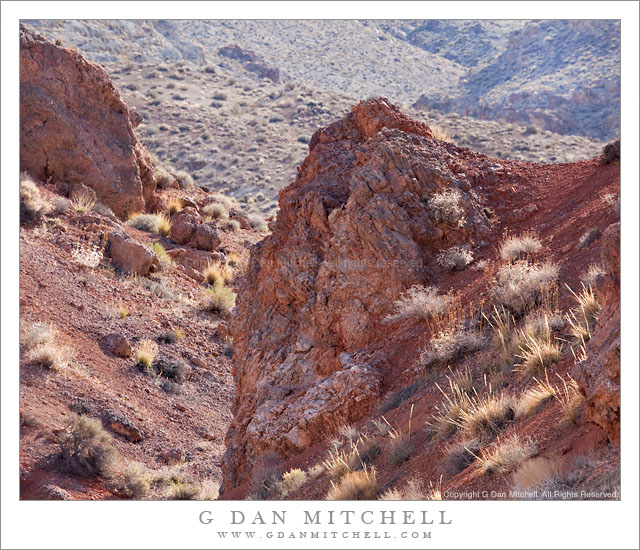
Red Rock and Desert Hills

Red Rock and Desert Hills

Red Rock and Desert Hills. Death Valley National Park, California. March 29, 2011. © Copyright G Dan Mitchell – all rights reserved.

A red rock gully among the desert hills of the Panamint Range, Death Valley National Park.

This is anything but an iconic image, but I think that it is emblematic of a certain type of scene that is often seen in Death Valley National Park once you get out of the main Valley and up into the hills, especially during the brief spring season when the light can be a bit softer and the plants a bit (relatively speaking!) greener.

The photograph looks up a broad valley that is visible from along the road that rises from the main road through the Valley and climbs toward the Wildrose Canyon area. Here the elevation is high enough that the dry, sun-baked flat land of the Valley is nowhere to be found. Instead this is a country of large valleys and plateaus, cut in places (mostly at the bottom of canyons) but rocky outcroppings and gullies. This red rock gully is easily visible from the road, though the odds are that most people just drive right by. I had seen it on several drives past this spot before I thought to stop and photograph it, and I was fortunate to be there when the light seemed just right.

G Dan Mitchell Photography | Flickr | Twitter | Facebook | Email
Text, photographs, and other media are © Copyright G Dan Mitchell (or others when indicated) and are not in the public domain and may not be used on websites, blogs, or in other media without advance permission from G Dan Mitchell.
McGee Canyon and Mount Morgan

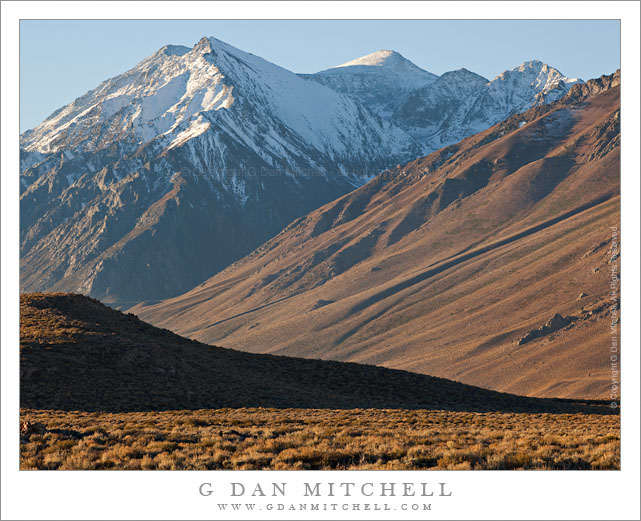
McGee Canyon and Mount Morgan

McGee Canyon and Mount Morgan. Owens Valley, California. October 10, 2010. © Copyright G Dan Mitchell – all rights reserved.

Snow crested Mount Morgan rises above McGee Canyon and the sagebrush-covered hills of Owens Valley in the eastern Sierra Nevada.

I’ve been traveling to the Sierra for many years. My first recollection of the range is a faint mental image of a shoreline park at Lake Tahoe when my family moved to California – I was four years old. My next memory is of staying at a small motel in El Portal next to the high water of the Merced River back in the days before the current mega-hotels were erected. One thing that all of my early Sierra experiences had in common is that I always approached the range from the west since I lived (and still live) in the San Francisco Bay Area. For the person whose orientation to the range is from the west, the Sierras are a range that begins almost imperceptibly in the Central Valley. Although you can see distant peaks from the Valley on clear days, it is hard to say where the range begins. As you head east you encounter some very small and rounded hills which gradually get larger. Eventually you are going up more than up and down as you  travel through oak and grass lands. At some point the road rises into forest, but the mountain tops are mostly rounded and forest covered. Keep going and a few rocky prominences begin to appear along the ridges and some distant granite peaks become visible. Only after a lot of driving do you find yourself in the higher reaches of the range, and this only in the few areas where roads cross from west to east. In most places you cannot even see the summit of the range close up from the west without walking a long ways.

It was only many years later that I first went over the summit of the range and saw it from the east side. The Sierra is (are?) completely different when approached this way. Instead of a long, gradual, and relatively gentle rise to high valleys and forests and meadows, the eastern escarpment of the Sierra rises abruptly – one might say violently – and directly, in most places, from the high desert sagebrush country of Owens Valley and similar places. This wall of peaks seems almost inaccessible, and I imagine that many people who only drive past on highway 395 must regard it that way.

This photograph was made from a spot just a mile or two east of highway 395, out an a gravel road that I know. I have photographed this shadowed foreground ridge and the peaks beyond in the past, so I had a fairly good idea of what I would find at this location before I made the photograph on an early October morning when fall storms had dusted the highest peaks with snow. I used a somewhat long lens and tight framing to emphasize the rise from the foreground desert to the very high peaks beyond.

This photograph is not in the public domain and may not be used on websites, blogs, or in other media without advance permission from G Dan Mitchell.
G Dan Mitchell Photography
Flickr | Twitter | Facebook Fan Page | Facebook | Friendfeed | Email

Tree-Covered Ridge, Mist

Ridge and Fog, Yosemite Valley

Tree-Covered Ridge, Mist. Yosemite Valley, California. October 30, 2010. © Copyright G Dan Mitchell – all rights reserved.

Mist from an autumn storm obscures trees growing on a steep ridge near the rim of Yosemite Valley.

Since I’ve written about this series of photographs of cloud- and fog-shouded subjects in Yosemite Valley several times during the past week, I’ll keep the background short on this one. I used a long lens to isolate small scenes in which the clouds of an autumn storm alternately hid and (sometimes barely) revealed trees, cliffs, and rocky spires along the rim of Yosemite Valley.

In a few of the photographs I was thinking about how close I could get to having very little or almost no detail in the photograph and still make it work. Here the only real detail is in the diagonal of trees and rocks that is mostly obscured by the clouds, with only a few bits of tree being a bit darker. What I’m thinking of is more along the lines of suggesting the presence of the bit of cliff and trees than actually trying to show it explicitly.

This is, for me at least, a tricky thing! The temptation is to boost contrast in post to get more definition from the tree shapes, but that quickly leads to something that has a very different mood than that of the actual scene – and which can easily look phony. I think I’m heading in a direction I like here, but I don’t think I’ll know for sure until I have a chance to try a print in a week or so.

(By the way, if your monitor is even a little bit “off,” you may see some colorations in this monochrome image that aren’t really there. Sorry! :-)

This photograph is not in the public domain and may not be used on websites, blogs, or in other media without advance permission from G Dan Mitchell.

G Dan Mitchell Photography | Twitter | Friendfeed | Facebook | Facebook Fan Page | Email

Aspens and Boulder

Aspens and Boulder
Aspens and Boulder

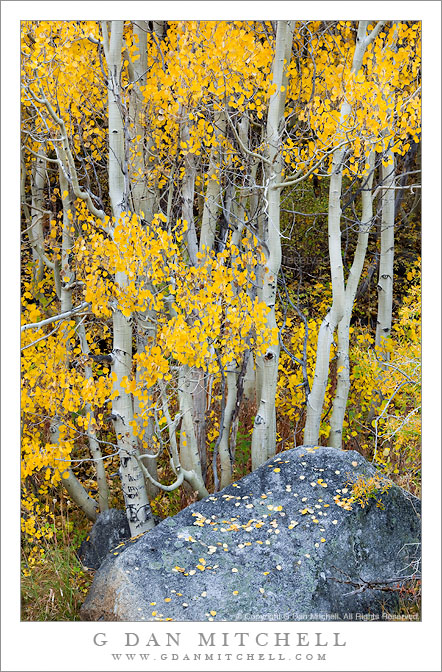
Aspens and Boulder. Sierra Nevada, California. October 2, 2010. © Copyright G Dan Mitchell – all rights reserved.

Fall aspen trees drop yellow leaves on a boulder in the Bishop Creek drainage, Sierra Nevada, California.

I made this photograph in very low evening light – as those who have looked at the technical information and noticed the four second exposure time have already figured out. I was shooting in canyon on a cloudy evening with light rain late in the day – so it should be no surprise that there was little light. What the light lacks in intensity at this time of day, it makes up for by being so diffused and soft that the shadows light up in ways that aren’t seen during the regular daylight hours.

On a day of gentle rain and overcast, the wind had died down in the evening, allowing the long exposure necessary for this photograph. The colorful aspens almost seem to glow in this light, and the golden leaves had first caught my attention. But as I looked at this little scene the leaves that had fallen across the boulder and the nearly white colors of the tree trunks also intrigued me.

G Dan Mitchell Photography
About | Flickr | Twitter | Facebook | Google+ | 500px.com | LinkedIn | Email

Text, photographs, and other media are © Copyright G Dan Mitchell (or others when indicated) and are not in the public domain and may not be used on websites, blogs, or in other media without advance permission from G Dan Mitchell.

(Basic EXIF data may be available by “mousing over” large images in posts. Leave a comment if you want to know more.)