
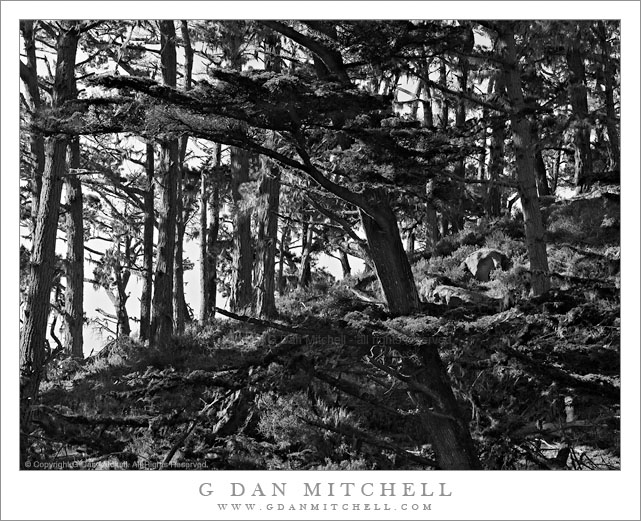
Monterey Cypress Forest, Point Lobos

Monterey Cypress Forest, Point Lobos

Monterey Cypress Forest, Point Lobos. Point Lobos State Reserve, California. January 8, 2011. © Copyright G Dan Mitchell – all rights reserved.

Winter light on the Monterey Cypress forest growing on a hillside at Point Lobos State Reserve.

This is perhaps an absurdly complex photograph – I think it is going to have to end up as a large print at some point. This is a section of Monterey Cypress forest that I’ve walked through many times on the trail along the north shore at Point Lobos State Reserve near Carmel, California. These trees grow along the tops of rocky bluffs above the ocean and in some sheltered places can grow tall and straight.

I made this photograph in what almost amounted to midday sun, though there were a few fog clouds floating around to mute the harshest character of the light a bit. But I knew that the photograph was going to be tricky. The first challenge was finding a location from which to shoot it – most angles are blocked by closer trees or are inaccessible. I finally found a spot along the trail where I could shoot between trees using a longer focal length. Then there was the problem of the light, or more accurately the dynamic range between the clouds and a bit of blue sky and the much darker backlit and shadowed trees in the foreground. Finally, it is just a very complex scene, and making any kind of coherent composition out of it was tricky. I don’t know yet whether it succeeds or not, but the idea was to use the angled division between the darker and very complex lower right side and the lighter upper left side with its vertical tree trunks, and to let the darker foreground tree connect it all together. That was the idea, anyway!

This photograph is not in the public domain and may not be used on websites, blogs, or in other media without advance permission from G Dan Mitchell.

G Dan Mitchell Photography
Flickr | Twitter | Facebook Fan Page | Facebook | Friendfeed | Email

Technical Data:
Canon EOS 5D Mark II (at B&H)
Canon EF 70-200mm f/4 L USM at 94mm (at B&H)
ISO 100, f/16, 1/40 second


A Difficult Question, and Thinking About Feedback

There is a lot to say about the subject of feedback – what constitutes useful feedback, when it is and is not appropriate to offer it, when to be “direct” and when to be diplomatic, how to offer it, and so forth. I’m thinking about this today – though I think about it often – after a thought-provoking experience I had yesterday.

Yesterday I visited Charles Cramer’s beautiful solo show at the Center for Photographic Art in Carmel – for the third time! I made a point of dropping in one more time because a) this was the final day of the show, b) I’m a huge fan of Charlie’s work, c) I knew that he would be there in the afternoon, and d) it gave me a perfect excuse to photograph on the Monterey Peninsula yesterday before and after visiting the show!

Charlie asked several of us two questions – one merely difficult and the other very difficult. The former, merely difficult question was, more or less, “Which are your favorites?” This wasn’t too difficult, since there are some very specific photographs in this show that “speak” to me very powerfully. In fact, I basically responded to this question by pointing those out and trying (with varying levels of success) to say something about what makes those photographs “work” for me. But there are so many that work in so many different ways that I could really do the question justice. Some work “as photographs” alone, there are others that I probably see differently because of my affinity for the subjects, some require some time to understand, and so forth.

But the second question was the really tough one: “Which photograph(s) would you leave out of the exhibit?” Really? You are asking me, Charlie? :-)

But then I thought about this a bit more and decided to attempt an answer. I’m not going to write about which photographs I would leave out – frankly I would add more of his photographs rather than removing any – since my selections are not the point. But I do want to think out loud a bit more about the question and the value of asking it and trying to answer. Continue reading A Difficult Question, and Thinking About Feedback

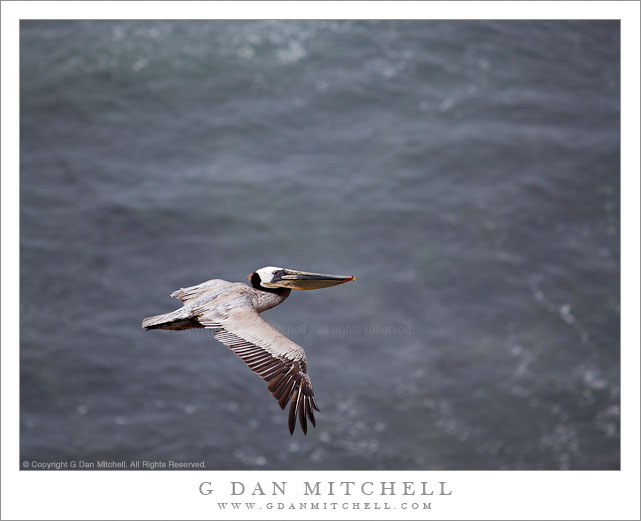
Pelican Above Water

Pelican Above Water
Pelican Above Water

Pelican Above Water. California coast. May 15, 2010. © Copyright G Dan Mitchell – all rights reserved.

A solo pelican coasts above the surface of the Pacific Ocean near the central California coast.

There is not too much to say about this one – since I posted a companion pelican photograph yesterday! This one is also “from the archives” – a photograph from last May that I found as I looked through last year’s raw files one last time.

(For those who are reading this in the archives, a bit more information. I frequently photograph pelicans along the California Pacific Ocean shoreline. This photograph was made from a location where I can access the top of a coastal bluff that drops almost immediately straight down to the water. The pelicans seem to make a habit of cruising up and down the tops of these bluffs on the updrafts that are created by the onshore breeze, and they fly very close to the bluff edges where I can photograph them close up.)

This photograph is not in the public domain and may not be used on websites, blogs, or in other media without advance permission from G Dan Mitchell.

G Dan Mitchell Photography
Flickr | Twitter | Facebook Fan Page | Facebook | Friendfeed | Email

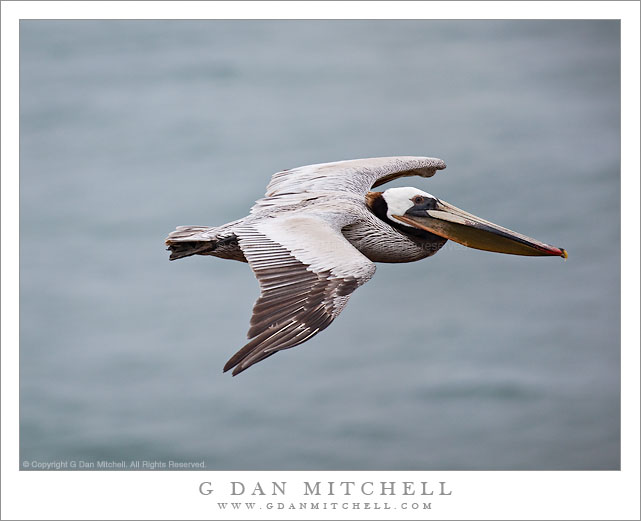
Pelican in Flight

Pelican in Flight
Pelican in Flight

Pelican in Flight. California coastline. May, 15, 2010.© Copyright G Dan Mitchell – all rights reserved.

A solo pelican in flight about the Pacific Ocean coast of California.

Last May I made one of my spontaneous drives over to the Pacific coast – a 30-45 minute drive from my location in Silicon Valley – and ended up engaging in my idea of sport, “hunting” pelicans with my camera and a long lens. I know a few places where the “pelican highway” passes along a high coastal bluff where I presume that the birds can coast on updrafts caused by onshore winds rising from the water. In one or two spots I can consistently find the birds passing very close to the edge of the bluffs, and it is often just a matter of waiting a while to see them fly past at very close distances. This bird came by a bit lower than some and instead of presenting itself against the more typical backdrop of the horizon and sky, this one gave me an overhead view with the surface of the Pacific as the background.

This photograph is not in the public domain and may not be used on websites, blogs, or in other media without advance permission from G Dan Mitchell.

G Dan Mitchell Photography
Flickr | Twitter | Facebook Fan Page | Facebook | Friendfeed | Email