
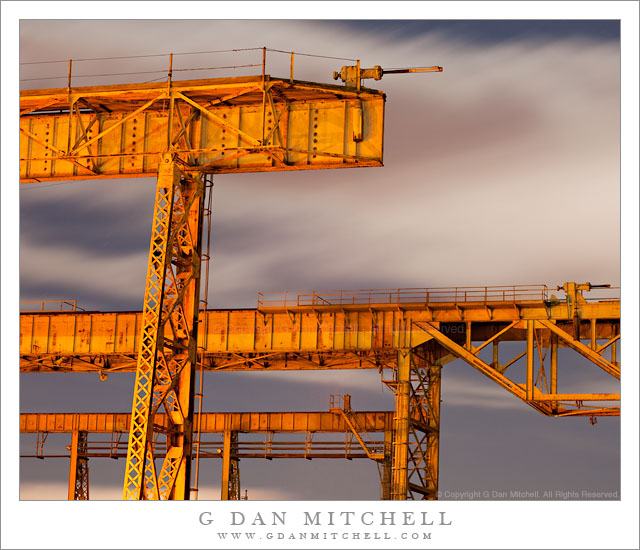
Ship Yard Structures, Artificial Light and Moonlit Fog

Ship Yard Structures, Artificial Light and Moonlit Fog

Ship Yard Structures, Artificial Light and Moonlit Fog. Mare Island Naval Shipyard, Vallejo, California. April 16, 2011. © Copyright G Dan Mitchell – all rights reserved.

The light of the full moon illuminates fast-moving fog clouds above Mare Island Naval Ship Yard structures lit by artificial lighting.

Since I haven’t posted photographs of these structures for a while, I’ll share a bit of explanation. The location is the Mare Island Naval Ship Yard, across the water from Vallejo, California. Mare Island is a decommissioned ship yard whose history goes way back into the 1800s, when it was the largest naval ship yard on the west coast. There is a ton of history to the place that I only know vaguely, but it was, among other place, the ship yard where a number of nuclear submarines were produced. (That and certain other dangerous residues are also part of the legacy of the place, unfortunately.) The ship yard has not been active since the 1990s, with the exception of some current work to dismantle a ship from the “ghost fleet” parked near the Carquinez Bridge.

The very old buildings and the remnants of some quite large industrial facilities draw night photographers from around the San Francisco Bay Area and beyond. (On my recent visit there were three groups photographing the place, including one from Sacramento.) There are almost endless subjects for night photography, ranging from very old to very new buildings, interesting structures like those in this photograph, old residences, and the general clutter found in any industrial area. All of it is lit by a varied array of lights including just about anything you can imagine: the full moon, light from nearby Vallejo, neon, fluorescent, tungsten, sodium vapor and probably other types of light.

In this photograph, huge overhead structures are lit by garish artificial light, while the overhead clouds are lit by the full moon. If I understand correctly, the structures supported huge cranes on tracks, and were used to move very heavy materials to the waterfront for installation in ships. They haven’t been used in a long time, and they are deteriorating in a way that is fascinating to photographers!

G Dan Mitchell Photography | Flickr | Twitter (follow me) | Facebook (“Like” my page) | LinkedIn | Email
Text, photographs, and other media are © Copyright G Dan Mitchell (or others when indicated) and are not in the public domain and may not be used on websites, blogs, or in other media without advance permission from G Dan Mitchell.
Photography and Gear Fetishes (Another Adapted Forum Post)

Earlier this week I dropped in on a photography forum in which the OP (original poster) suggested that the causal correlation between buying Really Expensive Gear and producing better photographs was weak. Oh, yeah!

Here is a slightly adapted version of my contribution to that discussion:

I’ve thought quite a bit about why so many “photography enthusiasts” seem to be much more interested in acquiring photography gear than in making photographs. Reasons might include:

1. Equipment is necessary in order to make photographs, so acquiring some is not unimportant.
2. Because it is, frankly, easier to write about gear in definitive (or seemingly definitive) ways than to write competently about photographs, there is much more written about gear – and newbies should be forgiven for having a false impression that the gear one has is more important than the photographs one makes.
3. Almost all of us do find the equipment fascinating to some extent. Some grow past this, but for some it ends up being more about possessing expensive and supposedly high-end stuff than anything else. (Photography is not the only area where this occurs.)
4. Because people more often encounter photographers when they are operating cameras than when they are exhibiting photographs, they associate the gear with the activity more than they associate photographs with it.
5. Some want to look like (what they imagine) professional photographers (look like).
6. Some are told, before they have enough experience to question it, that they must have “the best” gear if they are going to make photographs. I’ve actually seen rank beginners struggling with $6000 bodies and sets of L primes or big white telephotos… for their family vacations.
7. Some love to shop.

[The OP’s] notion that the causal correlation between expensive gear and photographic skill or quality is weak is one that I would agree with.

I think that a “cure” for the counter-productive obsession with gear at the expense of photographs may be to do everything in your power to focus on photographs – not photography, not cameras, not lenses, etc. If you are not or do not become passionate about producing photographs, then you might want to consider a different hobby. :-)

G Dan Mitchell Photography | Flickr | Twitter (follow me) | Facebook (“Like” my page) | LinkedIn | Email
Text, photographs, and other media are © Copyright G Dan Mitchell (or others when indicated) and are not in the public domain and may not be used on websites, blogs, or in other media without advance permission from G Dan Mitchell.

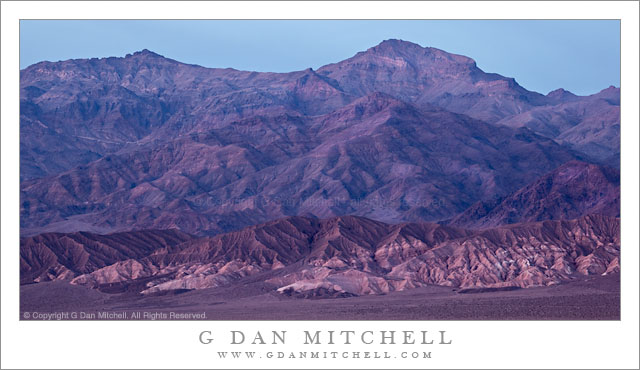
Post-Sunset Glow, Amargosa Range

Post-Sunset Glow, Amargosa Range

Post-Sunset Glow, Amargosa Range. Death Valley National Park, California. March 29, 2011. © Copyright G Dan Mitchell – all rights reserved.

Post-sunset light from bright red clouds casts a reddish glow on the Amargosa Range, Death Valley Buttes, and the Kit Fox Hills.

I think this might be the second in what I could call the “impossible color” series from my late-March trip to Death Valley. (The previous image was a photograph of a wash/alluvial fan at the base of Tucki Mountain, photographed on the same evening.) The lurid and unreal colors are not the result of post-processing gone horribly wrong – the light was actually this color for a short period. The sun had already gone down behind the Cottonwood Mountains to the west of my shooting location in the middle of Death Valley not far from Stovepipe Wells. It had been an interesting sunset with the usual increase in warm colors and some attractive clouds in the sky.

What happened next was something that is probably familiar to those who have done a lot of landscape photography, though they recognize that it is not something that you can quite predict. After the sun had set and dusk was coming on, some final light from far to the west, where the sun had probably already dropped just below the horizon, began to strike high clouds above Death Valley. (I could sort of see this coming, since I had noticed increasing color in the sky further to the east.) As this happened, these clouds began to glow with an intense red color that was mixed with the normal bluish tones of dusk light and surface features took on this purple/red glow for just a brief moment before the light faded.

(Those who look very carefully may notice that the sky above and to the east of the mountains is a lot bluer than the mountains themselves. The color had already left the sky to the east, and at this point was coming from the sky directly overhead and to my west.)

I’m still trying to sort out the complex geology of this area and the ways that features are named. The larger range containing these peaks is called the Amargosa Range, though it encompasses many smaller named sub-ranges – I think these might be part of the Grapevine Mountains, roughly in the neighborhood of Thimble and Corkscrew Peaks. A dark peak in front of the main range at the very far right may be part of Death Valley Buttes, and the banded foreground hills are sometimes called the “Kit Fox Hills.”

G Dan Mitchell Photography | Flickr | Twitter | Facebook |
LinkedIn | Email
Text, photographs, and other media are © Copyright G Dan Mitchell (or others when indicated) and are not in the public domain and may not be used on websites, blogs, or in other media without advance permission from G Dan Mitchell.

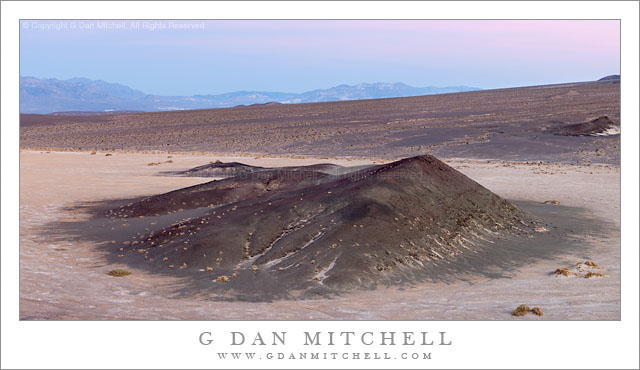
Hill Near Mesquite Flat, Dusk

Hill Near Mesquite Flat, Dusk

Hill Near Mesquite Flat, Dusk. Death Valley National Park, California. March 29, 2011. © Copyright G Dan Mitchell – all rights reserved.

Dusk light above a hill near Mesquite Flat in Death Valley, backed by a large alluvial fan from Tucki Mountain.

At the end of this day I was shooting from the top of a low hill in the Valley east of Stovepipe Wells, and there were interesting subjects throughout almost the entire 360 degree panorama around this elevated position. With this in mind, I had chosen to use the long 100-400mm zoom so that I could have some flexibility in composing elements of this huge scene.

I was mainly working with things that were in the large arc to my west (dunes and Cottonwood mountains and base of Tucki Mountain), north (the main Valley and transverse dunes), and east (the mountains running along that edge of the Valley) since the further subjects of the lower Valley were more or less out of sight beyond the alluvial fan that appears in the photograph. But I kept being intrigued by the low, dark hill on the flats below the similar hill on which I was standing. There is a row of them stretching from near the Devils Cornfield area up and across this alluvial fan. As the evening light transitioned towards post-sunset light I saw that the glow from clouds (a bit of which is visible in the distance above the Black Mountains) was lighting this hill and the surrounding flats in an interesting and colorful way.

But I had a little problem. I was still working a number of subjects and once and I really needed to keep shooting that 100-400. 100mm was still too long for this scene, but I didn’t have time to remove it and put on a shorter lens. I figured that I could simply change the camera to vertical orientation, very carefully level the tripod, and include the whole scene in four panning vertical frames that I could stitch together later. People often do this so that they can produce extremely high-resolution image, but that wasn’t my goal at all. In any case, it worked, and not only did I manage to get the shot that needed a wider lens, but as a bonus it is a very high-resolution shot.

G Dan Mitchell Photography | Flickr | Twitter (follow me) | Facebook (“Like” my page) | LinkedIn | Email
Text, photographs, and other media are © Copyright G Dan Mitchell (or others when indicated) and are not in the public domain and may not be used on websites, blogs, or in other media without advance permission from G Dan Mitchell.