
All posts by G Dan Mitchell

G Dan Mitchell, photographer and visual opportunist focusing on the Pacific coast, the Sierra Nevada, redwood forests, California oak/grasslands, California deserts, urban landscapes, night photography and more. Posting daily photographs since 2005, along with articles, reviews, news, and ideas.

Trees and Receding Red Rock Hills

Trees and Receding Red Rock Hills - Sparse pines grow on low ledges in the high country red-rock sandstone, Zion National Park
Sparse pines grow on low ledges in the high country red-rock sandstone, Zion National Park

Trees and Receding Red Rock Hills. Zion National Park, Utah. October 22, 2012. © Copyright 2012 G Dan Mitchell – all rights reserved.

Sparse pines grow on low ledges in the high country red-rock sandstone, Zion National Park

Since I’ve posted several photograph of this particular terrain, there may not be a lot more to say about it beyond summarizing some of the basics. (And, yes, there will be more of this subject – though not too many more!) Out of the main park attraction of Zion Canyon and up in the high country, instead of being in a world of vertical cliffs that tower high above, it seems like we are more within than below the terrain. We can look down into washes and slot canyons, up to see sloping mountain sides, or straight across areas filled with slabs of curving sandstone on which various trees and bushes grow.

Here I lined up some backlit trees on a near ridge with those on a further ridge, with even more sloping ridges beyond. In the afternoon haze, the rocks combine their native red color with a bit of blue that comes from atmospheric haze, emphasized by backlight. And this same backlight lights up the needles of the trees, turning them almost white in places.

G Dan Mitchell is a California photographer whose subjects include the Pacific coast, redwood forests, central California oak/grasslands, the Sierra Nevada, California deserts, urban landscapes, night photography, and more.
Blog | About | Flickr | Twitter | Facebook | Google+ | 500px.com | LinkedIn | Email

Text, photographs, and other media are © Copyright G Dan Mitchell (or others when indicated) and are not in the public domain and may not be used on websites, blogs, or in other media without advance permission from G Dan Mitchell.

Post-Processing: A Shadow Recovery Example

Note that this is an older article from 2012. While the concepts are largely the same with contemporary cameras and software, some aspects of the article are now a bit date.

(In another forum someone asked a question – actually, more like posed a challenge – related to how much usable detail and quality could be extracted from a raw file that contained areas of very low luminosity, as could happen with a badly underexposed image or with an image of a scene with a very large dynamic range. Since I went to the work of responding and illustrating my response, I figured that I might as well share it here, too. With minor revisions, here it is.)

First, I actually have a “real” version of this photograph in which highlights were slightly blown, but which I preferred to use since I could bring them back in post and get a bit more shadow detail to start with. (It looks a bit bright to me as an on-screen jpg, but it makes a fine print.) That photograph ended up looking like this:

Morning light slants over the top of sandstone cliffs above early autumn foliage in Kolob Canyon, Zion National Park

This photograph and the other I’ll move to below were both shot from a tripod with a Canon EOS 5D Mark II at ISO 100 using the Canon EF 24-105mm f/4L IS at f/16. While the “keeper” used for the photograph above had a 1/4 second exposure, the example I’ll use below was shot at 1/30 second.

The exposure challenge in this scene was the very large dynamic range between the bright spot of sky at the head of the canyon and the much darker colorful foliage in relatively deep shadow in the foreground. Exposing for optimal quality in the foreground would completely blow out the sky, while exposing for the sky would necessarily grossly underexpose the foreground.

I originally thought that I might like to have four bracketed exposures in case that would let me produce a better final image via layer blending, but it turned out to be unnecessary and the final image (as shown above) has a single source file with no blending. However, this means that I still happen to have one very badly underexposed (by three stops) version at 1/30 second which I’ll use here as the starting point for what I plan to illustrate in this post. Follow along with me and see what I can do with the very underexposed version of the file…

Continue reading Post-Processing: A Shadow Recovery Example →

Trees and Pasture, Central Valley

Trees and Pasture, Central Valley

Trees and Pasture, Central Valley. San Joaquin Valley, California. December 11, 2012. © Copyright 2012 G Dan Mitchell – all rights reserved.

Hazy light in clearing tule fog on solitary trees in California Central Valley pasture land

This is another in a series that might perhaps be called “accidental landscapes.” We were actually at a wildlife refuge not to photograph landscape subjects but to photograph migratory birds – mostly geese, herons, ibises, cranes, egrets and the like. Part of that activity involves driving around trying to find the darn critters! And sometimes during these drives my eyes wander over to something that is much more like a landscape than a bird. I have photographed this very tree in the past, most recently a matter of weeks earlier when I shot it from a slightly different angle that made it appear more isolated, and when it was full of a flock of red-winged blackbirds.

The first thing that attracted my attention this time was something small, the bit of warm side-light on the trunk of the foreground tree. Seeing that, I wondered how I might come up with a composition that made sense and included this little feature. First, I wanted this tree to fill a good portion of the frame. However that seemed a bit too straightforward, so I just moved around a bit until the more distant near-twin tree was just to the left of the foreground tree, being careful to not let them overlap. The photograph was shot handheld, with the same lens that stayed on my camera all day long, a 100-400mm zoom. We moved on and soon found lots of Ross’s geese on the far side of this pasture.

G Dan Mitchell is a California photographer and visual opportunist whose subjects include the Pacific coast, redwood forests, central California oak/grasslands, the Sierra Nevada, California deserts, urban landscapes, night photography, and more.
Blog | About | Flickr | Twitter | Facebook | Google+ | 500px.com | LinkedIn | Email

Text, photographs, and other media are © Copyright G Dan Mitchell (or others when indicated) and are not in the public domain and may not be used on websites, blogs, or in other media without advance permission from G Dan Mitchell.
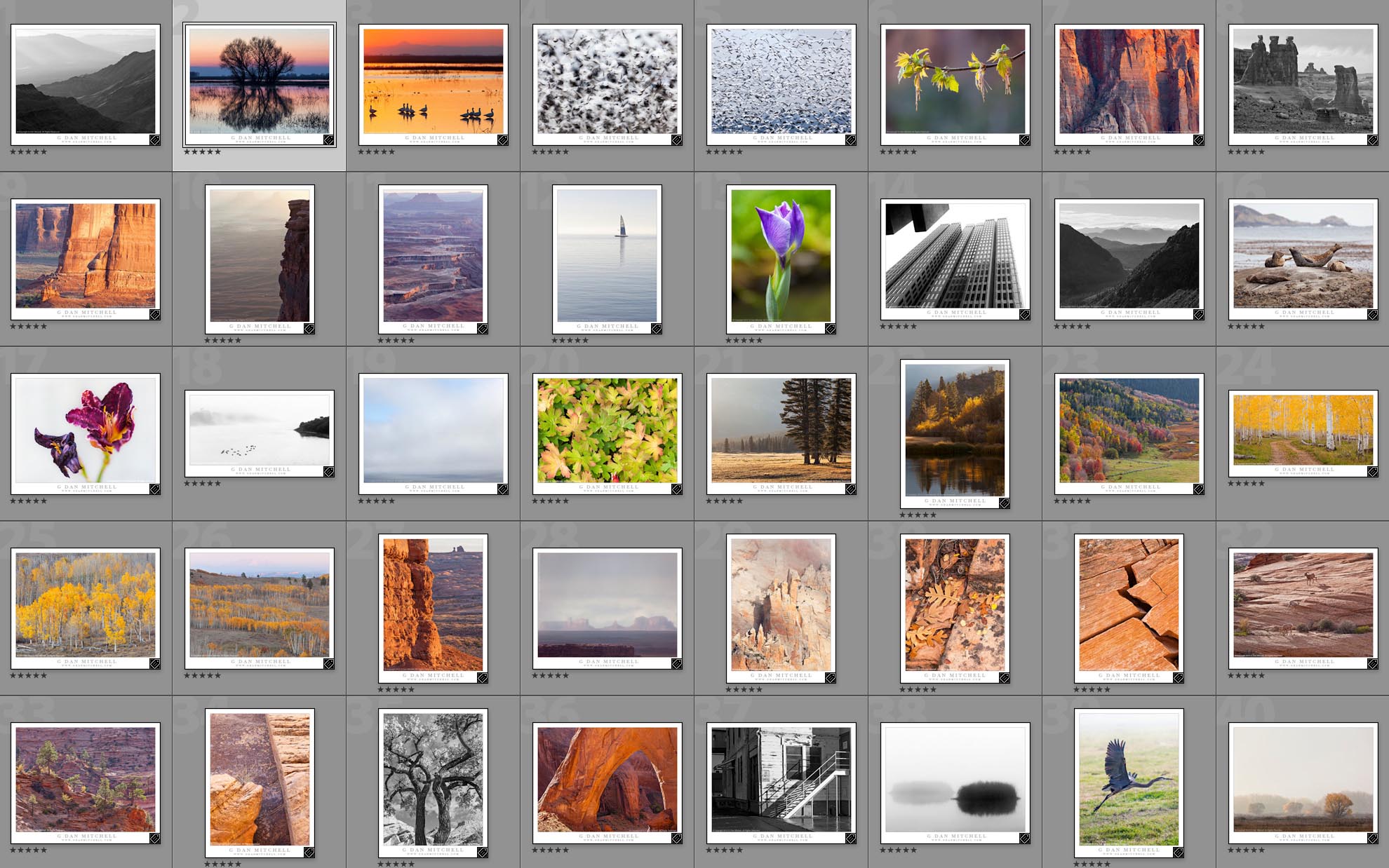
Selecting This Year’s “Favorite Photographs” – The Third Cut

I’ve taken one more step in the process of whittling down the original candidates for my “2012 Favorites” post –  the number now stands at forty. This still seems like too many, but it become harder to give up images at this point! (In fact, there are a few I removed that I really want to put back in!)

If you are interested in seeing them a bit larger, you can open the image and see it large enough to see a bit more detail. I’d be interested in your thoughts about these or even about some that have been left out.

2012FavoritesThirdCutScreenGrab

G Dan Mitchell is a California photographer and visual opportunist whose subjects include the Pacific coast, redwood forests, central California oak/grasslands, the Sierra Nevada, California deserts, urban landscapes, night photography, and more.
Blog | About | Flickr | Twitter | Facebook | Google+ | 500px.com | LinkedIn | Email

Text, photographs, and other media are © Copyright G Dan Mitchell (or others when indicated) and are not in the public domain and may not be used on websites, blogs, or in other media without advance permission from G Dan Mitchell.