
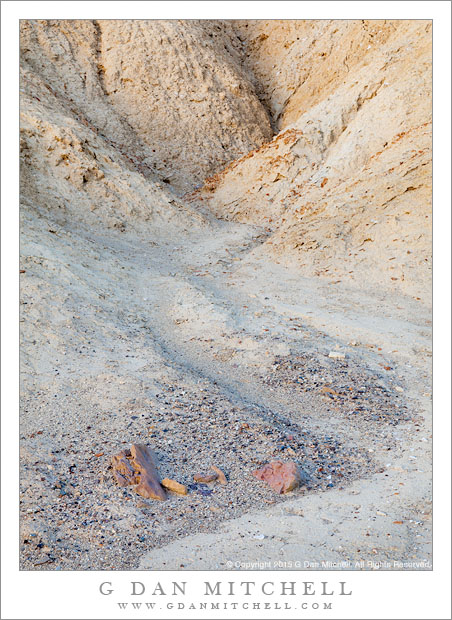
Category Archives: Photographs: Desert

Strata and Columns

Strata and Columns, Red Rock State Park
“Strata and Columns” — Red rock strata and vertical columns

For years I have passed by California’s Red Rock Canyon State Park on my way to or from other places, most often Death Valley National Park. My winter route between the San Francisco Bay Area and Death Valley almost inevitably takes me south over Tehachapi Pass and then north, where the highway cuts through this state park. Every time I have passed through I have marveled at the beautiful rock formations rising from the desert and thought about stopping… but kept driving, anxious either to get to DEVA or to get home after a long time on the road.

This time we made a plan to stop, booking a motel in a nearby town for the night to more or less force a stop. We made a fairly brief visit, but we did go this time. This visit, although brief, may have finally cracked the door open a bit to the idea of returning and photographing here again. Being unfamiliar with the park I cannot be sure, but I would guess that this formation may be one of its “icons.” It stands in an easily visited location and presents a striking appearance. It also seems to me to tell a bit of a story. One of the first things that got my attention is the way that its thick band of red rock tilts the opposite direction from the similar rock in the sculpted cliffs that stand behind it. It seems to me that this piece must have dropped off the face (probably with a big bang and lots of dust!), landed in the softer material at the base of the cliff, and momentarily leaned toward falling over to the right, but then managed to just keep its balance enough to be locked into this off-kilter tilted position.


G Dan Mitchell is a California photographer and visual opportunist. His book, “California’s Fall Color: A Photographer’s Guide to Autumn in the Sierra” (Heyday Books) is available directly from him.

G Dan Mitchell: Blog | Bluesky | Mastodon | Substack Notes | Flickr | Email


All media © Copyright G Dan Mitchell and others as indicated. Any use requires advance permission from G Dan Mitchell.

Dry Mud and Sand

Dry Mud and Sand
Dry Mud and Sand

Dry Mud and Sand. Grand Staircase-Escalante National Monument, Utah. October 25, 2014.© Copyright 2014 G Dan Mitchell – all rights reserved.

A dry and curled layer of mud atop red sand in the bottom of a Utah canyon

It might be amusing for “normal people” to encounter a group of photographers in the bottom of a narrow Utah canyon, where the photographers might be found clustered attentively and enthusiastically around… dry mud. That was the case here, as a group of use suddenly halted our progress down a small (though much larger later on) canyon to set up tripods, fit just the right lenses, and spend about a half hour making photographs of mud.

However, as is often the case in landscape photography, it turns out that even dried mud may have a lot more going on than a casual glance would suggest. For people who are not particularly conscious of their “seeing,” it would be easy to walk past and think, “that curled mud is very interesting” and not pay much more attention to it. However, a bit of time spent in these narrow canyon walls teaches you to become alert to the possibility that you might be missing certain things. One bit of visual magic in these canyons happens during the middle part of the day, when the sun directly strikes the red rock canyon walls and reflects this red-saturated light down into the bottom of the canyon. Once you train yourself to see past what your visual system tells you it is seeing (brown mud) you can begin to see the intensely red coloration of this light and even begin to notice that there is a blue component where direct light from the open sky reflects off of some surfaces. And then, you may also find yourself intently focusing on making a photograph of a small patch of dry and cracked mud sitting atop red sand.


G Dan Mitchell is a California photographer and visual opportunist whose subjects include the Pacific coast, redwood forests, central California oak/grasslands, the Sierra Nevada, California deserts, urban landscapes, night photography, and more.
Blog | About | Flickr | Twitter | FacebookGoogle+ | 500px.com | LinkedIn | Email

Text, photographs, and other media are © Copyright G Dan Mitchell (or others when indicated) and are not in the public domain and may not be used on websites, blogs, or in other media without advance permission from G Dan Mitchell.

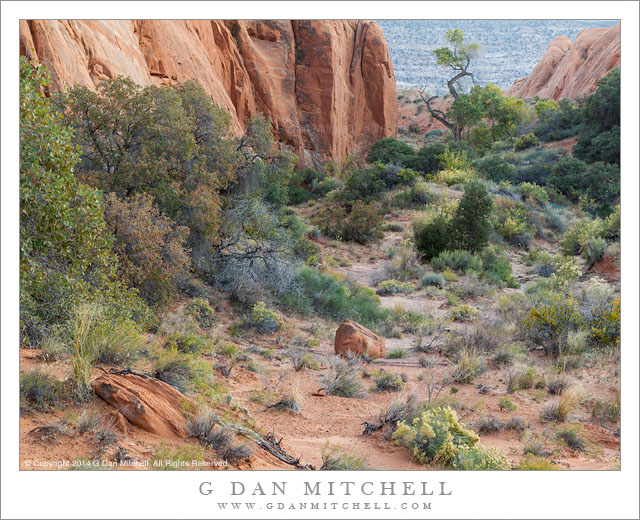
Cottonwood, Red Rock Canyon

Cottonwood, Red Rock Canyon

Cottonwood, Red Rock Canyon. Grand Staircase-Escalante National Monument, Utah. October 24, 2014. © Copyright 2014 G Dan Mitchell – all rights reserved.

A fall color-tinged cottonwood tree grows in the depths of a red rock canyon, Utah

It is time to begin the Utah posts — I already have perhaps a month of photographs to share. (I still have more photographs from my late-summer back-country Yosemite shoot in the queue, but they can wait for a bit.) Utah, especially the southwest portion that I have visited frequently during the past few years, is an intriguing place for this California photographer. After decades of happily photographing my increasingly familiar home territory, it has been a special experience to work in a place where almost everything is new to me. I’ve gone there will few specific expectations, and I’ve made a point of not seeking out the familiar icons — though I have stumbled onto a few of them. (Yes, I do have a photograph of the Watchman. ;-) Compared to the gray tones of California granite, the red rock country of the Southwest is absolutely wild. Combine that rock with intense colors of green plants, yellow/gold fall foliage, blue sky and the effect is very different from what I’m used to shooting.

On my recent visit I managed to get into a number of canyons and gulches, which are perhaps the most magical of Utah places. In many cases, including the canyon where I made this photograph, the visit often begins in a place that looks nothing like this canyon scene — some dry, shallow wash or perhaps out on the flatlands above the canyon, where the air is dry and warm. I follow a path downstream and soon the wash becomes deeper and the walls rockier, and before long these walls rise to become cliffs and the world outside and above disappears, replaced by cool and moist air and water in the bottom of the echoing canyon. Trees and brush grow here, and sometimes you are caught up short when you encounter the sacred traces of people who made this world their home centuries ago. This photograph was made in such a canyon. At a stream crossing I made an almost random decision to climb up onto a higher route around a bend in the stream rather than following the the stream along the bottom of the canyon. As I crossed the slightly higher area I looked down into this world of red rock where a solitary cottonwood tree grows against the curving patterns of the rock.


G Dan Mitchell is a California photographer and visual opportunist whose subjects include the Pacific coast, redwood forests, central California oak/grasslands, the Sierra Nevada, California deserts, urban landscapes, night photography, and more.
Blog | About | Flickr | Twitter | FacebookGoogle+ | 500px.com | LinkedIn | Email

Text, photographs, and other media are © Copyright G Dan Mitchell (or others when indicated) and are not in the public domain and may not be used on websites, blogs, or in other media without advance permission from G Dan Mitchell.
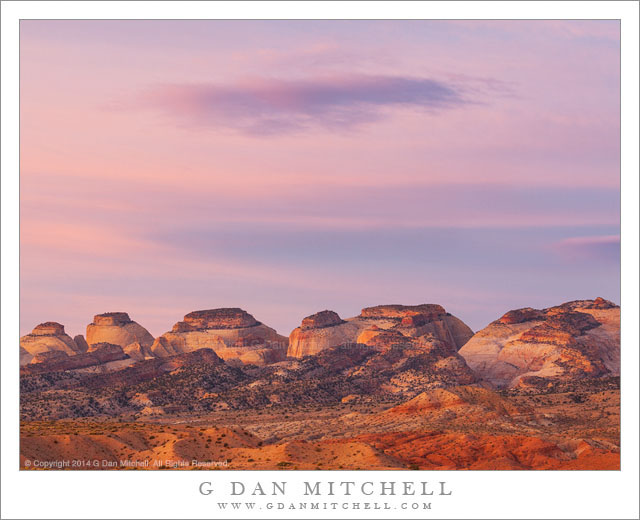
Telescope Peak

Telescope Peak
Telescope Peak

Telescope Peak. Death Valley National Park, California. April 1, 2014. © Copyright 2014 G Dan Mitchell – all rights reserved.

Telescope Peak, the highest point in Death Valley National Park, in the distance beyond the rugged terrain of upper Titanothere Canyon in the Amargosa Range

This one has been sitting in my queue for months now, and it is finally time to send it out with the other photographs! I made the photograph back in early April, while spending a few days in Death Valley exploring a lot of higher elevation area in the mountains on either side of the Valley itself. At one point during this visit, we ended up spending nearly an entire day high up in the Panamint range, at times doing something very unusual — photographing Death Valley wildflowers during a snowstorm!

The distant snow-covered peak in the photograph is Telescope Peak, at over 11,000′ of elevation the highest point in the Panamint range and in Death Valley National Park. While we often think of Death Valley’s reputation for heat, this peak is often covered with snow during the colder times of the year. The location from which I made this photograph is high in the mountains on the other, east side of the Valley, a very arid and rugged region that presents a different appearance than the much lower areas of the Valley itself. Here there is a landscape of dry and rugged mountains and valleys, often receding one behind the other into the distance. I stopped at this spot, where I have photographed before, and was captivated by the conduction of three peak shapes — the nearly peak at upper right, the distant summit of Telegraph Peak, and the peak-like form of the clouds above.

G Dan Mitchell is a California photographer and visual opportunist whose subjects include the Pacific coast, redwood forests, central California oak/grasslands, the Sierra Nevada, California deserts, urban landscapes, night photography, and more.
Blog | About | Flickr | Twitter | FacebookGoogle+ | 500px.com | LinkedIn | Email

Text, photographs, and other media are © Copyright G Dan Mitchell (or others when indicated) and are not in the public domain and may not be used on websites, blogs, or in other media without advance permission from G Dan Mitchell.