
Category Archives: Photographs: Desert

Eureka Valley Dunes, Twilight

Eureka Valley Dunes, Twilight -
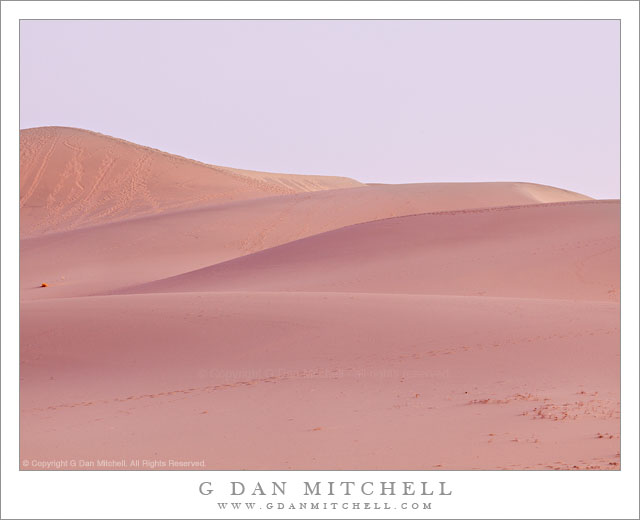
Twilight on the curving hills of sand at the Eureka Valley Dunes, Death Valley National Park.

Eureka Valley Dunes, Twilight. Death Valley National Park, California. January 5, 2012. © Copyright 2012 G Dan Mitchell – all rights reserved.

Twilight on the curving hills of sand at the Eureka Valley Dunes, Death Valley National Park.

By the time I completed the long and bumpy drive from Stovepipe Wells to the Eureka Valley Dunes, the last 45 miles of washboarded gravel roads, it was getting to be quite late in the day. I did not take any time to set up camp when I arrived, being afraid that if I delayed at all I might miss the bit of good light that remained. So I parked, grabbed my camera and tripod and bag of lenses, and headed of into the lower reaches of these huge dunes.

As I began shooting, the sun was almost ready to drop below the ridges to the west of Eureka Valley, and I ended up only having a short time to photograph the actual direct sunset light on the west face of the dunes near where I would camp later that evening. But no problem – I actually love to shoot right past sunset and on into the twilight period when the color of the light can do all sorts of interesting and sometimes unexpected things, and when the overall quality of the light becomes much softer and more diffused. This was one of the last photographs I made on this evening. I was actually already starting my walk back to the camp ground, but I spotted this beautiful section of overlapping ridges in the dunes just as the light took on a rose coloration.

G Dan Mitchell is a California photographer whose subjects include the Pacific coast, redwood forests, central California oak/grasslands, the Sierra Nevada, California deserts, urban landscapes, night photography, and more.
Blog | About | Flickr | Twitter | FacebookGoogle+ | 500px.com | LinkedIn | Email

Text, photographs, and other media are © Copyright G Dan Mitchell (or others when indicated) and are not in the public domain and may not be used on websites, blogs, or in other media without advance permission from G Dan Mitchell.
Ridge Above Tucki Wash, Dawn

Ridge Above Tucki Wash, Dawn - First dawn light on a stratified ridge above Tucki Wash along the base of the Panamint Range, Death Valley National Park.
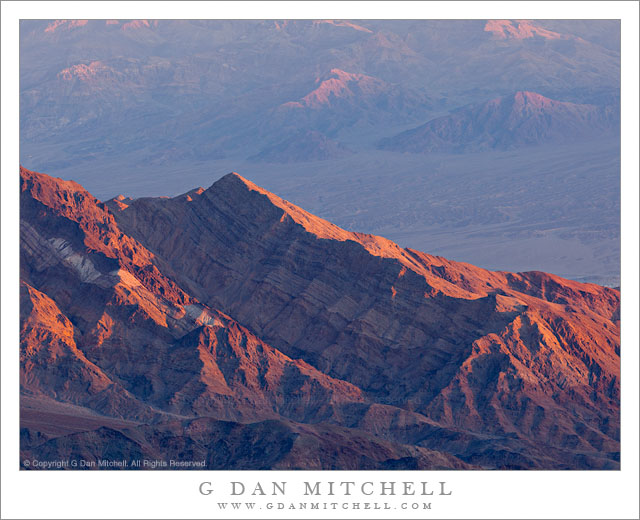
First dawn light on a stratified ridge above Tucki Wash along the base of the Panamint Range, Death Valley National Park.

Ridge Above Tucki Wash, Dawn. Death Valley National Park, California. January 5, 2012. © Copyright 2011 G Dan Mitchell – all rights reserved.

First dawn light on a stratified ridge above Tucki Wash along the base of the Panamint Range, Death Valley National Park.

I spent a good portion of the week following New Year’s Day in Death Valley National Park. My goals were to earlier in the seasons when the days were shorter and more “good light” was available, to perhaps encounter cloudy skies from a passing weather system or two, and to both shoot some new subjects and shoot some familiar ones in somewhat different ways. I think that I succeeded with most of these goals, though those storm front clouds were elusive. (This is a very strange and troubling season for California weather. At a time when the Sierra are usually covered in winter snows… all of the high trans-Sierra passes are still open, and the east side of the range looks pretty much like it might normally look in, say, July.)

On one morning I decided to visit a favorite overlook high in the Panamint Range very early in the morning. I’ve shot here a number of times in the past, but always late in the day during sunset and dusk hours. While getting up an hour and a half before dawn to drive to such a place is always a bit of a challenge, at least the sunrise isn’t quite as early at this time of year. On the other hand, it is colder! (Those unfamiliar with the Death Valley seasons may think of it as an entirely hot and dry place, but it gets quite cold there this time of year.) When I got up the temperature down in the Valley at my camp site at Stovepipe Wells was in the thirties. Surprisingly, the temperature rose into the low fifties as I ascended into the mountains, and when I reached my goal at a bit above 6000′ it was no colder than the Valley at this hour.

I arrived before dawn, but just as the pre-dawn light show was beginning. On this morning I had perhaps the best clouds of the entire trip, and they lit up shortly after I arrived and got my equipment ready. (Photos of that moment will likely come a bit later.) As the sun finally rose above the horizon the interesting light began to work its way down, starting with the higher peaks and then descending past the lower ridges to finally reach the Valley itself. This photograph shows the first light striking an unnamed (as far as I’ve been able to determine) spur ridge the projects eastward into the Valley from the massive bulk of Tucki Mountain. In the far distance are the low mountains and washes along the far side of the Valley, and the are also just beginning to pick up the first light.

Shooting in these rapidly evolving conditions that are not entirely predictable is more of an action sport than a sedate and contemplative experience, at least during the first minutes of light as it works its way across and down the landscape, often surprising me by showing up in places I had not thought to look. At one point I had photographed the cloud-filled sky but lamented a bit that the mountains below that shot were a bit dark and drab. I look away for a moment and when I looked back this intense and saturate light had hit those very mountains… so I turned and quickly began to photograph them.

G Dan Mitchell is a California photographer whose subjects include the Pacific coast, redwood forests, central California oak/grasslands, the Sierra Nevada, California deserts, urban landscapes, night photography, and more.
Blog | About | Flickr | Twitter | FacebookGoogle+ | 500px.com | LinkedIn | Email

Text, photographs, and other media are © Copyright G Dan Mitchell (or others when indicated) and are not in the public domain and may not be used on websites, blogs, or in other media without advance permission from G Dan Mitchell.

Crumbling Ghost Town Ruins, Evening

Crumbling Ghost Town Ruins, Evening

Crumbling Ghost Town Ruins, Evening. Rhyolite, Nevada. March 27, 2010. © Copyright 2011 G Dan Mitchell – all rights reserved.

Evening light in the crumbling ruins of an old mining ghost town near Death Valley National Park, California.

Rhyolite is a Nevada ghost town not far from Death Valley National Park. (The bit of distant ridge seen through the “windows” of the structure is probably inside the park.) The story of Rhyolite is interesting, and not all that different from what happened in many other “boom and bust” towns in the desert and in other areas of the west. For a short time, thousands showed up to work in extractive industries, otherwise known as mines, and there was apparently an actual bustling city here. The old railroad station, ruins of bank buildings and a school, and the size of the area occupied by the town are evidence of this. But, as is virtually always the case, the boom couldn’t last and the departed inhabitant left some years ago, leaving the town to the elements.

This is a different sort of Rhyolite photograph than I might usually share. Most are made either at night or in the golden hour period near dawn. This one was made in the evening, when the direct sun was gone. (At this time of year the sun sets beyond a nearby ridge, so the direct light is gone well before sunset.) The soft, bluish evening light creates a different effect and, for me, makes the old buildings a bit more mysterious. Here I shot from outside one of the crumbling structures that is now filled with rocks. I don’t usually say much about what a photograph might mean (and often my photographs are simply what they are) but this one evoked for me some thoughts about the nature of time and the transitory effect of the human presence on the landscape. Not only has this building – which at one time must have had a floor, a roof, a nicely finished interior, and perhaps even comfortable furniture and perhaps art on the walls – decayed to the point where the line between its structure and the rocks of the natural landscape becomes obscure, but even the attempts to declare ones presence by means of graffiti have begun to crumble.

G Dan Mitchell is a California photographer whose subjects include the Pacific coast, redwood forests, central California oak/grasslands, the Sierra Nevada, California deserts, urban landscapes, night photography, and more.
Blog | About | Flickr | Twitter | FacebookGoogle+ | 500px.com | LinkedIn | Email

Text, photographs, and other media are © Copyright G Dan Mitchell (or others when indicated) and are not in the public domain and may not be used on websites, blogs, or in other media without advance permission from G Dan Mitchell.

Detail, Red Cathedral

Detail, Red Cathedral
“Detail, Red Cathedral” — The eroded and fluted face of the Red Cathedral, Zabriski Point, Death Valley National Park.

I have recently posted other photographs made in the area of Zabriskie Point in Death Valley, including one other of this feature sometimes known as the Red Cathedral. It stands to the right of the more famous and recognizable parts of the Zabriskie Point Landscape where, for example, Manley Beacon is one of the most well-known visual icons in the park.

This detail photograph was made using a long lens very shortly after the first morning light had arrived on this feature. In my experience, getting good light on Red Cathedral can be a tricky thing. Parts of it face away from the sun and towards Death Valley and because its face is deeply fluted it can be tricky avoiding blocked shadows. But increasing exposure too much creates problems with saturated colors on the brightest strata that cut through its face. If you shoot it in the morning, light somewhat softened by some high clouds can be helpful, and that is what I had on this morning – the sun light is direct, but it is also filtered a bit by passing through broken clouds to the east.


Leave a comment or question using the form. (If you are reading this on the home page, click the article title to see the full article and the comment form.

G Dan Mitchell is a California photographer and visual opportunist. His book, “California’s Fall Color: A Photographer’s Guide to Autumn in the Sierra” (Heyday Books) is available directly from him. Blog | Bluesky | Mastodon | Substack Notes | Flickr | Email

All media © Copyright G Dan Mitchell and others.