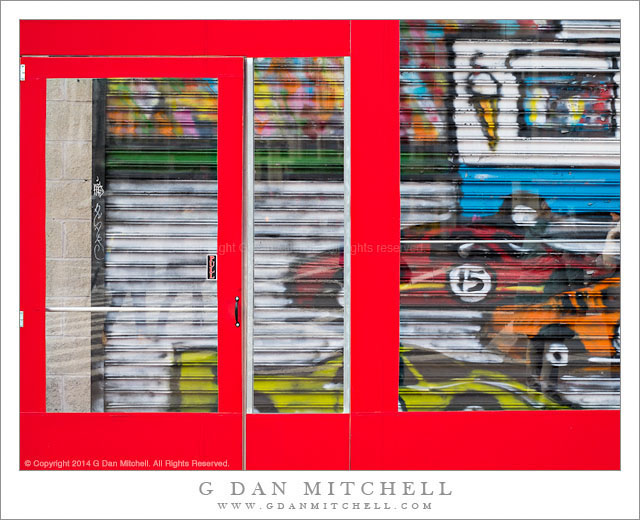
Red Storefront With Mural

Red Storefront With Mural

Red Storefront With Mural. New York City. December 25, 2013.© Copyright 2014 G Dan Mitchell – all rights reserved.

Red doors and window frames and brightly painted mural on a New York shop

Given the date, I suppose that this is a sort of Christmas photograph! We had arrived in New York the evening before, and while we had Christmas plans in Brooklyn, those were scheduled for much later in the day, so we ended up out and about in Lower Manhattan on a cold Christmas morning. Initially we headed south toward the financial district and the World Trade Center site – where it seemed that pretty much the only people around were our fellow tourists.

We finished up there and decided to head back to the hotel for a bit before going to Brooklyn. Starting this day and continuing throughout our weeklong stay, this small food stand became something of an icon, as we walked past it on the way to and from our Canal Street hotel daily. Oddly, when the place was closed it was at its most visually interesting, with a roll up door that had been painted brightly with the images of cars as you see here. The whole thing was behind an exterior set of glass windows/doors, the frame of which was painted the most gaudy shade of red imaginable.

G Dan Mitchell is a California photographer and visual opportunist whose subjects include the Pacific coast, redwood forests, central California oak/grasslands, the Sierra Nevada, California deserts, urban landscapes, night photography, and more.
Blog | About | Flickr | Twitter | FacebookGoogle+ | 500px.com | LinkedIn | Email

Text, photographs, and other media are © Copyright G Dan Mitchell (or others when indicated) and are not in the public domain and may not be used on websites, blogs, or in other media without advance permission from G Dan Mitchell.

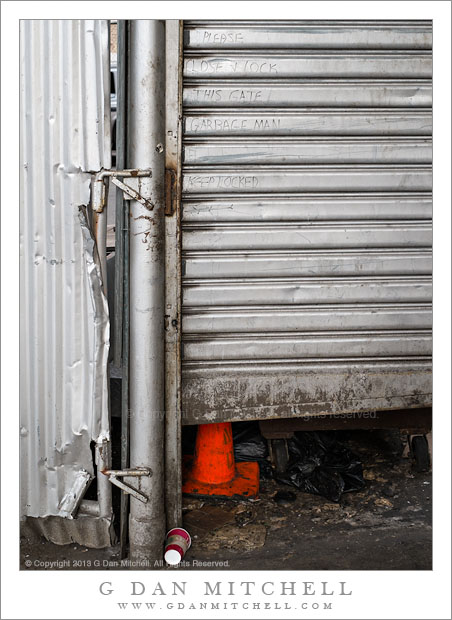
Garbage Man Gate

Garbage Man Gate
Garbage Man Gate

Garbage Man Gate. Brooklyn, New York. December 27, 2013. © Copyright 2014 G Dan Mitchell – all rights reserved.

Sheet metal fence, roll-up door, trash, and hand-written message to the garbage man, Brooklyn

“Please close and lock this gage. Garbage man”

I know this will baffle a few readers… but there you go. I’m tempted to offer little explanation and let you make of it what you will. This small vignette comes from a semi-industrial area beneath a bridge in a section of Brooklyn, New York. Is that cryptic enough? ;-)

G Dan Mitchell is a California photographer and visual opportunist whose subjects include the Pacific coast, redwood forests, central California oak/grasslands, the Sierra Nevada, California deserts, urban landscapes, night photography, and more.
Blog | About | Flickr | Twitter | FacebookGoogle+ | 500px.com | LinkedIn | Email

Text, photographs, and other media are © Copyright G Dan Mitchell (or others when indicated) and are not in the public domain and may not be used on websites, blogs, or in other media without advance permission from G Dan Mitchell.

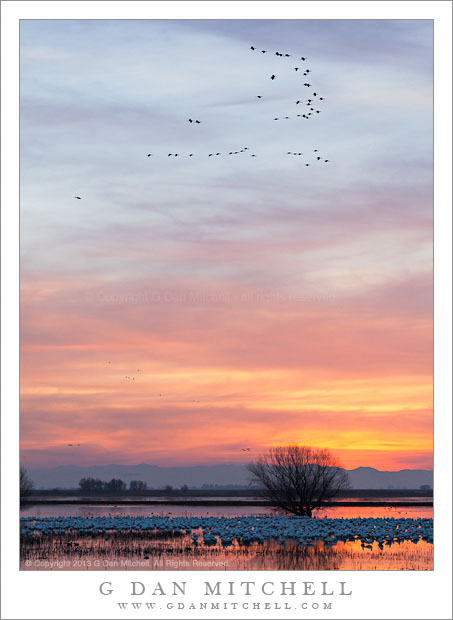
Cranes and Geese, Sunset, Reflecting Pond

Cranes and Geese, Sunset, Reflecting Pond

Cranes and Geese, Sunset, Reflecting Pond. San Joaquin Valley, California. January 1, 2014. © Copyright 2014 G Dan Mitchell – all rights reserved.

Cranes fly through evening sky above geese in a San Joaquin Valley pond.

I made this photograph on New Year’s Day 2014. Two years ago it seemed like a good idea to begin the new year by greeting its first dawn in the San Joaquin Valley, and sharing the experience with thousands of migratory birds and a few like-minded friends. Getting there was a stretch this year – late the previous night I had arrived home from a week in New York City, and getting up four hours later to drive two hours in the dark was going to be a challenge. But I made it and after photographing through the morning I thought that I might just head home. In the early afternoon we broke off from the photography and went to nearby town to grab something to eat, and by the time we were done it was only an hour or less until the evening “show” would begin back in the wetlands, so I shelved by early departure plans and headed back into the field.

I’m glad I did. It turned out to be a very beautiful evening, with many thousands of birds and with an unexpectedly beautiful sky. Often when it seems a bit gray and “blah” in the late afternoon, the evening light can end up illuminating this thick atmosphere, turning it both colorful and near-transparent. That is what happened here as I was photographing a large group of Ross’s geese that had settled in on the wetlands near this small tree. As the light diminished, I hoped for a fly-in of the sandhill cranes, which can be one of the most magical moments of any day in this area. Unlike the geese, which tend toward raucous and unpredictable behavior, the sandhill cranes seem to show up in large groups right at dusk, mostly gliding smoothly above the ponds as they head for their landing spots.

G Dan Mitchell is a California photographer and visual opportunist whose subjects include the Pacific coast, redwood forests, central California oak/grasslands, the Sierra Nevada, California deserts, urban landscapes, night photography, and more.
Blog | About | Flickr | Twitter | FacebookGoogle+ | 500px.com | LinkedIn | Email

Text, photographs, and other media are © Copyright G Dan Mitchell (or others when indicated) and are not in the public domain and may not be used on websites, blogs, or in other media without advance permission from G Dan Mitchell.

Photographic Myths and Platitudes: No Post-Processing!

(The following is another (more or less stream of consciousness) post that I wrote in reply to a comment I read somewhere else, in this case suggesting that photographic history implies that post-processing or manipulating photographs after the shutter has been clicked is ethically questionable and should be avoided. I’ll start with a modified version of the message I saw.)

…it is invalid to claim that Adams was a modern photoshoppe[r]… 

I… recommend to every beginner to do film… to develop a better feeling for composition… The most difficult in digital is to restrict yourself to [taking] a limited number of photos… in the beginning…

…I want to leave my photos as natural looking as possible…

This is an important conversation, for the beginner and for people who have been making photographs for a long time.

When people make pronouncements about how photography is supposed to be done or has been done based on notions about what great photographers do or have done, it is important to check those notions against reality. In photography there is a frequent mantra about “no post processing” and “get it right in camera” that has been, in my view, perverted to suggest that photographs are created in certain ways that do not correspond to reality – and worse, that other photographers should adhere to these false “rules.” It obviously is important to develop an eye for composition and an ability to operate a camera, but that is most certainly not the end of it, nor is there much of any evidence to indicate that great photographers have felt that photography is limited to what happens in the camera.

Did Adams ever make a “bad” negative look good in post? That depends on what you think of as bad. I’m can’t think of photographs that were poorly composed and where post-processing compensated for this. (However, there are some negatives that were damaged in the fire at the Yosemite studio very early on, and in which the composition is affected by this. I’m pretty certain that “Monolith” was burned along its top edge, which is partly responsible for the crop with which we are familiar today.)

Adams did, by the reports that I have heard first hand from people who knew him, make a good number of banal and boring exposures. In fact, like photographers today, he made far, far more uninteresting and forgettable photographs than great ones. His famous statement about a dozen successful photographs in a year being a good crop is a partial acknowledgment of this truth about photography.

Some of Adams’ most famous, most successful, and most universally admired photographs would have been forgettable without extensive work in post. It still surprises me how many photographers don’t know this and, in fact, believe that the opposite is the case. A number of other photographers who knew and worked with him regularly point this out in their presentation on Adams. One of their favorite and most compelling examples is the iconic “Clearing Winter Storm” photograph of Yosemite Valley. There are three powerful pieces of evidence in this case: the straight prints of the negative (which has been printed by others), Adams’ own shorthand instructions for his extensive dodging and burning of the image when producing prints, and the profoundly different appearance of the print we all know, in which clouds that were almost uniformly near white become a dramatic mixture of very contrasting tones. Further, Adams made a number of exposures of this exact composition – most of which are not as spectacular – but he selected one from which to create the brilliant print in post that became so famous. Continue reading Photographic Myths and Platitudes: No Post-Processing!

Photographer and visual opportunist. Daily photos since 2005, plus articles, reviews, news, and ideas.