
A Question About Noise and Prints

A reader asks:

I’m curious if you know the answer.  I don’t print very often so I’m not experienced with it.  I keep reading about noise in digital of course.  I also have read many remarks about noise not being visible in print under some conditions.  So I’m curious if there is a threshold.  For example, on the 5D2, what is the print size where noise becomes visible at a given ISO?  The 7D?  I realize that where it becomes objectionable may be subjective, but I thought it may be interesting to know when it is visible or invisible in print.

Let’s assume other technical details are handled well… good exposure, good focus, sharp lens, and no camera shake.

Thanks for writing. This is a great question and a subject that lots of people worry about. I’m not sure I know the answer, but I have an answer based on my own experience. The situation turns out to be a bit fuzzy in the end – in other words, if there is a threshold a number of factors could change your notions of where it might be. (I welcome comments from others who have experience to share.)

From reading photography discussions one could get the idea that image noise in digital photography is a terrible and limiting problem. Discussions often focus on questions like “which camera produces less noise?” and “how do I fix this noise problem.” We see 100% magnification crops of images in which noise is, indeed, quite visible. There are most certainly noise issues that we have to concern ourselves with, but all too often people get worked up over noise issues that are insignificant or even imperceptible – and which are often easy to resolve. Continue reading A Question About Noise and Prints
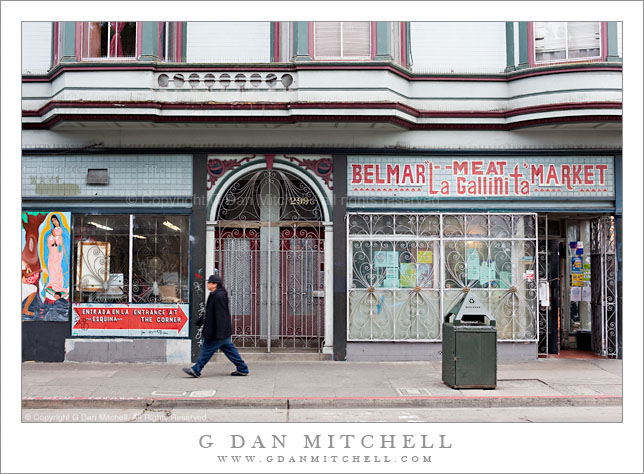
Belmar Meat Market, The Mission

Belmar Meat Market, The Mission

Belmar Meat Market, The Mission. San Francisco, California. February 20, 2010. © Copyright G Dan Mitchell – all rights reserved.

Photograph of street scene in the Mission with man walking on sidewalk, Belmar Meat Market sign, and other urban elements – San Francisco, California.

Another Mission District street scene – a matter of spotting an interested set of urban storefronts, composing the shot, and then watching for the right person or persons to walk through the frame. I’m fascinated by the complexity of these urban scenes and by the individuality of the storefronts in this type of place – each one seems to reflect something about the surrounding community and the people who live there. In this one certain compositional elements and color relationships also caught my attention.

This photograph is not in the public domain and may not be used on websites, blogs, or in other media without advance permission from G Dan Mitchell.

G Dan Mitchell Photography | Twitter | Friendfeed | Facebook | Facebook Fan Page | Email

Technical Data:
Canon EOS 5D Mark II
Canon EF 50mm f/1.4 USM
ISO 200, f/8, 1/50 second

keywords: the, mission, san francisco, california, usa, north america, street, urban, city, man, walking, trash, recycle, can, receptacle, belmar, meat market, la gallinita, entrance, corner, gate, door, window, blinds, painting, decay, wrought, iron, tile, 24th, curb, travel, stock

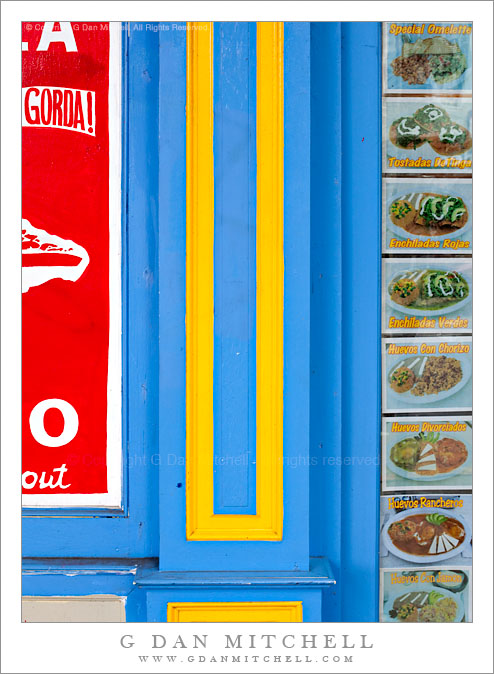
Wall and Signs, The Mission

Wall and Signs, The Mission

Wall and Signs, The Mission. San Francisco, California. February 20, 2010. © Copyright G Dan Mitchell – all rights reserved.

Brightly colored yellow and blue wall with red and white sign and restaurant window with food photographs, The Mission, San Francisco, California.

Another photograph of the subject I posted earlier – some very colorfully painted walls in the Mission District of San Francisco. While the previous one was a tighter crop in “landscape” orientation, I composed this one to show more of the vertical lines and to include the window-posted menu on the right side. Kind of makes me hungry just to look at it!

This photograph is not in the public domain and may not be used on websites, blogs, or in other media without advance permission from G Dan Mitchell.

G Dan Mitchell Photography | Twitter | Friendfeed | Facebook | Facebook Fan Page | Email

Technical Data:
Canon EOS 5D Mark II
Canon EF 50mm f/1.4 USM
ISO 200, f/8, 1/30 second

keywords: the, mission, san francisco, california, usa, north america, street, urban, city, wooden, wall, yellow, blue, paint, sign, gorda, red, white, mexican, food, photo, picture, window, menu, enchiladas, verde, tostadas, special, omelette, rojas, huevos, con, chorizo, rancheros, stripe, structure, graphic, vertical, shadow, trim, architecture, structure, stock

‘Ansel Adams: Early Works’ at the San Jose Museum of Art

As noted earlier, yesterday I again visited the “Ansel Adams: Early Works” exhibit at the San Jose Museum of Art. (Yesterday was supposed to be the final day – so if you missed it, I’m afraid you missed it!)

I always see and learn more when I have a chance to revisit work like this, and this was my second visit to this show. One of the wonderful things about it was that most of the photographs were small! This meant that they were presented more intimately, forcing one to look at them in a way different from our typical “monumental photograph” mindset when we look at Adams’ landscapes. In addition, many were from the 1920s (especially) and early 1930s before he adopted the more sharp and high contrast style with which most of us are more familiar.

A few things I came away with:

I’m so impressed with his seemingly atypical photograph of Stieglitz in his gallery in New York, with its beautiful composition and wonderful use of light and tonality. And next to this (small) photograph was a simple quote from Adams that (finally!) crystallized the whole Stieglitz “equivalence” thing for me.

I think I actually liked some of the early prints more than some the later ones, at least in a few cases. Side by side were hung two versions of the famous “Monolith” Half Dome photograph from the Diving Board. One was a small and rather dark early print, and the other was a much larger print made later that exhibits the lighter and brighter appearance. To me, the upper portion of the larger and more famous version has “issues,” especially in the handling of tones near the upper right corner. I think I actually prefer the darker rendition of his earlier print. (I guess that if I could “make my own Adams,” I might start with the darker one and go about 20% of the way towards the lighter one.)

In the “how could I have missed this before” department was my sudden recognition of the obvious parallels between one of his “White House Ruin” photographs (not the more famous one shot from an oblique angle but one shot straight on that even includes a bit of fence in the foreground) and the “Frozen Lake and Cliffs” photograph from Precipice Lake in the Sierra. Not only do both feature similar vertical banded patterns on the predominant rock faces, but both feature small “pyramid” shapes (sun-lit brush in the former and snow in the latter) and contrasting horizontal bands at the bottom of the frame (sunlit ground in the former and the ce/lake in the latter).

I also thought more about the photograph of roots that he made in Hawaii. As I understand it, Adams said that he didn’t really quite connect with Hawaii in the same way he connected with other subjects that he worked with. But this particular photograph – featuring a beautifully lit and composed group of curving roots and some small leaves – is truly wonderful.

Finally, in an odd way it reassures me to see some Ansel Adams prints that seem, how to say this, “not so special.” This is an important reminder of so many things: How astonishing it is when truly amazing work emerges from the background of lesser work; reaffirmation that no artist just creates great stuff – failure (often a lot of it!) is necessary as well; and a clearer sense of the humanity of Adams.

Sorry you missed it!

Photographer and visual opportunist. Daily photos since 2005, plus articles, reviews, news, and ideas.