A Few Thoughts On EVF Versus OVF Cameras

This is one of my occasional posts adapted from something I wrote elsewhere but felt might we worth sharing here on the blog.

A person had asked about “switching” from a Canon DSLR to a Fujifilm mirrorless camera, and some others had replied with points about the ergonomics of the smaller cameras along with some comments about using electronic viewfinders (EVF) in place of optical viewfinders (OVF). Since I use both (OVF and EFV, Canon and Fujifilm) I thought my thoughts might be relevant. 

Note: A few details of the article were updated on March 8, 2018 to reflect more recent developments – for example, referring to contemporary products from companies mentioned here.

EDITING CURRENTLY UNDERWAY


If the goal is a smaller camera and you already are invested in a Canon DSLR system, one option is to consider one of the much smaller Canon bodies. I know a couple of serious photographers who use the little SL1 for travel and certain other kinds of photography, often with smaller and lighter lenses. This gives you a traditional SLR OVF if you are concerned about using an EVF.

Here are some thoughts about perceived/real potential “downsides” (from some perspectives”) of the Fujifilm x-trans cameras specifically and regarding mirrorless cameras in general:

The EVF — The EVF versus OVF issue is complicated and, in a number of ways, subjective. Early on there was a lot of resistance to the EVF products — I think it was a combination of resistance to something new along with the relatively poorer performance of the initial versions. (They were slow, had lower resolution, and generally did not provide as positive of an experience.) I had such cameras a long time ago. (Does anyone else recall the Canon Pro1 of a dozen years ago?) More recent EVFs are far better in every measurable way — though they still won’t be for ideal everyone.

EVFs have pluses and minuses. In the minus category…

  • they show you a video image of the world, rather than an optical view of the “actual” subject
  • as video devices they are never be truly realtime displays — there is always at least some display latency
  • it takes more battery power to drive a video display.

In the plus category…

  • they are usable in extremely low light due to exposure simulation
  • additional useful data can be overlaid on the scene image
  • useful focusing aids can be incorporated into the display, etc.
  • they can reduce the size/weight of the camera and permit use of smaller lenses

In the end, you simply have to try an EVF camera for a while. Lots of people are fine with them, and even some of us who prefer the quality of an OVF are happy to use EVF if it is part of a package that has other advantages for the kinds of photography we are doing. Continue reading A Few Thoughts On EVF Versus OVF Cameras
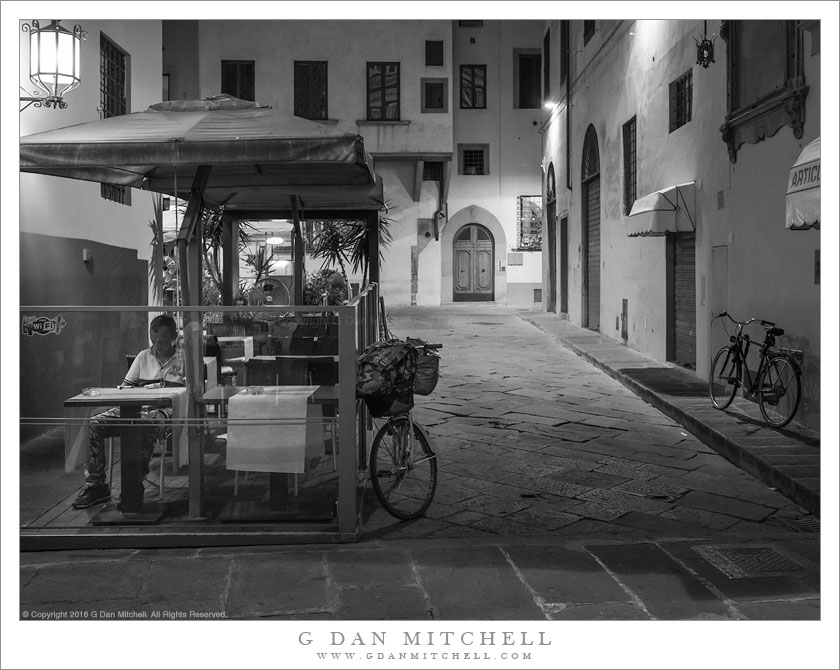
Restaurant, Diner, Bicycles

Restaurant, Diner, Bicycles
A man sits at a table at an outdoor restaurant at night, Florence, Italy

Restaurant, Diner, Bicycles. Florence, Italy. August 27, 2016. © Copyright 2016 G Dan Mitchell – all rights reserved.

A man sits at a table at an outdoor restaurant at night, Florence, Italy

Photographing in the streets of Florence, Italy was a joy when we visited this past summer. My only regret is that we were there for such a short time. We spent a week in the hills between Florence and Siena, and we picked up our rental car in Florence before leaving for the hills. (And, yes, driving in Florence is just as much fun as you have heard.) Then we returned to Florence and had parts of three days there before leaving. As I know fully understand, three days was not nearly enough time!

In one way, the streets of Florence seem to have a more uniform look than many American cities. There are few obvious commercial signs and many buildings are roughly the same shade of brown. But the streets are often very narrow and they twist and turn in all kinds of interesting ways, occasionally opening up to large squares or the banks of the Arno River. At night things are even more magical. One moment you might find yourself in the midst of crowds of people, and in another you might be on a deserted side street. This small street, with its beautiful lighting, extended off of one of the large squares, a somewhat busy place, but here there was just one man sitting at this sidewalk cafe.


G Dan Mitchell is a California photographer and visual opportunist. His book, “California’s Fall Color: A Photographer’s Guide to Autumn in the Sierra” is available from Heyday Books and Amazon.
Blog | About | Flickr | Twitter | FacebookGoogle+ | LinkedIn | Email


All media © Copyright G Dan Mitchell and others as indicated. Any use requires advance permission from G Dan Mitchell.

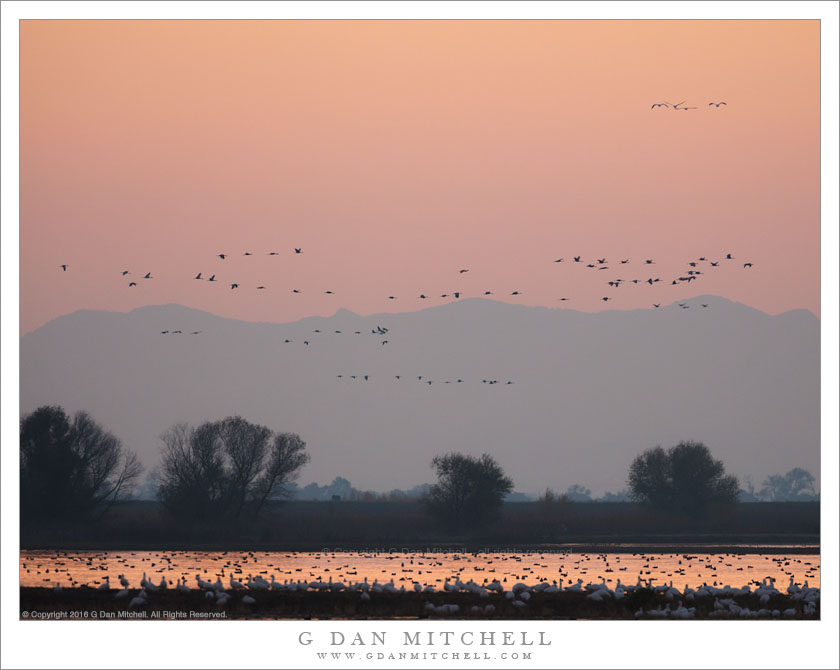
The Cranes Return

The Cranes Return
Lesser sandhill cranes return to wetland marshes in fading dusk light

The Cranes Return. San Joaquin Valley, California. December 3, 2016. © Copyright 2016 G Dan Mitchell – all rights reserved.

Lesser sandhill cranes return to wetland marshes in fading dusk light

There is a natural cycle to the day during the winter at these San Joaquin Valley wetland marshes — actually there are multiple cycles. One is the cycle of the animals themselves, responding to the dawn, moving to daytime activities, coming and going, then settling in once again for the night. Another is the cycle of the photographer or viewer of this wildlife, whose own patterns are inextricably linked to those of the birds and the light, but who also may sometimes choose when and where to focus efforts.

The midday and early afternoon hours are, at least most of the time, relatively quiet and slow. It makes sense that during the times of day when conditions are the most stable that the birds would also be more settled. (There are seasonal exceptions, including the late winter time when the winter residence of many birds is coming to an end and another migration cycle is about to begin.) The evening brings another transition, and one of the final and most impressive moments often comes after sunset with the dusk fly-in of the sandhill cranes. Long strings of these birds appear (usually from the south in this place), flying low and straight paths toward the places where they will land and spend the night.


G Dan Mitchell is a California photographer and visual opportunist. His book, “California’s Fall Color: A Photographer’s Guide to Autumn in the Sierra” is available from Heyday Books and Amazon.
Blog | About | Flickr | Twitter | FacebookGoogle+ | LinkedIn | Email


All media © Copyright G Dan Mitchell and others as indicated. Any use requires advance permission from G Dan Mitchell.

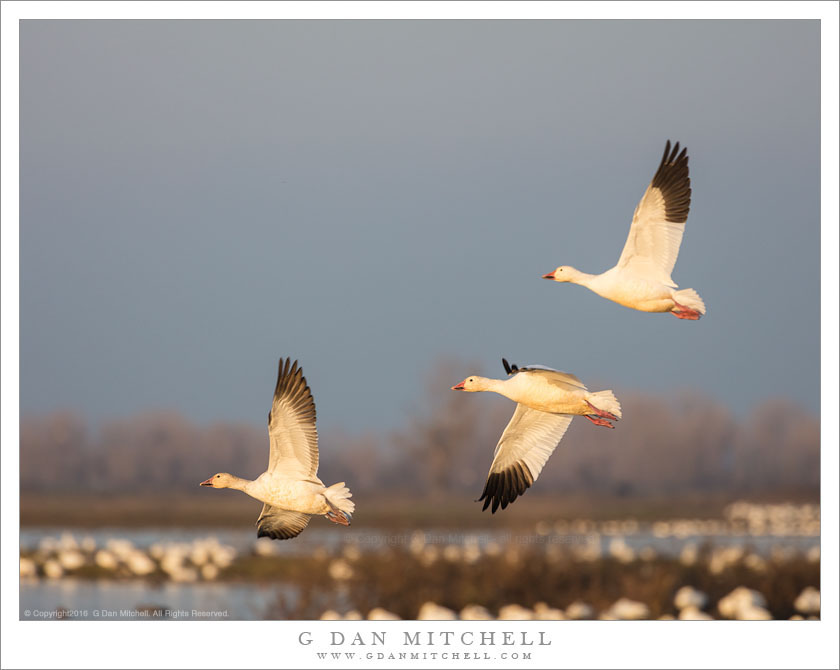
Three Snow Geese

Three Snow Geese
Three snow geese in flight over San Joaquin Valley wetlands

Three Snow Geese. San Joaquin Valley, California. December 3, 2016. © Copyright 2016 G Dan Mitchell – all rights reserved.

Three snow geese in flight over San Joaquin Valley wetlands

There are many ways to photograph geese in these California Central Valley locations, where they spend the winter months after migrating down from points far to the north. Great flocks of them settle in on ponds in these areas, or sometimes gather in fields. At other times giant flocks fill the sky, especially when something spooks them and thousands will take to the air at once, producing a sound that is the combination of their excited cries and the rush of wind from their wings. Large groups of them come and go throughout the day. Occasionally smaller groups, like this trio, arrive and circle before finding a spot to land and join the flock.

I confess that part of the fun with these groups comes from the challenge of trying to track and photograph them as they move so quickly. With practice one can find a few hints about their trajectory — they will circle a few times and they always land facing into the breeze — but they move fast, the light on their feathers changes, and they spend most of their time facing in the wrong direction! I saw this group coming in from a good distance away, and I tracked them as they approached a spot to my right, banked into a turn, and passed in front of me as they crossed to my left, circled away, and then returned to face the wind and land.


G Dan Mitchell is a California photographer and visual opportunist. His book, “California’s Fall Color: A Photographer’s Guide to Autumn in the Sierra” is available from Heyday Books and Amazon.
Blog | About | Flickr | Twitter | FacebookGoogle+ | LinkedIn | Email


All media © Copyright G Dan Mitchell and others as indicated. Any use requires advance permission from G Dan Mitchell.

Photographer and visual opportunist. Daily photos since 2005, plus articles, reviews, news, and ideas.