
Tag Archives: barren

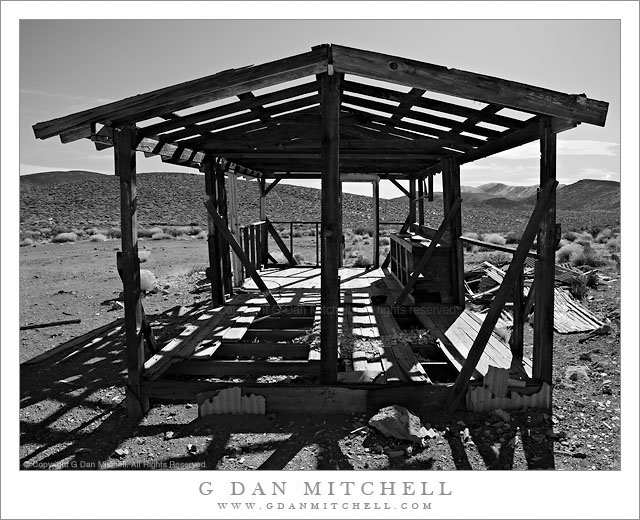
Abandoned Mining Cabin Ruins, Panamint Range

Abandoned Mining Cabin Ruins, Panamint Range

Abandoned Mining Cabin Ruins, Panamint Range. Death Valley National Park, California. March 29, 2011. © Copyright G Dan Mitchell – all rights reserved.

Black and white photograph of the ruins of an abandoned mining cabin high in the Panamint Mountain Range of Death Valley National Park.

There are a number of things that make Death Valley National Park, to the best of my knowledge, rather unique. One is the extensive history of human habitation inside the park boundaries, quite a bit of which is visible –  though some takes a bit more effort and attention to spot. The history of mining in the park is well-known, and many of the icons of the park have connections to this history. If you visit Furnace Creek, for example, you cannot miss the displays of old wagons and so forth used to move ore out of the Valley. It doesn’t take a lot of careful study to figure out that many park roads originated in an era of prospecting and mining. There are several well-known examples of structures left over from that era in and around the park, too.

It is largely because of this history that many areas of this national park are (or have been – some are now reverting to wilderness status) accessible by gravel road or four-wheel-drive routes. I would argue that you can’t really get to know this park if you just stick to the paved roads and the points of interest that they access. If you drive any of these other routes and keep your eyes open you will often be surprised by the left overs from relatively recent mining and prospecting, much of which isn’t really written about or described in the usual guides to the park. (And I’m not going to offer specific details about where to find such places here, since I don’t want to be even a little bit responsible for damage to them. If you do visit, treat them with care and respect.)

As I drove along a gravel road in one of the many mountain ranges of the park, returning from a site that is somewhat well-known, I began to notice evidence of fairly recent mining and prospecting. Faint tracks depart from the main “road” and cross valleys and hills, here and there tailing piles and mine entrances are visible, and sometimes you come across old structures such as cabins, storage bunkers, or wooden towers above mine entrances. I spotted the ruins of this old cabin above the road at one point and decided to walk up and investigate.

I’m almost always surprised at how “modern” many of the traces found at these places seem to be. I guess I am expecting something from the 1800s, but quite a few of these places look like they were build and occupied much later than that. I find modern things like linoleum flooring or modern-looking nails or electrical wire in many of them. There obviously isn’t much left of this cabin now, but from the detritus lying around near it and the form and materials found here, it must have been a reasonably comfortable place to live. As I walk around such places I often try to imagine what it must have been like to wake up every morning in this silent desert and head out for another day of physical labor.

G Dan Mitchell Photography | Flickr | Twitter (follow me) | Facebook (“Like” my page) | LinkedIn | Email
Text, photographs, and other media are © Copyright G Dan Mitchell (or others when indicated) and are not in the public domain and may not be used on websites, blogs, or in other media without advance permission from G Dan Mitchell.
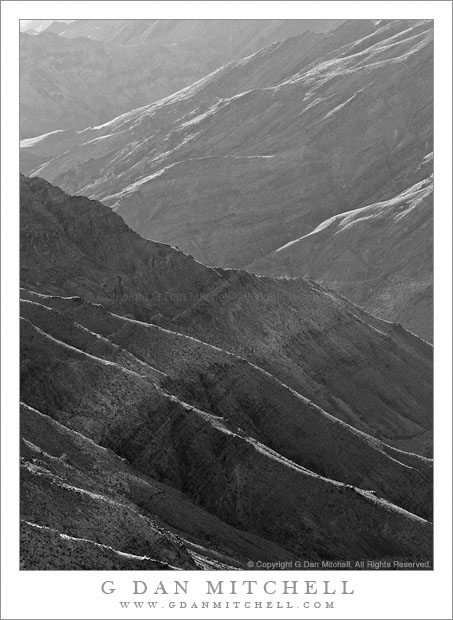
Dawn Light, Base of the Cottonwood Mountains

Dawn Light, Base of the Cottonwood Mountains

Dawn Light, Base of the Cottonwood Mountains. Death Valley National Park, California. March 29, 2011. © Copyright G Dan Mitchell – all rights reserved.

Dawn light on the based of the Cottonwood Mountains at the edge of Death Valley.

This is (yet another) one of those photographs that is the result of some odd combination of “planning” and serendipity. When I travel somewhere to do photography I often, though not always, have some ideas about certain types of subjects I would like to photograph or about ways I’d like to photograph them. On this visit to Death Valley I had a few such ideas in mind – one of them had to do with scenes that filled the frame with the rugged and forbidding and seemingly lifeless mountains and valleys and ridges of the place. Another had to do with photographing in the early light along the west side of the Valley, something I thought about but didn’t really try on my previous visit. This photograph and a few others like grew out of those ideas.

On the other hand, I wouldn’t have been in this spot at this moment if I had not had an electrical problem with my car! The night before I had returned to the campground from a bit of late shooting, parked the car, and went about my “camp business” before crawling into the tent and setting my alarm for an appropriate pre-dawn hour so that I could arrive at a particular location before the sun came up. The alarm went off at the appointed time, and a few minutes later I emerged from my tent and got into my car. It wouldn’t start. I soon realized that the car was electrically “dead” – no interior lights, etc. Since it was still completely dark, the idea of doing auto repair outside the tents and RVs of lots of other sleeping campers was out of the question, so I went back into my tent and speculated uncomfortably about the potential costs of towing and automobile repair in Death Valley.

Later, as the sky began to lighten, I heard other campers stirring. I got up – again – and opened the engine compartment to find that one of the battery cables had come off, perhaps as I drove a rather rough road the previous day! Relieved to find that this was something that I could fix, I reattached the cable, quickly got in the car, and figured I would see what I could salvage of the morning shoot. I headed west across the Valley toward Towne Pass, thinking about photographing some snow that was high on the ridge. As I drove I saw that the first light had still not quite reached the Valley floor along the base of the Cottonwood Range. I quickly found a slight rise along the road where the view wasn’t obstructed by desert plants, pulled over, put on the long lens, and made a few photographs as this beautiful light worked its way down the face of the range and began to work its way out across the giant wash along the edge of the Valley.

G Dan Mitchell Photography | Flickr | Twitter | Facebook | Email
Text, photographs, and other media are © Copyright G Dan Mitchell (or others when indicated) and are not in the public domain and may not be used on websites, blogs, or in other media without advance permission from G Dan Mitchell.
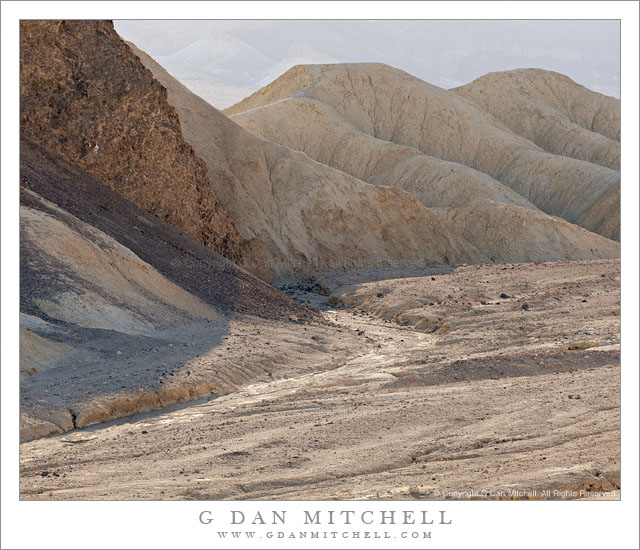
Red Rock Gully

Red Rock Gully
Red Rock Gully

Red Rock Gully. Death Valley National Park, California. March 29, 2011. © Copyright G Dan Mitchell – all rights reserved.

A red rock gully and wash in the Panamint Range of Death Valley National Park.

I have driven past this area along the road from Death Valley up to Wildrose Canyon quite a few times, and as I do I always am impressed by the many convoluted little canyons and odd and interesting rock formations. Most often I have been on my way to some other place or the light wasn’t quite right, but I always take a look and make a mental list of little spots to keep an eye on. This particular little canyon is one you might not even notice unless you were looking carefully as you passed it. It is in a narrow section of the lower canyon where it is one of many such little landscapes. On this morning I was coming back down from shooting up higher in the Panamints and I was watching carefully as I drove, frequently pulling over to stop and check things out more carefully. At first I almost drove past this spot, but it looked like the light might be interesting this time so I quickly stopped and backed up and made a series of photographs including this one.

The question of how to frame this scene was an interesting one. As is often the case I cover more than one base and shoot the subject in several ways. Initially I worked with a vertical orientation that includes a bit more of the rough terrain a bit higher in the canyon. That image may still see the light of day! But as I shot the scene I also realized that I could use a horizontal orientation too, more tightly frame the entrance to the small canyon, and give up some of the upper canyon formations.

With many subjects I would prefer softer light, and I would probably try to shoot much earlier in the day or come back in the evening. But this canyon, I think, works well in the light of a bit later in the morning when the sun has topped the ridge and direct light hits the top of the rocks and reflects into the recesses a bit more.

G Dan Mitchell Photography | Flickr | Twitter | Facebook | Email
Text, photographs, and other media are © Copyright G Dan Mitchell (or others when indicated) and are not in the public domain and may not be used on websites, blogs, or in other media without advance permission from G Dan Mitchell.

Rugged Terrain, Lower Titus Canyon

Rugged Terrain, Lower Titus Canyon

Rugged Terrain, Lower Titus Canyon. Death Valley National Park, California. March 28, 2010. © Copyright G Dan Mitchell – all rights reserved.

Details of the rugged cliffs and walls rising above lower Titus Canyon in Death Valley National Park.

Titus Canyon Road is one of the marvels of Death Valley National Park. It begins in high desert of Amargosa Valley near the town of Beatty and the ghost town of Rhyolite, winds over the summit of the Grapevine Mountains, drops precipitously into upper Titus Canyon, passes a number of historically interesting sites, passes through a very narrow and deep section in the lower canyon, and then suddenly emerges into the vastness of Death Valley.

In the lower section of the canyon, the wash becomes very narrow, passing through a twisty slot canyon and is, in places, barely wide enough for the one-lane gravel road. Here the walls of the canyon press tightly together and rise steeply for hundreds of feet. Some places are so deep that the sun rarely penetrates to the bottom.

Fortunately for the preservation of the canyon the road is horrible, at least if you are used to more civilized driving. It is a one-way road and the whole thing is gravel. Sections are in decent shape, but it other places the road passes over narrow and twisty sections next to precipitous drop-offs and then dives steeply into deep canyons. At times the route is closed after heavy rains or other conditions that make the route impassable.

Fortunately, the section that is perhaps the most impressive in many ways – the deep slot canyon near the bottom – is easily accessible by foot from Death Valley. After a short drive up to the canyon entrance on a gravel road to a parking area, you can enter the canyon on foot and walk up as far as you want. This photograph was made within the lower mile of the canyon during the late morning, when the light penetrates more deeply into the canyon and creates a glow on the canyon walls.

G Dan Mitchell Photography
About | Flickr | Twitter | Facebook | Google+ | 500px.com | LinkedIn | Email

Text, photographs, and other media are © Copyright G Dan Mitchell (or others when indicated) and are not in the public domain and may not be used on websites, blogs, or in other media without advance permission from G Dan Mitchell.

(Basic EXIF data may be available by “mousing over” large images in posts. Leave a comment if you want to know more.)