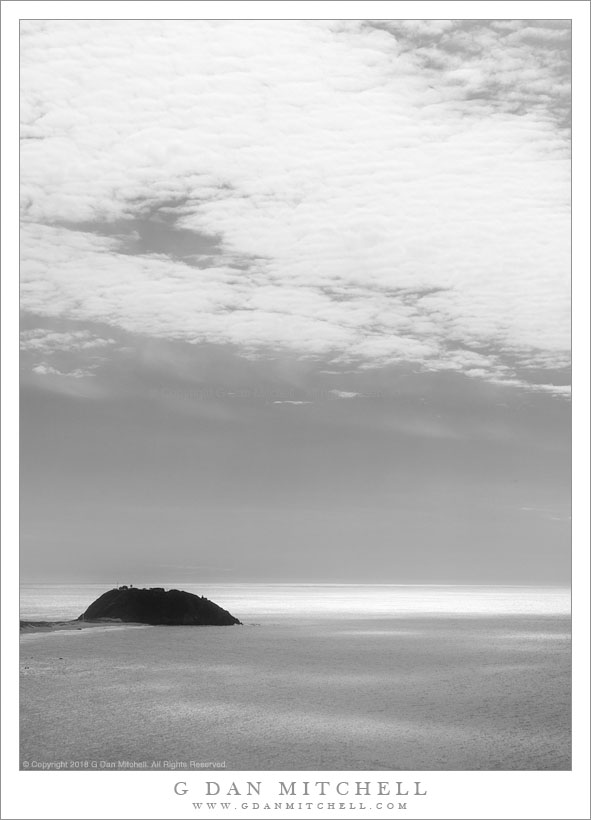
Historic Point Sur is dwarfed by clouds and the Pacific Ocean
By the time I got to this point on the Big Sur coast on this February winter day, it was past early morning and the light was more that of the midday hours. Often that might mean that the light had become flat and uninteresting, but some clouds close to the shoreline, some sunlight in the distance, and some high clouds further on made even this daytime light interesting.
I’m very familiar with this spot, where a historic lighthouse facility sits on top of a remarkable hill that would be separated from the land but for a low, sandy peninsula connecting it to the shoreline. Photographing from some distance away with a long lens, and aiming pretty much straight into the brightest reflected light, the hill’s details almost disappear into shadow, and it appears to float in the light and water.
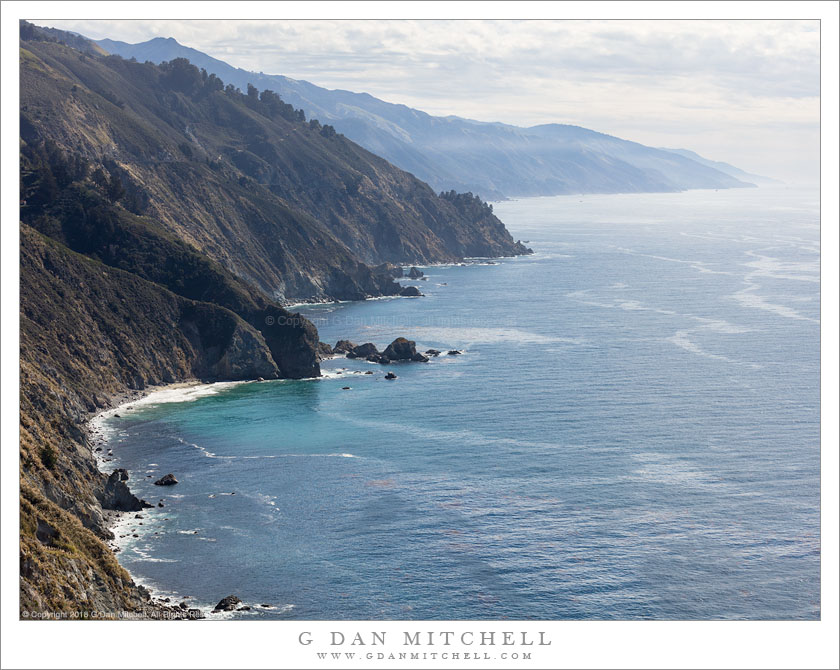
Gentle winter haze along California’s Pacific Ocean coastline south of Monterey
I have visited this coast for decades, since my parents moved to California from the Midwest when I was four-years-old. Back then we took lots of family “day trips,” and the Monterey Peninsula and Point Lobos areas were often our goals, and I became familiar with the Coast Highway Pacific Ocean interface at a young age. There was perhaps a gap when I was in college, but when our kids were old enough we headed down this way from time to time, too.
There are a few constants here: the headland cliffs plunging into the Pacific, the twisting and turning route of the highway, the little places to stop and grab a bite to eat, the long views over the ocean and up and down the coast. But other things are rarely the same twice. The light is constantly changing, from morning to evening, from winter to summer, from clear air to fog. I would most typically photograph early or late, but on this winter day there was interesting light and atmosphere right into the middle of the day when I made this photograph, looking south along the coastline as the haze gradually obscured distant hills and the sunlight’s reflection turned the oceans distant surface a brilliant white.
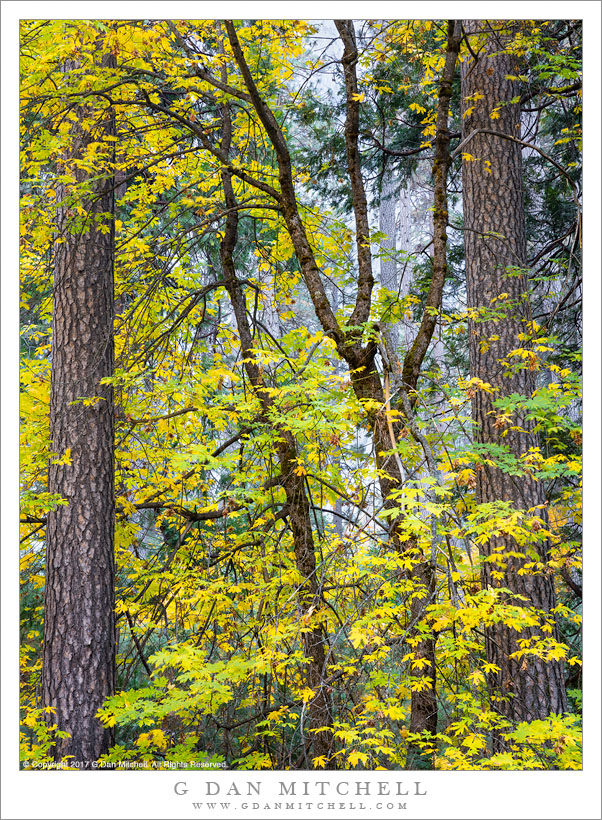
I’ll start with a story about crowds, but I’ll end on a better note. :-) I drove to Yosemite Valley on this late-October weekend partially to photograph early fall color in The Valley, but also so that I could attend an exhibit opening at Gallery Five in Oakhurst — where the final showing to the 2017 Yosemite Renaissance exhibit had been installed. I have visited the Valley for years at about this time, since fall colors there typically peak around the end of the month. On this trip, my first indication that I wouldn’t exactly be alone in the park — despite there being a lot of wildfire smoke — was the extraordinarily long line to enter the park, even very early in the morning. Further into the Valley I was stunned by the number of cars and visitors — it wouldn’t have been anything special during the summer, but near the end of October? I decided to head up to the Curry Village (sorry, “Half Dome Village”) area to park where I could wander off and make photographs, but when I arrived there was literally no place to park — not the Village lot, the overflow lot, the nearby roadways, or anything else all the way up to nearby campgrounds. I was floored…
I finally left that area and found a pull-out along the roadway, parked my car near some a portion of the forest filled with colorful big leaf maple and dogwood trees, and headed off into an area where there was virtually no one else around. Yes, there are such places here, even on busy days. As I walked I spotted a number of potential photographs, but I kept going, walking slowly until I finally reached the banks of the Merced River. I made a few photographs there in solitude before turning around and slowly starting back the way I had come. I now had in mind a few trees that I thought might make interesting photographs, so I paused and poked around near them looking for compositions. This photograph falls into a category that I think of as “order from chaos” compositions, in which there is an almost overwhelming amount of detail tied together (I hope!) by some underlying compositional order. Here the darker branches and trunks of trees supply that order underlying the complexity of the colorful big leaf maple leaves.
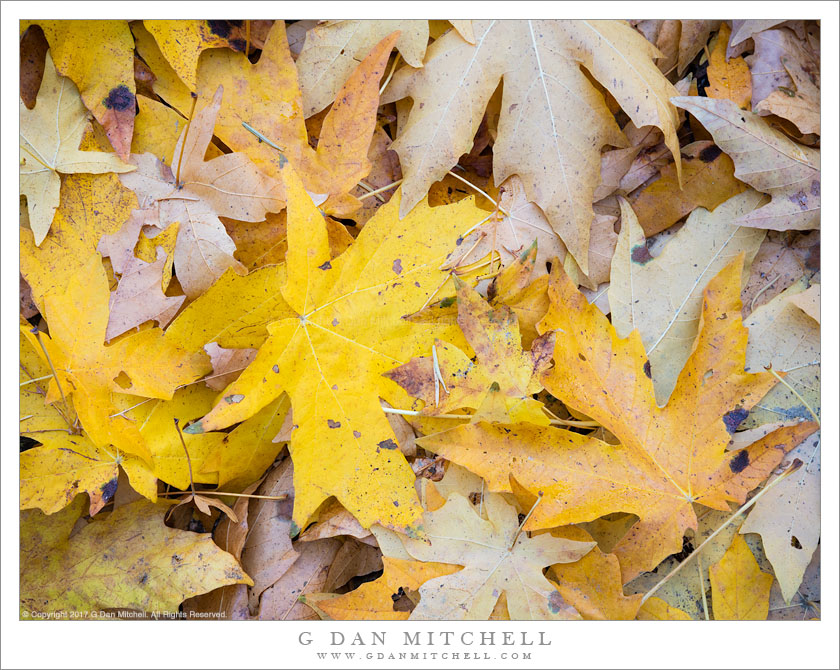
Fallen big leaf maple leaves along a Yosemite Valley trail
I suppose it would not truly be autumn without at least one photograph of fallen leaves littering the forest floor! I made this photograph on a walk along the south side of a quiet section of trail in Yosemite Valley where big leaf maple trees grow. Along with black oaks and dogwoods, these trees produce some of the most interesting fall colors in The Valley. The big leaf maples often grow among conifers and in autumn their brilliant yellow leaves contrast with the darker and more somber tones of the other forest trees.
Just before I made this photograph I had been looking for the actual trees, and trying to find some that were separated enough from their surroundings to stand out in a photograph. In this particular location that turned out to be difficult. There were some lovely big leaf maples, but the lighting was a challenge and they often were too interspersed with dense forest. At about that point I thought to look down, and I saw thick piles of the large leaves alongside the trail.
Photographer and visual opportunist. Daily photos since 2005, plus articles, reviews, news, and ideas.
Manage Consent
To provide the best experiences, we use technologies like cookies to store and/or access device information. Consenting to these technologies will allow us to process data such as browsing behavior or unique IDs on this site. Not consenting or withdrawing consent, may adversely affect certain features and functions.
Functional
Always active
The technical storage or access is strictly necessary for the legitimate purpose of enabling the use of a specific service explicitly requested by the subscriber or user, or for the sole purpose of carrying out the transmission of a communication over an electronic communications network.
Preferences
The technical storage or access is necessary for the legitimate purpose of storing preferences that are not requested by the subscriber or user.
Statistics
The technical storage or access that is used exclusively for statistical purposes.The technical storage or access that is used exclusively for anonymous statistical purposes. Without a subpoena, voluntary compliance on the part of your Internet Service Provider, or additional records from a third party, information stored or retrieved for this purpose alone cannot usually be used to identify you.
Marketing
The technical storage or access is required to create user profiles to send advertising, or to track the user on a website or across several websites for similar marketing purposes.

 G Dan Mitchell is a California photographer and visual opportunist. His book, “California’s Fall Color: A Photographer’s Guide to Autumn in the Sierra” is available from Heyday Books and Amazon.