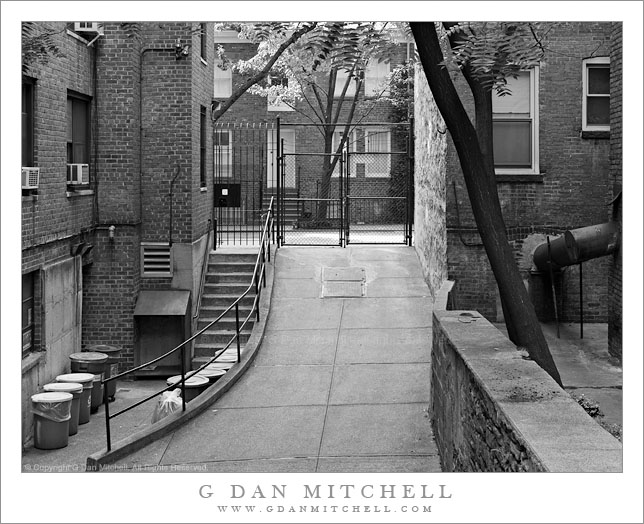
Black and white photograph of a concrete driveway between tightly-spaced brick homes, New York City.
I’m actually not precisely sure where in Manhattan this scene is any more. We were walking somewhere towards Chelsea when we passed through a little neighborhood of brick homes, and I just happened to notice this little scene as we walked past. Aside from plastic trash receptacles with plastic liners and the air conditioners, I don’t think there is much in this scene to date it, which is one of the reasons that I chose to go with a black and white rendition.
(Basic EXIF data may be available by “mousing over” large images in posts when this page is viewed on the web. Leave a comment if you want to know more.)
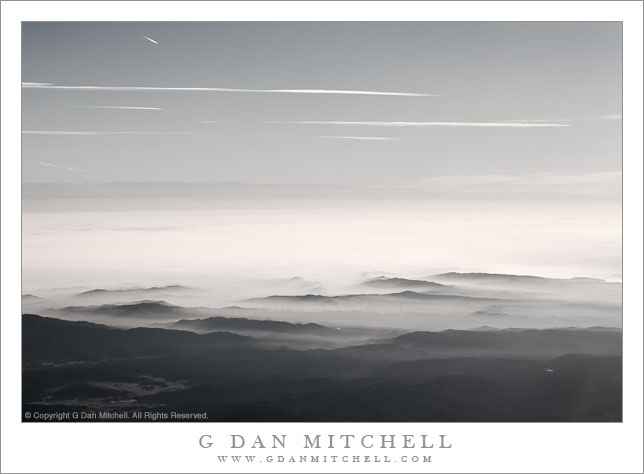
The sky over Northern California, stretching from coastal hills and fog across the tule-fog-filled Central Valley to the Sierra Nevada, New Years Morning.
On New Years Day 2008 I flew to Seattle for a family visit. As we flew out of San Jose and over the hills along the eastern edge of the Bay Area, the winter tule fog was filling the Central Valley and spilling up against the hills, while above and beyond it was a nearly perfectly clear sky. For those who might be unfamiliar with the landscape here, beyond the fog-filled Central Valley, and very far away, the faint dark line of the Sierra Nevada crest is visible, and if you look very closely you may be able to see that the highest peaks are snow-capped.
This photograph has sat in the archive for over three years. I liked the scene but I wasn’t quite sure of what to do with the somewhat odd colors that resulted from shooting though an airplane window and into very bright light. I had considered a straightforward black and white interpretation and, if fact, that is what I was working on when I decided to instead desaturate the image about three-quarters of the way to being monochrome – and for me this seemed like just the right thing and more in line with how I think of the scene now. Another question was whether to clone out the contrail of another plane near the upper left corner. In the end I decided to leave it, for several reasons that I’ll leave to your imagination for now.
G Dan Mitchell is a California photographer and visual opportunist. His book, “California’s Fall Color: A Photographer’s Guide to Autumn in the Sierra” (Heyday Books) is available directly from him.
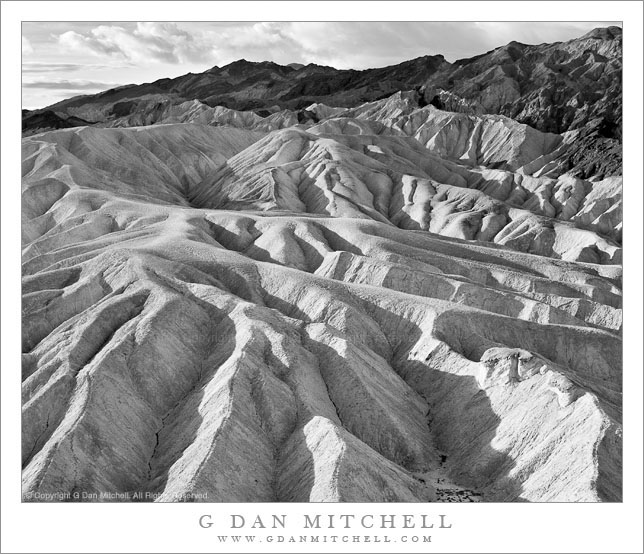
Low angle morning light illuminates a tortured landscape of eroded gullies at Zabriskie Point, Death Valley National Park.
I recently “rediscovered” this photograph while undertaking a major review of the past eight years of my raw files. (And, yes, that task is just about as much fun as you might imagine. It would actually be pretty unbearable except that every so often I find some photographs that I had perhaps forgotten or overlooked, and I also come across images that remind me of experiences that took place some time ago.)
This photograph was made, as virtually anyone who has visited the spot recognizes, by pointing my camera about 90 degrees to the left of the classic Zabriskie Point views. Timing was important, as the early light is just skimming across the tops of these tortuously eroded gullies, picking out the ridges between them but leaving the lower sections in shadow. But good fortune also played a role here. Death Valley is usually a clear blue sky kind of place, but on this morning I had clouds! At dawn, if I recall correctly, the clouds actually interfered with the light a bit. But as the sun rose the clouds provided a more dramatic background than plain blue sky and created some softer and diffused light that gave just the right sort of dynamic range for photographs.
On a technical note, if you are viewing this in the right web browser you can mouse over the image and see a summary of basic EXIF data. (Sorry, but this feature only works in web browsers – if you are viewing email, etc. you’ll need to visit the version at my blog to see the EXIF.) If you do check the EXIF you might notice that this photograph was made with a very humble example of photographic technology, the Canon Digital Rebel XT. This camera is a 8MP cropped sensor “consumer” camera that I acquired when I first tested the waters of DSLR photography. (I had actually used digital cameras back in the 1990s, but not for serious photographic work.) Those who wonder which of today’s current DSLRs might enable them to produce interesting and effective images might consider what could be done with such a humble camera. ;-)
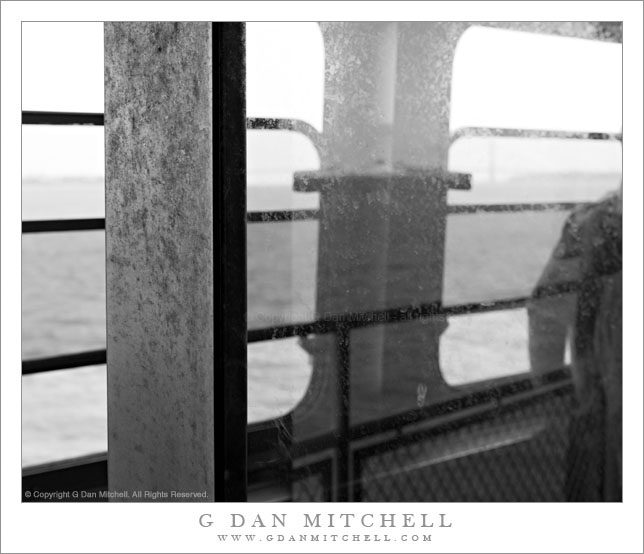
Details of the Staten Island Ferry in black and white.
This photograph may need a bit of explanation. Though it might be fun for you to try to parse out what you are seeing first. Go ahead. I’ll wait…
We did the cheap thing on this afternoon after walking around parts of south Manhattan – we wandered over to the Battery Park, saw a ferry approaching, figured we had just enough time for a scenic round trip, ran to the terminal, and did the free over-and-back on the Staten Island Ferry. The price is certainly right, and the ferry provides interesting views of the Brooklyn shoreline and the south end of Manhattan.
This is a photograph of… not much. The only in-focus element is the vertical metal bar near the left side of the frame. There are windows in the frame as well, and they provide several layers of reflections along with some other “stuff” from the glass itself. (The fence-like object at lower right is actually behind my camera position.) I shot this with a very large aperture to get a narrow depth of field, so everything beyond the metal column is out of focus – the sliding windows, the portion of a person at the right edge of the frame, the water and horizon, and the barely visible bit of the Verrazano bridge in the right window.
(Basic EXIF data may be available by “mousing over” large images in posts. Leave a comment if you want to know more.)
Photographer and visual opportunist. Daily photos since 2005, plus articles, reviews, news, and ideas.
Manage Consent
To provide the best experiences, we use technologies like cookies to store and/or access device information. Consenting to these technologies will allow us to process data such as browsing behavior or unique IDs on this site. Not consenting or withdrawing consent, may adversely affect certain features and functions.
Functional
Always active
The technical storage or access is strictly necessary for the legitimate purpose of enabling the use of a specific service explicitly requested by the subscriber or user, or for the sole purpose of carrying out the transmission of a communication over an electronic communications network.
Preferences
The technical storage or access is necessary for the legitimate purpose of storing preferences that are not requested by the subscriber or user.
Statistics
The technical storage or access that is used exclusively for statistical purposes.The technical storage or access that is used exclusively for anonymous statistical purposes. Without a subpoena, voluntary compliance on the part of your Internet Service Provider, or additional records from a third party, information stored or retrieved for this purpose alone cannot usually be used to identify you.
Marketing
The technical storage or access is required to create user profiles to send advertising, or to track the user on a website or across several websites for similar marketing purposes.