
Tag Archives: broken

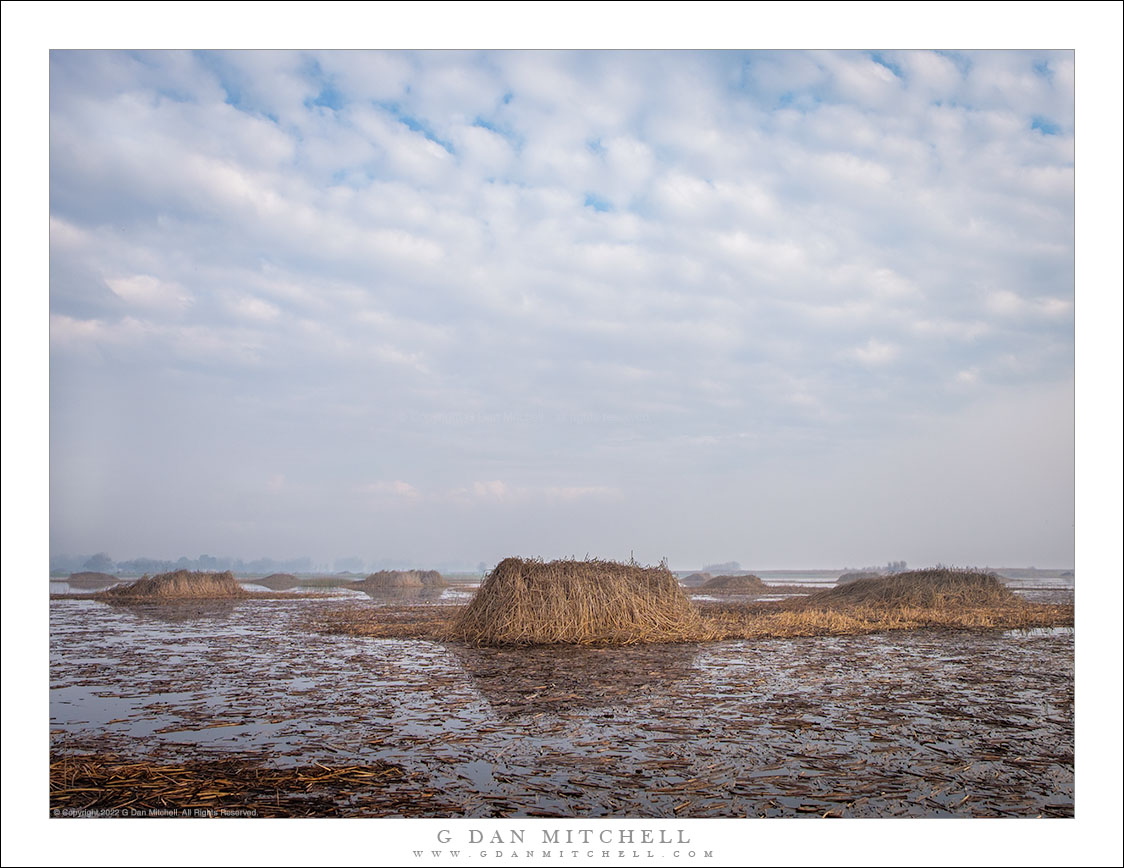
Winter Wetlands

Winter Wetlands
Flooded winter wetlands with broken-down tules .

Winter Wetlands. © Copyright 2022 G Dan Mitchell – all rights reserved.

Flooded winter wetlands with broken-down tules .

Places like this fascinate me. The location is in California’s Great Central Valley, a 400+ mile long feature running up and down the state, separating the coastal mountain ranges from the Sierra Nevada. Most people are probably familiar with it from driving through or across it on their way to some other place. It is largely agricultural, though these days population centers are expanding rapidly and parts of the valley are increasingly urban. Bottom line? It is hardly a place that most people would regard as a scenic attraction.

I get it. And most of my visits are more of the “passing through” than the “going there” sort — except in winter when I often make it my destination. Winter provides a relief from the valley’s generally hot and dry climate during most of the year, and wet areas appear when rain falls, especially where rivers meet and were old marshes once existed. The soft light and the expansive sky can be a relief from the urban experience. Here, wetland ponds are full from recent rains, and interesting tule islands stand where someone has chopped town the vegetation before the pond was flooded.


G Dan Mitchell is a California photographer and visual opportunist. His book, “California’s Fall Color: A Photographer’s Guide to Autumn in the Sierra” is available from Heyday Books, Amazon, and directly from G Dan Mitchell.

Blog | About | Flickr | FacebookEmail

Links to Articles, Sales and Licensing, my Sierra Nevada Fall Color book, Contact Information.

Scroll down to leave a comment or question. (Click this post’s title first if you are viewing on the home page.)


All media © Copyright G Dan Mitchell and others as indicated. Any use requires advance permission from G Dan Mitchell.
Pumpkin Universe

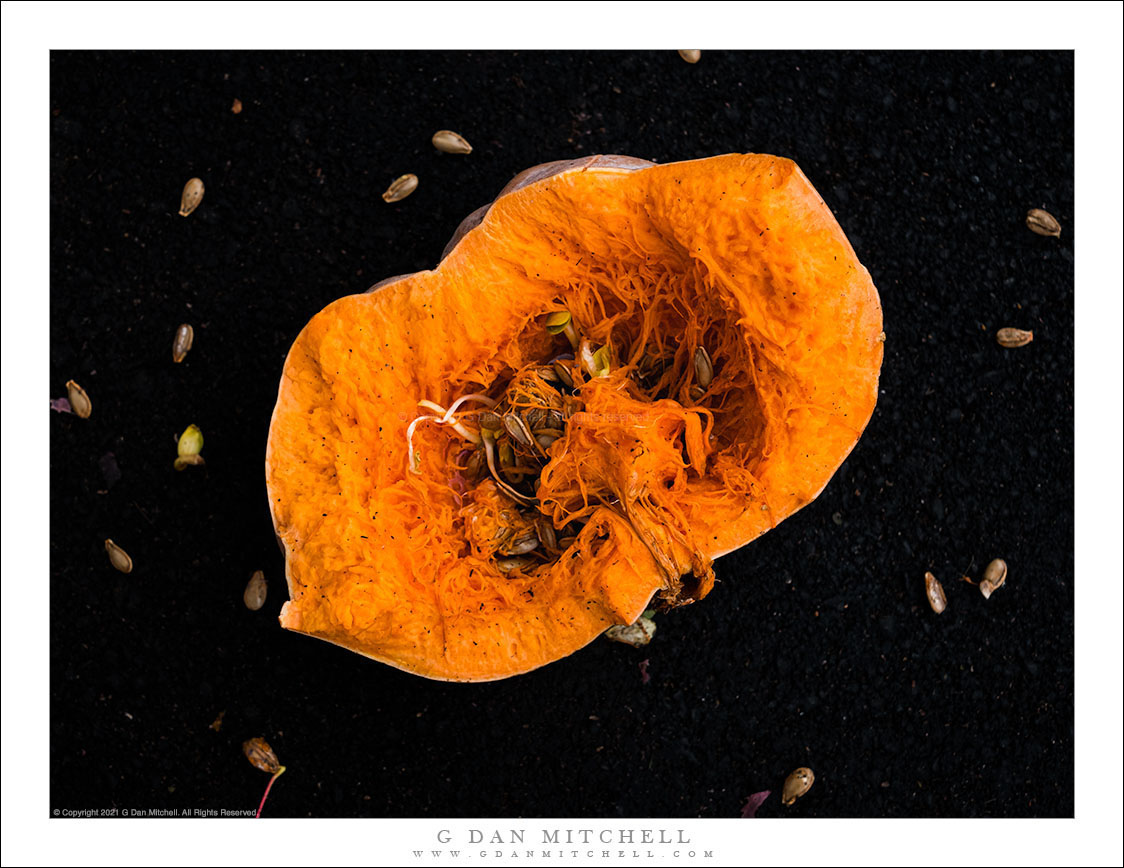
Pumpkin Universe
What was left of a pumpkin on the day after Halloween.

Pumpkin Universe. © Copyright 2021 G Dan Mitchell – all rights reserved.

What was left of a pumpkin on the day after Halloween.

This is another in the “orange series” of photographs that I made in October as part of a seasonal challenge issued by a group of fellow photographers — namely to go out and make photographs of orange things. I’ve written about this in other posts, so I’ll keep the story somewhat short. I started with the obvious Halloween notion of photographing pumpkins, but then I decided to look for ways to photograph them somewhat differently — not jack-o-lanterns and not the common “fall bounty” images. So I headed out into the neighborhood looking for distorted and damaged subjects.

There’s a well-known quote about a photograph being what it is (a supposedly objective visual record) and what else it is (a rather wide field). It should be obvious that you can “see” a photograph in multiple ways — an image of the literal thing, a suggestion of something else that it isn’t, and so on. While this photograph obviously depicts a fairly ordinary thing, I enjoy looking at it as something different from that.


G Dan Mitchell is a California photographer and visual opportunist. His book, “California’s Fall Color: A Photographer’s Guide to Autumn in the Sierra” is available from Heyday Books, Amazon, and directly from G Dan Mitchell.

Blog | About | Flickr | FacebookEmail

Links to Articles, Sales and Licensing, my Sierra Nevada Fall Color book, Contact Information.

Scroll down to leave a comment or question.


All media © Copyright G Dan Mitchell and others as indicated. Any use requires advance permission from G Dan Mitchell.
Canyon Wall

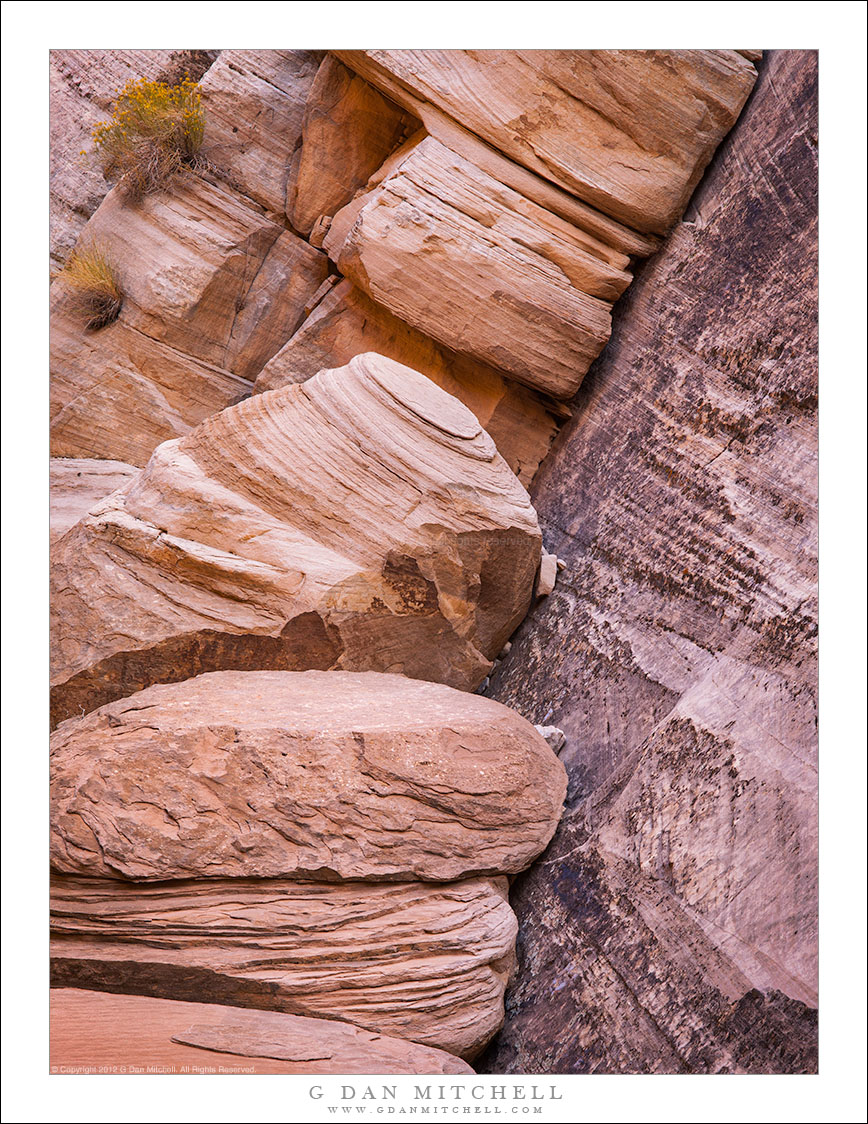
Canyon Wall
Broken boulders and strata at the base of a slot canyon wall.

Canyon Wall. © Copyright 2012 G Dan Mitchell – all rights reserved.

Broken boulders and strata at the base of a slot canyon wall.

These canyons are simply full of fascinating details. Unlike much of my familiar Sierra Nevada landscape, where vistas can often go on for many miles, here the size of your world is much smaller. It is constricted to the width of the canyon, the distance to the upper rims (plus some sky), and upstream and downstream to only the next bends. So you are almost forced to focus on smaller details, of which there are many.

Here my attention was drawn to the rocks. I’m no geologist, and I only know enough to speculate about these things. But a close look at the rocks in this scene show material that was created in layers. Near the upper right corner, if you look closely, you can spot a place where there is a striking convergence of angles in the strata. And although this material was laid down in horizontal layers, over time it has been pushed and stretched and lifted until the formerly horizontal now angles up distinctly to the left. There is also an interesting almost vertical fracture between the more solid (and darker) rock on the right, and the lighter color of the broken rocks stacked up on the left.


G Dan Mitchell is a California photographer and visual opportunist. His book, “California’s Fall Color: A Photographer’s Guide to Autumn in the Sierra” is available from Heyday Books and Amazon.

Blog | About | Flickr | FacebookEmail

Links to Articles, Sales and Licensing, my Sierra Nevada Fall Color book, Contact Information.

Scroll down to leave a comment or question.


All media © Copyright G Dan Mitchell and others as indicated. Any use requires advance permission from G Dan Mitchell.
Autumn Aspens, Broken Boulders

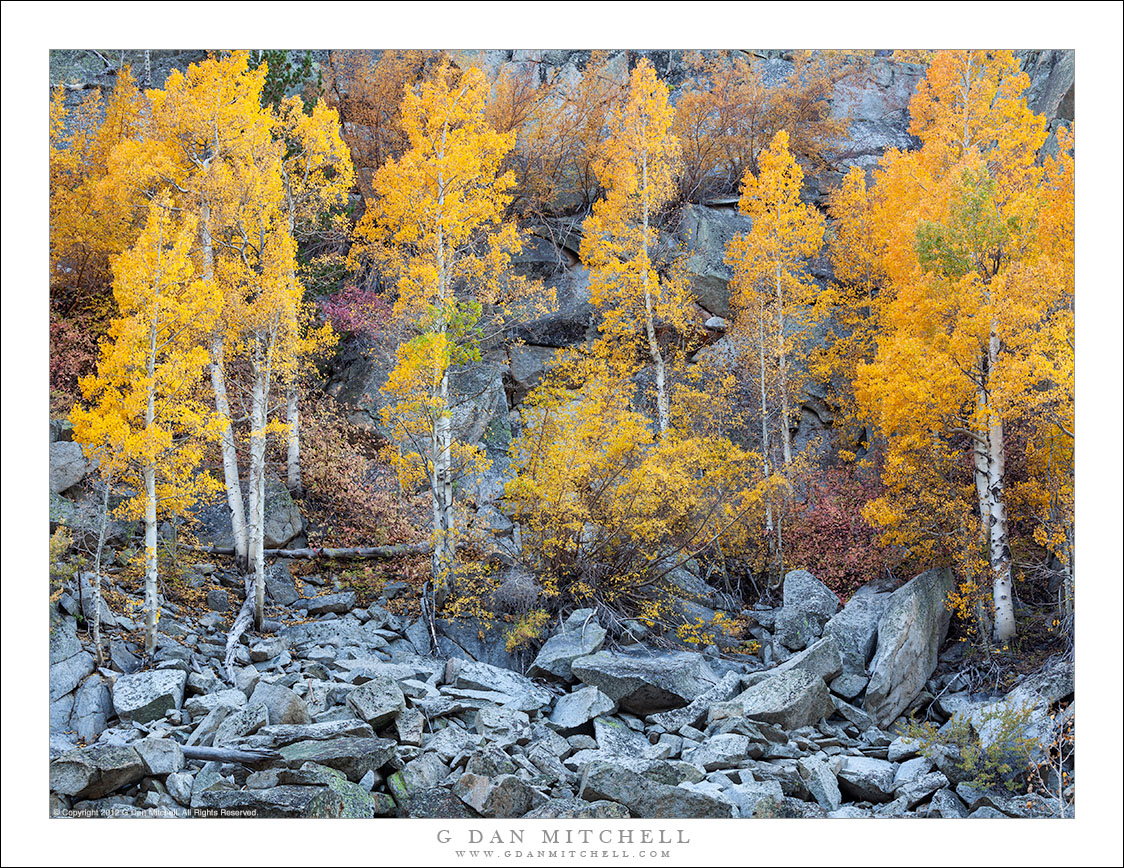
Autumn Aspens, Broken Boulders
A group of autumn aspen trees grows in jumbled and rocky Eastern Sierra Nevada terrain.

Autumn Aspens, Broken Boulders. © Copyright 2012 G Dan Mitchell – all rights reserved.

A group of autumn aspen trees grows in jumbled and rocky Eastern Sierra Nevada terrain.

Aspen trees frequently grow on what we might regard as less-than-optimal soil and terrain, at least in the Eastern Sierra Nevada. While some manage to find a home in canyon bottoms and other places with good soil, many trees live their lives in dry, rocky, and exposed places. Often the trees seem to adapt — perhaps remaining quite small or maybe maintaining more space between them. The trees in this photograph are growing on truly rocky terrain. The trees are rooted in little more than cracks in the granite, and around them are solid rock and a field of broken granite.

Dealing with color when photographing aspens in locations like this can be tricky, especially since I much prefer to photograph them when they are shaded. (Direct sunlight on these trees can be quite harsh.) The light in shadows can be extremely blue, mainly because the main light source is that giant blue light panel we call the say. On the scene, our human visual system adapts and we register the rocks as gray. But the camera is, to an extent, more objective, and the intense blue color of those “gray” rocks is revealed in a photograph. With that we are faced with a subjective, interpretative question: where should be set the colors along the continuum stretching from the objective blue to what we recall in our mind’s eye? Here, as I often do, I shifted the color away from blue to produce colors that are more like what I recall — and even here those rocks seem quite blue to my eyes. Fortunately, there is no one right answer to this question, and I’ve seen effective interpretations that were strikingly blue along with others that used much warmer colors.


G Dan Mitchell is a California photographer and visual opportunist. His book, “California’s Fall Color: A Photographer’s Guide to Autumn in the Sierra” is available from Heyday Books and Amazon.

Blog | About | Flickr | FacebookEmail

Links to Articles, Sales and Licensing, my Sierra Nevada Fall Color book, Contact Information.

Scroll down to leave a comment or question.


All media © Copyright G Dan Mitchell and others as indicated. Any use requires advance permission from G Dan Mitchell.