Tag Archives: capitol reef

Two From the Waterpocket Fold Area

I’m going to double-up here and share two photographs in a single post — both are from the Waterpocket Fold (Strike Valley) area just to the east of Capitol Reef National Park.

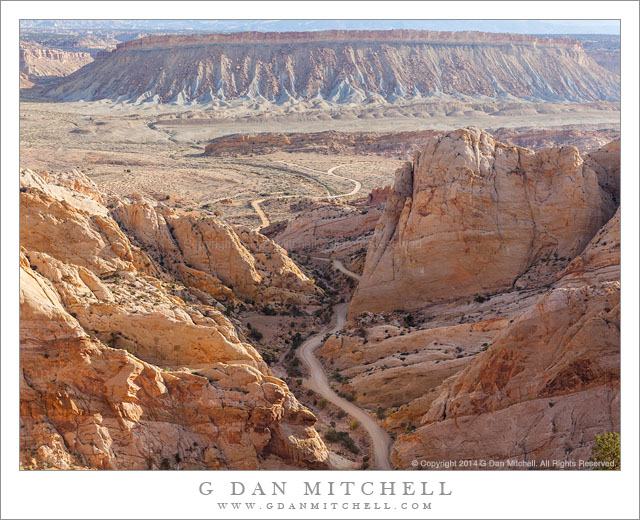
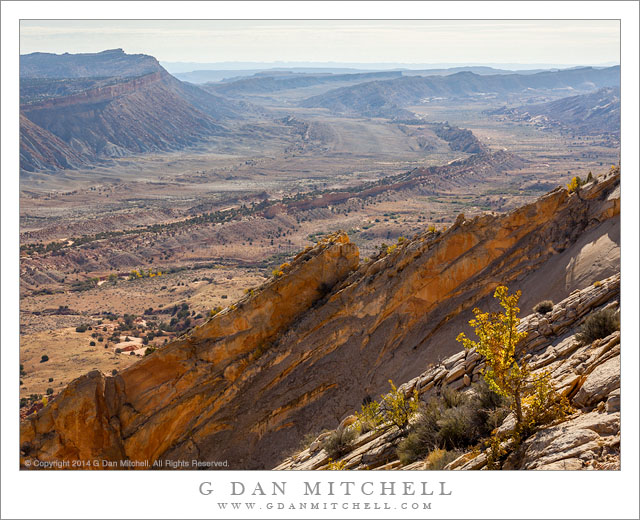
Waterpocket Fold, Utah

Waterpocket Fold, Utah. Capitol Reef National Park, Utah. October 22, 2014. © Copyright 2014 G Dan Mitchell – all rights reserved.

Utah’s Waterpocket fold, viewed from high in the southern part of Capitol Reef National Park

The “Waterpocket Fold” is a gigantic geologic formation in Utah, a good portion of which runs the length of Capitol Reef National Park and beyond. As I understand it, the formation is a monocline, where strata change depth at a fairly steep angle, and subsequent erosion has worn away and exposed these strata in amazing ways, especially where the up-trending layers end. This photograph, made from a high point along the ridge of Capitol Reef, looks south into the waterpocket valley as it bends and continues to head south.

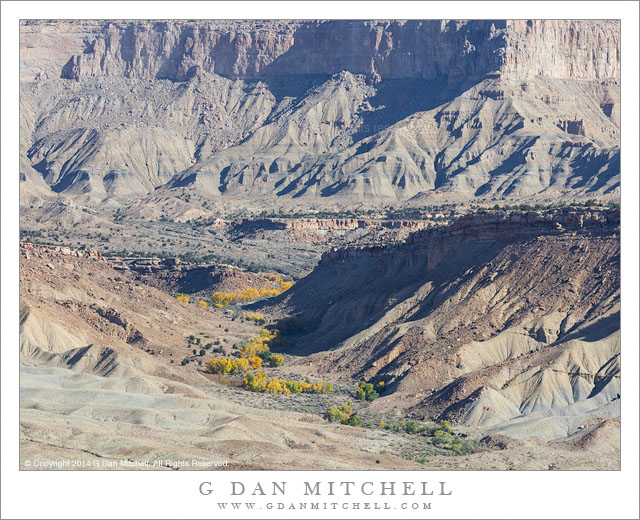
Canyon with Cottonwood Trees

Canyon With Cottonwood Trees. Waterpocket Fold, Utah. October 22, 2014.© Copyright 2014 G Dan Mitchell – all rights reserved.

Cottonwood trees with autumn foliage follow a wash up a canyon toward Waterpocket Fold area cliffs

This photograph looks to the east across the strike valley of the Waterpocket Fold feature from along the ridge of Capitol Reef. A wash (which may be Bitter Creek?) winds away and upwards toward the giant cliffs along the east side of the Valley. The scene illustrates, I think, quite a few common features of this terrain. It is quite arid and rugged — except that along the bottom of the wash, which periodically floods, a long grove of cottonwood trees and other vegetation has taken hold and seems to thrive.


G Dan Mitchell is a California photographer and visual opportunist whose subjects include the Pacific coast, redwood forests, central California oak/grasslands, the Sierra Nevada, California deserts, urban landscapes, night photography, and more.
Blog | About | Flickr | Twitter | FacebookGoogle+ | 500px.com | LinkedIn | Email

Text, photographs, and other media are © Copyright G Dan Mitchell (or others when indicated) and are not in the public domain and may not be used on websites, blogs, or in other media without advance permission from G Dan Mitchell.

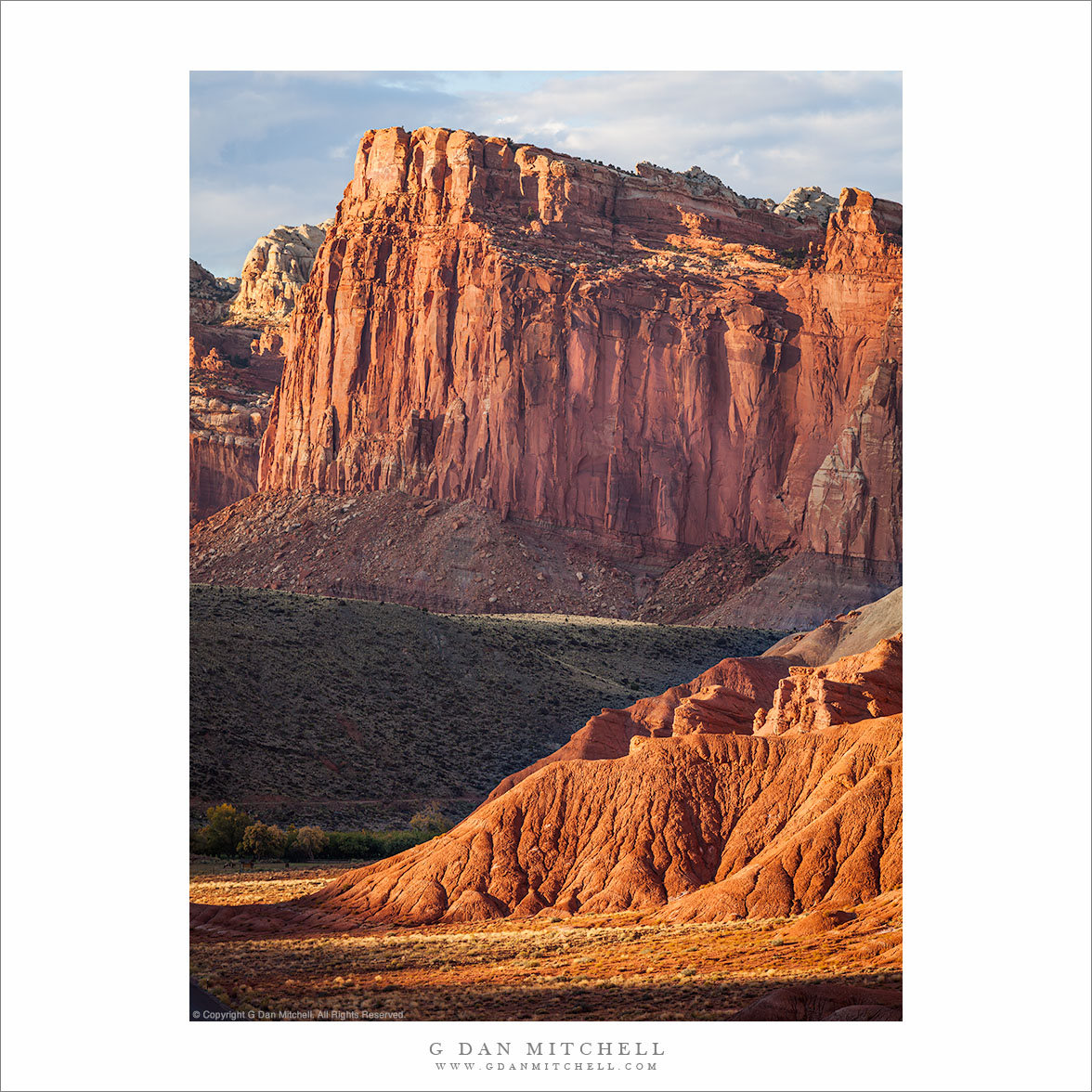
Erosion Gullies, Waterpocket Fold

Erosion Gullies, Waterpocket Fold

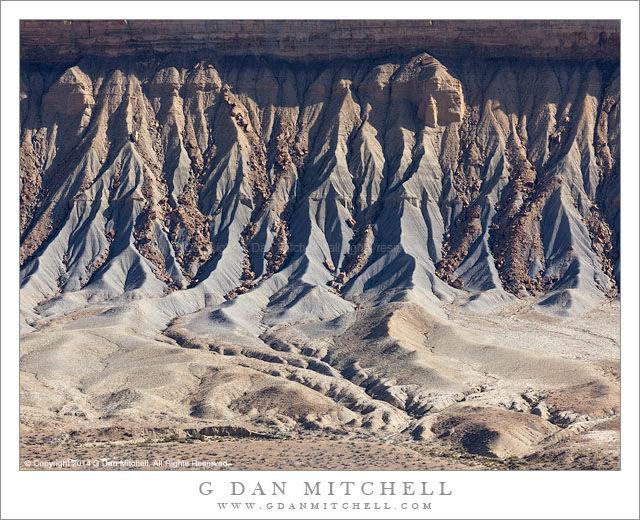
Erosion Gullies, Waterpocket Fold. Capitol Reef National Park, Utah. October 22, 2014. © Copyright 2014 G Dan Mitchell – all rights reserved.

Eroded gullies at the base of cliffs along the east side of the Waterpocket Fold Valley, Utah

The Waterpocket Fold is a huge geological feature of Utah that essentially defines Capitol Reef National Park, creating the deep valley along its east flank, the uplift that created the high ridge that runs the length of the park, and the many exposed edges of rock strata found all over the park. Its westward-trending uplift is also a reason why you may be challenged to get a traditional golden hour spectacular western sky photograph from along the west side of the park — the land continues to trend upward to the west there.

It is easy to overlook the feature if you are within the intimate landscape of many of the popular portions of the park, where you may be more attracted to washes and canyons and trees and nearby cliffs. But if you head down the east side of the park — on a long gravel road — the immensity of this feature becomes very obvious. This photograph was made from a high point in this part of the park, at a location that sits on the edge of this big valley and offers views to the north, east, and south. Here the view is straight across the valley toward the base of the tall ridge on the opposite side, below which there are steep gullies in the material that has eroded from the faces above, a bit of which is visible at the top of the frame.

And, yes, it is a double post day.


G Dan Mitchell is a California photographer and visual opportunist whose subjects include the Pacific coast, redwood forests, central California oak/grasslands, the Sierra Nevada, California deserts, urban landscapes, night photography, and more.
Blog | About | Flickr | Twitter | FacebookGoogle+ | 500px.com | LinkedIn | Email

Text, photographs, and other media are © Copyright G Dan Mitchell (or others when indicated) and are not in the public domain and may not be used on websites, blogs, or in other media without advance permission from G Dan Mitchell.

Gambel Oak Leaves, Autumn

Gambel Oak Leaves, Autumn - Brilliantly colored autumn colors of Gambel Oak leaves, Capitol Reef National Park
Brilliantly colored autumn colors of Gambel Oak leaves, Capitol Reef National Park

Gambel Oak Leaves, Autumn. Capitol Reef National Park, Utah. October 26, 2012. © Copyright 2012 G Dan Mitchell – all rights reserved.

Brilliantly colored autumn colors of Gambel Oak leaves, Capitol Reef National Park

This is a very different view of the autumn gambel oak leaves than another that I recently posted. That other photograph showed the perhaps more typical brown or tan phase of fall oak leaf color. This one, on the other hand, shows a particularly colorful specimen of these leaves, caught at perhaps just the right moment and in the right light in a canyon of Capitol Reef National Park early one late-October morning.

The angle from which you view these leaves matters a lot, as it often does with autumn leaves in general. The nature of the ambient light also makes a big difference. And did I mention the timing!? If you can get a bit of back-light behind the oak leaves, what might otherwise be a bit dull can begin to glow. And the soft, diffused lighting in this deep canyon setting allowed the light to fill in the shadows. These particular specimens possess very interesting color and shape patterns: there is an interior still-green section on many of the leaves that is just beginning to edge towards yellow-gold, and it is surrounded by brilliantly red and orange leaf edges. When I shoot in deep shade – and these plants were deep in the shade of this small canyon – I often find that the photograph seems unnaturally blue, given that most of the light is either direct or reflected blue sky. In most cases, in order to get a color balance that reflects what the eye saw – and our visual system compensates for the blue saturation – I have to alter the color balance a bit and move it away from this artificial-seeming blueness. However, in this case, if I adjusted far enough to neutralize the blue that you can still see on the more-or-less gray branches and twigs, the color of the leaves would probably defy belief!

G Dan Mitchell is a California photographer whose subjects include the Pacific coast, redwood forests, central California oak/grasslands, the Sierra Nevada, California deserts, urban landscapes, night photography, and more.
Blog | About | Flickr | Twitter | FacebookGoogle+ | 500px.com | LinkedIn | Email

Text, photographs, and other media are © Copyright G Dan Mitchell (or others when indicated) and are not in the public domain and may not be used on websites, blogs, or in other media without advance permission from G Dan Mitchell.

Juniper Tree, Towers at Base of Sandstone Cliff, Evening

Juniper Tree, Towers at Base of Sandstone Cliff, Evening
“Juniper Tree, Towers at Base of Sandstone Cliff, Evening” —A lone juniper tree grows among boulders at below sandstone towers at the base of cliffs, Capitol Reef National Park

I made this photograph midway through a trip of about 11 days that took us to a number of locations in Utah. Every such trip seems to have a sort of arc that includes the initial excitement and expectation of heading out into the world to photograph, a settling in period, perhaps a lull in the middle followed by a reconnection to the work, a sense that the trip is ending and there is too much left to do, and the final trip back to the “real world.” This photograph was made near the end of the “lull,” and might have marked the transition back to rededication to the work. On this mid-trip day, we had found ourselves perhaps a bit without direction and one of the members of the group had not been feeling well. At a low point in our energy but perhaps feeling that we should at least carry on and act like we were working, we went to a nearby area of the park in the evening.

At first we had no clear goal in mind, though we sort of stopped and looked around at a few spots, but without really making any serious photographs. Eventually we headed up into a large canyon, first photographing the walls near the start of the canyon and then photographing the canyon itself a bit as the light began to fade. This work went OK, but it didn’t seem to be quite “clicking.” But eventually, in my experience, you get to the point where you sometimes simply accept this as part of the work, trusting that if you keep looking and keep seeing you will eventually find what you are looking for – and that this is far more productive and useful than packing it up when it isn’t working. (Though, to be fair, there are a few times when packing it up and going and having a nice dinner can be a reasonable option!) In any case, we loaded up the vehicle and began to drive back out of the canyon. Looking up at the surrounding canyon walls, we were surprised to find some very unusual post-sunset light. During normal light these canyon walls look very dark and have the intensely “red” quality of the iconic Utah sandstone. But somehow this light seemed to have drained the color from the rocks, creating a de-saturated and almost slightly metallic effect. We quickly stopped an piled out with cameras and tripods and began shooting, and it seemed to me that the connection had been made once again.


Leave a comment or question using the form. (If you are reading this on the home page, click the article title to see the full article and the comment form.

G Dan Mitchell is a California photographer and visual opportunist. His book, “California’s Fall Color: A Photographer’s Guide to Autumn in the Sierra” (Heyday Books) is available directly from him. Blog | Bluesky | Mastodon | Substack Notes | Flickr | Email

All media © Copyright G Dan Mitchell and others.