
Tag Archives: erosion

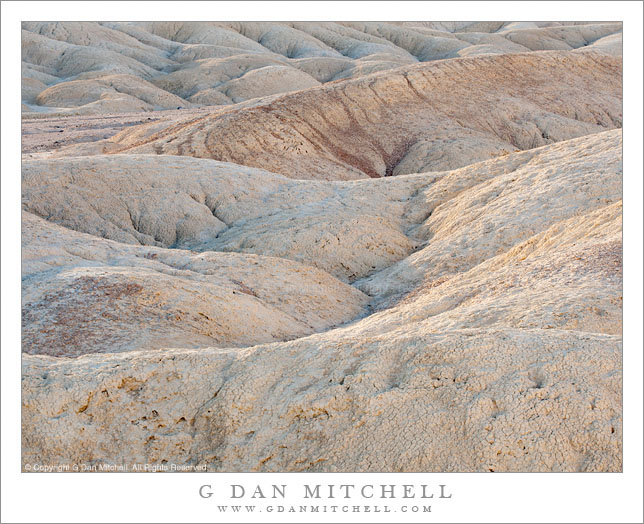
Hills and Gullies, Twenty Mule Team Canyon

Hills and Gullies, Twenty Mule Team Canyon

Hills and Gullies, Twenty Mule Team Canyon. Death Valley National Park, California. April 2, 2009 © Copyright 2009 G Dan Mitchell – all rights reserved.

Morning light across the shapes of hills and gullies, Twenty Mule Team Canyon, Death Valley National Park.

This is a photograph I made back in 2009 when I managed to get to Twenty Mule Team Canyon before sunrise and then continued to shoot for several hours. Though this area is very close to one of the most popular and oft-photographed locations in Death Valley National Park, it gets relatively few visitors from what I’ve seen. While it doesn’t generally present the huge and expansive vistas of some of the more famous areas, it is a great playground for those of us who enjoy the eroded and rounded landforms and the seemingly infinite variations of color and texture.

Here I tried to fill the frame completely with these shapes that have been produced by water eroding the relatively soft earth. The light was very interesting and a bit complex. Some diffused light was coming straight down from the sky, hence the bits of blue shadow in some of the gullies. At the same time, slightly diffused sunlight was directly striking the earth in a few spots. And in some of the foreground areas additional illumination was being reflected into the scene from nearby formations.

G Dan Mitchell Photography
About | Flickr | Twitter | FacebookGoogle+ | 500px.com | LinkedIn | Email

Text, photographs, and other media are © Copyright G Dan Mitchell (or others when indicated) and are not in the public domain and may not be used on websites, blogs, or in other media without advance permission from G Dan Mitchell.

(Basic EXIF data may be available by “mousing over” large images in posts when this page is viewed on the web. Leave a comment if you want to know more.)
Tree in Granite Bowl, Sunset

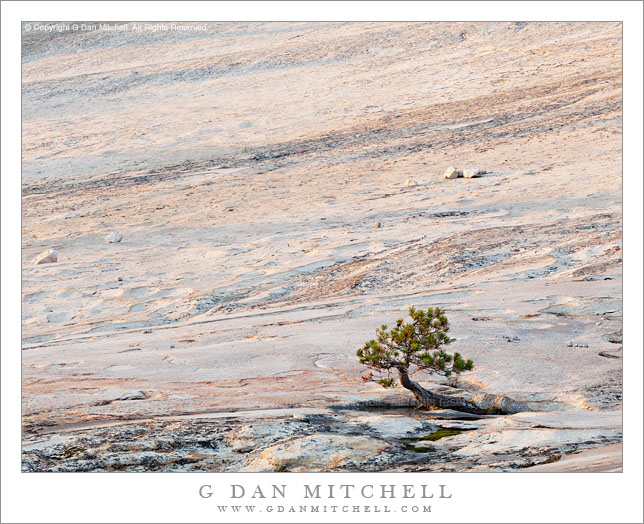
Tree in Granite Bowl, Sunset

Tree in Granite Bowl, Sunset. Yosemite National Park, California. September 15, 2011. © Copyright 2011 G Dan Mitchell – all rights reserved.

A small tree near the base of a granite bowl is illuminated by sunset light, Yosemite National Park.

I made this photograph in an area alongside the Tuolumne River where large expanses of granite slabs tilt down almost to the river itself. This is a wonderful place for photography: subjects here include everything from the river itself to the granite and the trees and other plants, the light ranges from colorful light reflected from nearby cliffs to sunset and sunrise light to the soft pre-sunrise and post-sunset light.

I had been photographing some larger trees and some trees and plants growing from narrow cracks in the solid rock, but as the sun dropped to near the horizon and the light’s color warmed, I moved over to an area where a line of larger trees marches up the slope between two expanses of granite. From here I spotted this small and stunted tree growing out of nearly solid rock and with a background of curving granite slabs occasionally interrupted by the odd boulder. The photograph was made in just about the very last light of the evening is it slanted across the rocky scene, and the “golden hour” light intensified the subtle colors of the rocks.

G Dan Mitchell Photography
About | Flickr | Twitter | FacebookGoogle+ | 500px.com | LinkedIn | Email

Text, photographs, and other media are © Copyright G Dan Mitchell (or others when indicated) and are not in the public domain and may not be used on websites, blogs, or in other media without advance permission from G Dan Mitchell.

(Basic EXIF data may be available by “mousing over” large images in posts when this page is viewed on the web. Leave a comment if you want to know more.)
Eroded Gullies at Zabriskie Point, Morning

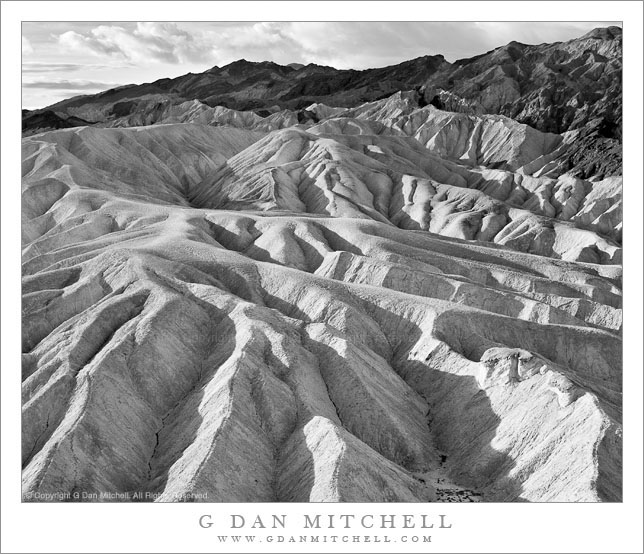
Eroded Gullies at Zabriskie Point, Morning

Eroded Gullies at Zabriskie Point, Morning. Death Valley National Park, California. April 6, 2006. © Copyright 2011 G Dan Mitchell – all rights reserved.

Low angle morning light illuminates a tortured landscape of eroded gullies at Zabriskie Point, Death Valley National Park.

I recently “rediscovered” this photograph while undertaking a major review of the past eight years of my raw files. (And, yes, that task is just about as much fun as you might imagine. It would actually be pretty unbearable except that every so often I find some photographs that I had perhaps forgotten or overlooked, and I also come across images that remind me of experiences that took place some time ago.)

This photograph was made, as virtually anyone who has visited the spot recognizes, by pointing my camera about 90 degrees to the left of the classic Zabriskie Point views. Timing was important, as the early light is just skimming across the tops of these tortuously eroded gullies, picking out the ridges between them but leaving the lower sections in shadow. But good fortune also played a role here. Death Valley is usually a clear blue sky kind of place, but on this morning I had clouds! At dawn, if I recall correctly, the clouds actually interfered with the light a bit. But as the sun rose the clouds provided a more dramatic background than plain blue sky and created some softer and diffused light that gave just the right sort of dynamic range for photographs.

On a technical note, if you are viewing this in the right web browser you can mouse over the image and see a summary of basic EXIF data. (Sorry, but this feature only works in web browsers – if you are viewing email, etc. you’ll need to visit the version at my blog to see the EXIF.) If you do check the EXIF you might notice that this photograph was made with a very humble example of photographic technology, the Canon Digital Rebel XT. This camera is a 8MP cropped sensor “consumer” camera that I acquired when I first tested the waters of DSLR photography. (I had actually used digital cameras back in the 1990s, but not for serious photographic work.) Those who wonder which of today’s current DSLRs might enable them to produce interesting and effective images might consider what could be done with such a humble camera. ;-)

G Dan Mitchell Photography
About | Flickr | Twitter | FacebookGoogle+ | 500px.com | LinkedIn | Email

Text, photographs, and other media are © Copyright G Dan Mitchell (or others when indicated) and are not in the public domain and may not be used on websites, blogs, or in other media without advance permission from G Dan Mitchell.

(Basic EXIF data may be available by “mousing over” large images in posts. Leave a comment if you want to know more.)

Desert Wash at Base of Tucki Mountain, Dusk

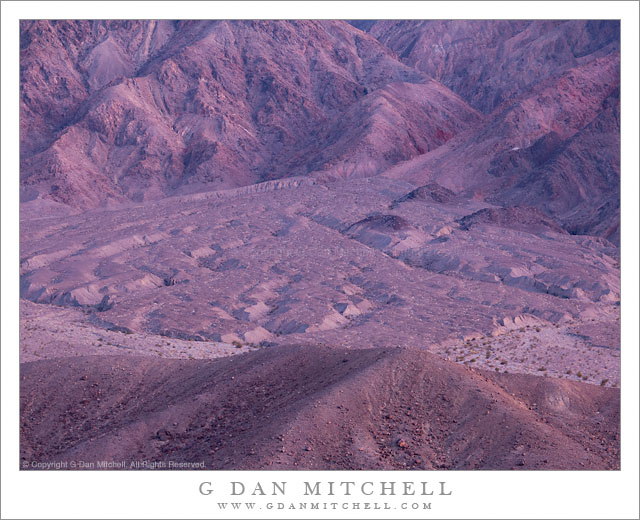
Desert Wash at Base of Tucki Mountain, Dusk

Desert Wash at Base of Tucki Mountain, Dusk. Death Valley National Park, California. March 29, 2011. © Copyright G Dan Mitchell – all rights reserved.

Soft rose-colored dusk light illuminates an alluvial fan below a canyon at the base of Tucki Mountain, Death Valley National Park.

This is one of several photographs from the recent Death Valley trip that beg the question, “Is that color real?!”*

Yes, this really is the color of the light from this scene.

I learned quite a while ago that the interesting light most definitely does not end at sunset – often the best and most interesting light comes after the sun has set. Sunset on this evening had been quite interesting, but a few minutes after the sun set the last brilliant red light struck high clouds overhead and lit up the entire scene with this lurid and intense wash of color.

The scene is a large desert gravel wash where a drainage canyon spills out into Death Valley at the base of Tucki Mountain and forms a huge alluvial fan. I had climbed to the top of a low hill to shoot late afternoon and sunset light, so I had a good vantage point to view this wash beyond intervening hills. Tucki Mountain itself is a massive lump of a mountain that rises above Stovepipe Wells – what it lacks in terms of an impressive and jagged summit peak in makes up for by means of its sheer bulk. It constitutes a large spur off of the Panamint Range and almost seems like a small sub-range all by itself.

*After I originally wrote the text to this post I made a 12″ x 16″ test print of this photograph. As I often do, I put the print out on a table in our living room so that I can see it in a context other than that of my small studio. My wife, who is a very perceptive viewer and who has seen the results of, uh, printer errors (for real fun, print on the back side of your paper by accident some time…) looked at these colors and said, “Is something wrong with your printer?” Ah, I love critics! ;-)

G Dan Mitchell Photography | Flickr | Twitter | Facebook | Email
Text, photographs, and other media are © Copyright G Dan Mitchell (or others when indicated) and are not in the public domain and may not be used on websites, blogs, or in other media without advance permission from G Dan Mitchell.