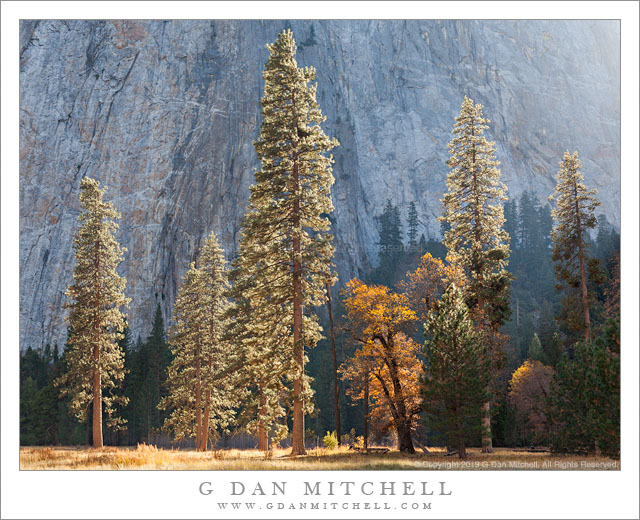
The immense granite face of Cathedral Rocks looms behind trees of El Capitan Meadow in autumn afternoon light
This meadow, located between two of the largest cliffs in Yosemite Valley, is both an obvious place to make photographs – everyone does it – and a place of nearly infinite variations of light, season, and atmosphere. Sometimes when I’m in the Valley I may stop here two or three times during the day. As is the case in other spots in Yosemite Valley, the place changes radically depending upon what the light is doing – soft early morning or evening light, strong light coming down the Valley in the early morning, light blocked by cliffs at midday, strong backlight in the late afternoon. And many of these changes happen very rapidly. As I made this photograph I could virtually watch the shadow move over the trees from the right.
The granite face rising beyond this meadow – one of the two I mentioned above – has always attracted me for some reason. Although not as high as the much more famous El Capitan, in some ways it seems to me to look more forbidding. It seems to lack the obvious crack systems seen on El Capitan, and unlike the larger wall, which is often bathed in sun, this one is often in shadow. In winter it casts a shadow across this portion of the Valley in the middle of the day, though a low spot may allow a beam of light to sweep across this area in the late afternoon.
G Dan Mitchell is a California photographer and visual opportunist whose subjects include the Pacific coast, redwood forests, central California oak/grasslands, the Sierra Nevada, California deserts, urban landscapes, night photography, and more. Blog | About | Flickr | Twitter | Facebook | Google+ | 500px.com | LinkedIn | Email
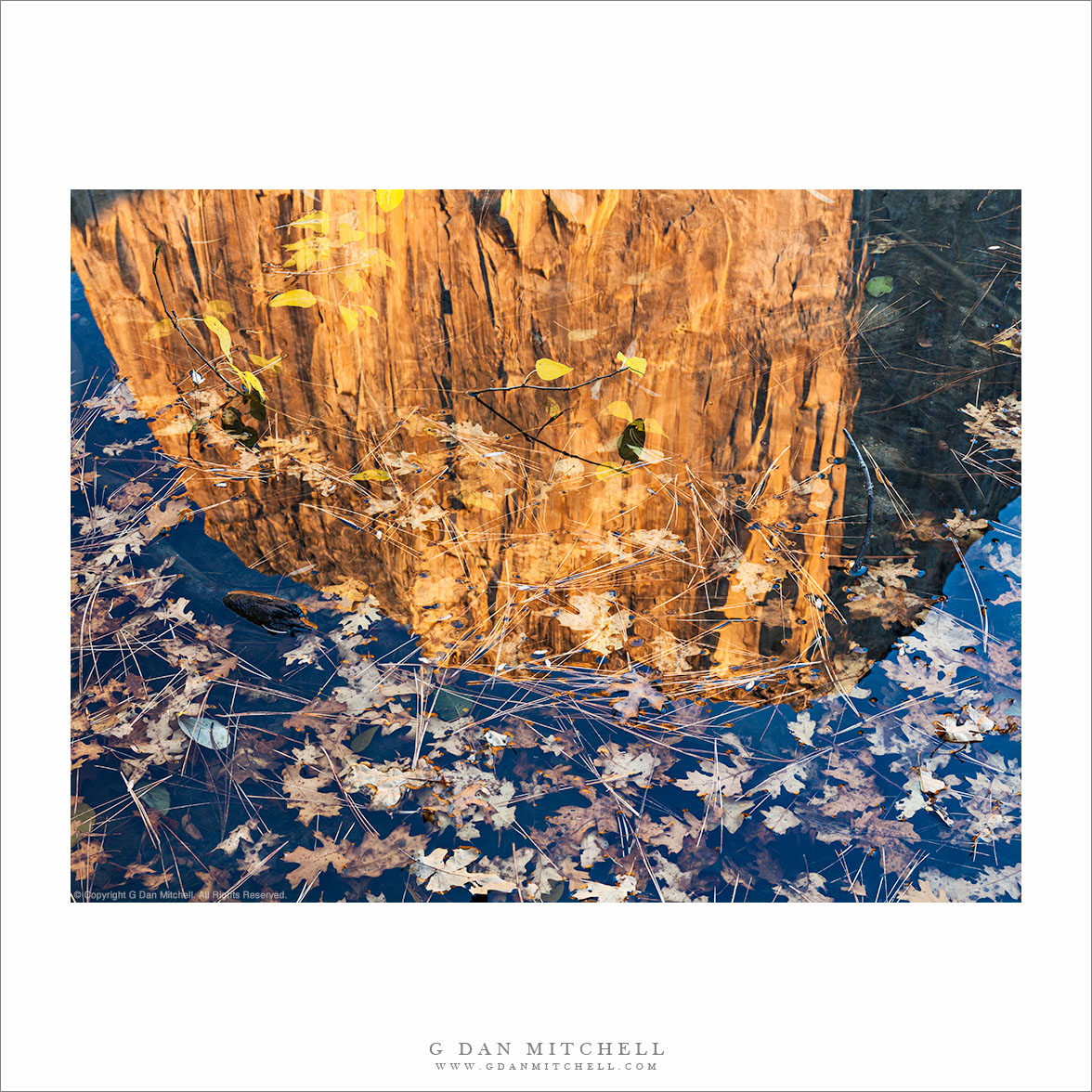
“Autumn Leaves, Reflection of a Monolith” — The face of El Capitan is reflected in the surface of a autumn leaf-filled pool along the Merced River
A book could be written about this photograph, but I promise to keep it shorter than that. The book would include chapters on the role of luck in photography, the importance of patience, knowing places well, looking at things other than the most obvious, not forgetting to look at the obvious as well, the pleasure of finding like-minded friends in such places, the importance of wandering around slowly, and more.
Every autumn, right around the end of October, I like to go to Yosemite Valley to photograph fall subjects. This mostly means the fall colors of cottonwoods, black oaks, big leaf maples, and dogwood trees – though it also includes the beautiful brown, rust, golden, and tan colors of autumn meadows. It also includes the magical fall light of the Sierra. I’ve never been able to quite put my finger on just what it is that makes this light so special, but I am certain that it is different. When the timing works out just right – as it did on this visit – the first snows of the season might have fallen, and there will be at least a dusting along the rim of the Valley. The Valley slows down in other ways at this time of year, too. The visitors to the Valley are different. There are fewer in general, and especially there are fewer of those who might seem to be checking another goal off the list, and more who genuinely know and love the place. Only the committed – or the poor and RV owners – stay in campgrounds, so you can just show up and get a camp site. Interestingly, although there are far fewer people, I’m much more likely to run into folks I know, which seems to be one of the special pleasures of this recent visit.
As I photographed during this trip, I more or less followed the light and my intuition around the Valley. I might get an idea to go shoot some subject, and along the way I would find something else worth shooting… and many other things worth remembering for a later visit. One of the things on the mental list was a single isolated dogwood tree sitting back in a dark section of forest off to the side of the roadway. I passed it several times, each time thinking about coming back and photographing it, and I finally made it there late on my final day in the Valley. I parked – and no one else at all was around – picked up my gear and walked off into the woods. This light in the shadows along the base of the Valley cliffs changes very slowly, so there was no hurry to make a photograph before light went away and I just poked about slowly, looking at the tree from various angles and considering other subjects in the area. I made a few photographs, and just as I finished a car pulled up and I saw that it belonged to a couple of friends.
I wandered back over that way and after the requisite wise cracks and good-natured insults we realized that all three of us had the same idea to photograph on the other side of the road among trees along the river bank. So, still moving at a relaxed pace and talking as we walked, we headed off towards the river through trees and brush. Along the shoreline I came to a spot where a few leaves littered the surface of the water in a tiny, still cove along the edge of the river. This familiar granite monolith stands not far away, and I found that I could, if I put tripod feet in the water, get both the leaves and its reflection in the frame. I made a few photographs and then wandered off to photograph leaves and grass and some trees and more of the river. Eventually, the light began to fail, and I climbed a small hill and started back to my car through the trees. I happened to look up – yes, sometimes I forget to look up for a moment – and saw that the intense sunset light was striking the granite… and it occurred to me that I might just barely have time to get back to that spot where I had photographed earlier and put those leaves into the reflection of this transformed scene. Fortunately, I knew exactly what lens to use, what aperture to set, and where to locate the tripod, so I could move quickly and efficiently to make the photograph before shadow rose from the bottom of the cliff.
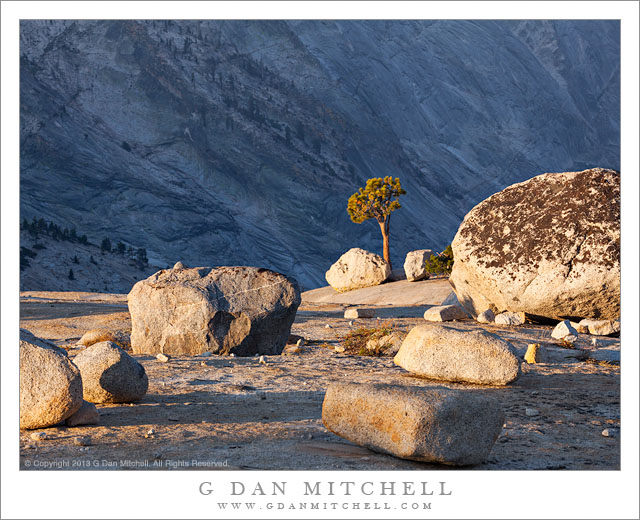
A solitary tree stands on granite slabs among glacial erratic boulders against the dark background of a granite face in shadow
I have previously posted a few photographs from this early August four-day shoot in Yosemite, when I ranged between about Olmsted Point and Mono Lake for about four days. The photography was a bit strange compared to more normal years – there was smoke in the air from a fire near Mammoth Lakes and there was not much water due to the drought afflicting the mountains after a second very dry winter. So some of my photography instincts may have been challenged a bit, and I had to adapt to conditions – sometimes ending up shooting in a different place than planned when the haze was too thick, sometimes using the haze as part of the photograph, and also ranging a bit more widely than I might usually do.
On this morning I had decided to “work” that area between roughly Tenaya Lake and some rocky slabs a bit past Olmsted Point. I began at Tenaya just before sunrise, but the smoke haze was making things difficult. I made a few photographs along the curving shore as the first sun hit nearby ridges, but I wasn’t especially happy with the atmosphere or the color and quality of the light so I moved on. The slabs and domes along the road to the west of Tenaya Lake, which track the road for some distance and spread well beyond the road itself, have been an ongoing subject of interest to me. While the sun had hit the highest peaks by the time I got there, it had not quite worked its way down to these slabs, so I found some likely groups of glacial erratic boulders and various small trees and made some photographs. In this one, a single tree stands beyond a group of large boulders that had just been hit by the first light, and across a nearby canyon large granite walls are still in shadow.
G Dan Mitchell is a California photographer and visual opportunist whose subjects include the Pacific coast, redwood forests, central California oak/grasslands, the Sierra Nevada, California deserts, urban landscapes, night photography, and more. Blog | About | Flickr | Twitter | Facebook | Google+ | 500px.com | LinkedIn | Email
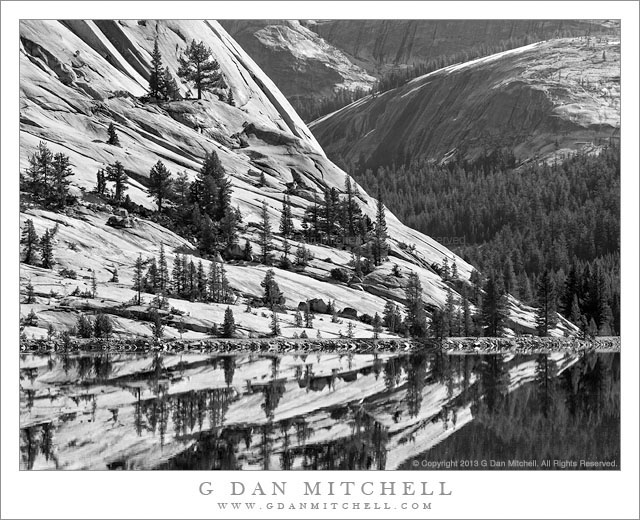
Granite slabs rise above the reflected shoreline of Tenaya Lake, Yosemite National Park
I woke up on this morning in Yosemite Valley, car camping (as in “camping in the back of my car”) so that I could rise well before dawn, get out of the Valley, and drive over Tioga Pass in the morning light on this first weekend during which the road was open. It had actually opened the previous day, and I had made a ritual midday “first of the season” drive to the pass, but it was in light that was less than inspiring – hence my return at an earlier hour this next morning. It was dark when I left the Valley and the sky began to lighten as I headed up toward highway 120 and the trans-Sierra route.
I stopped along the way in the very early light to photograph lakes and rocks and trees and granite, and by the time I arrived at the shoreline of Tenaya Lake I felt like the light was going. However, the stillness of the water and the slight atmospheric recession produced by morning haze caught my attention and I pulled over. The main draw for me in this composition and a few other similar ones that I did at the same time was the reflection of the sunlit granite slabs ascending from the far shoreline. I also wanted to contrast that hard and bright surface with the softer and darker patterns of the forest beyond and the shaded faces above the forest.
G Dan Mitchell is a California photographer and visual opportunist whose subjects include the Pacific coast, redwood forests, central California oak/grasslands, the Sierra Nevada, California deserts, urban landscapes, night photography, and more. Blog | About | Flickr | Twitter | Facebook | Google+ | 500px.com | LinkedIn | Email
Photographer and visual opportunist. Daily photos since 2005, plus articles, reviews, news, and ideas.
Manage Consent
To provide the best experiences, we use technologies like cookies to store and/or access device information. Consenting to these technologies will allow us to process data such as browsing behavior or unique IDs on this site. Not consenting or withdrawing consent, may adversely affect certain features and functions.
Functional
Always active
The technical storage or access is strictly necessary for the legitimate purpose of enabling the use of a specific service explicitly requested by the subscriber or user, or for the sole purpose of carrying out the transmission of a communication over an electronic communications network.
Preferences
The technical storage or access is necessary for the legitimate purpose of storing preferences that are not requested by the subscriber or user.
Statistics
The technical storage or access that is used exclusively for statistical purposes.The technical storage or access that is used exclusively for anonymous statistical purposes. Without a subpoena, voluntary compliance on the part of your Internet Service Provider, or additional records from a third party, information stored or retrieved for this purpose alone cannot usually be used to identify you.
Marketing
The technical storage or access is required to create user profiles to send advertising, or to track the user on a website or across several websites for similar marketing purposes.

 G Dan Mitchell is a California photographer and visual opportunist whose subjects include the Pacific coast, redwood forests, central California oak/grasslands, the Sierra Nevada, California deserts, urban landscapes, night photography, and more.