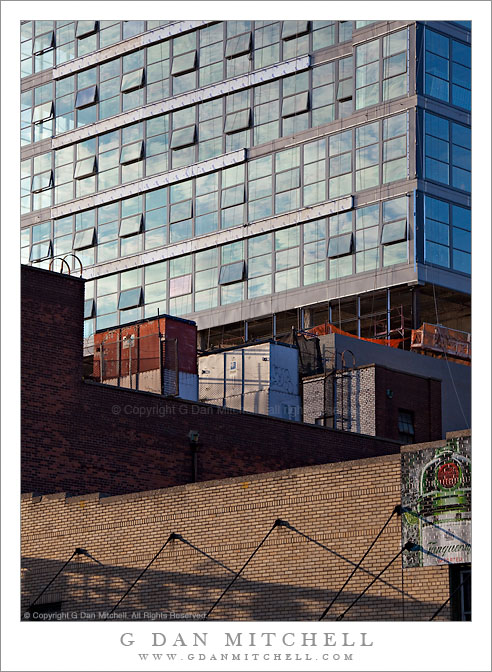
Brick walls and a building under construction above the High Line Elevated Park, New York City.
Another bit of architecture photographed from the High Line Elevated Park in Chelsea on a summer evening in August. The most interesting features of this evening included the “mackerel sky” clouds to the west, which are reflected in the windows of the upper building, and the warm light of early evening. The juxtapositions of angles and textures (especially the bricks and the glass windows) got my attention as we walked along the High Line. I cannot identify the building, but it appears to be under construction.
This photograph is not in the public domain and may not be used on websites, blogs, or in other media without advance permission from G Dan Mitchell.
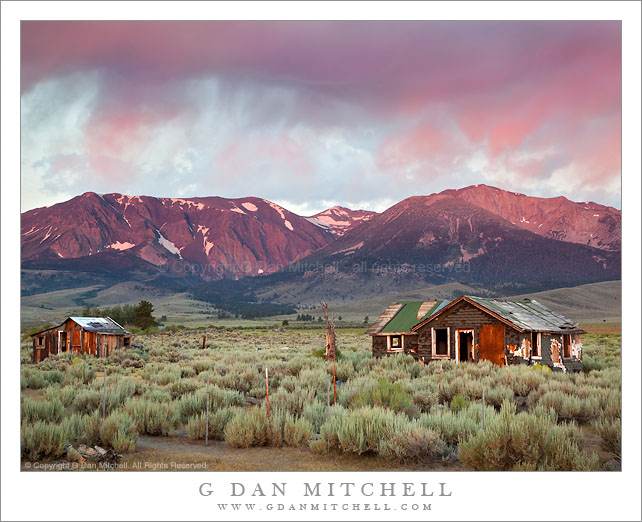
Blood-red dawn light illuminates eastern Sierra Nevada peaks of Yosemite National Park and morning clouds above abandoned high desert cabins in the sage brush along highway 395.
Many who travel the eastern Sierra on highway 395 have no doubt seen these two abandoned buildings along the highway not far from Lee Vining, set against the background of the Sierra’s eastern escarpment along the border of Yosemite National Park. I’ve noticed them for years and have tried to photograph them a few times in the past.
On this late-July morning I had gotten up very early at my Tuolumne Meadows camp site and decided that there might be enough interesting clouds to warrant a trip down to the South Tufa area of Mono Lake for a sunrise shoot. However, I apparently didn’t get up quite early enough (actually, I miscalculated the time of dawn) since the sun began to rise above the horizon just before I turned east from 395 onto 120 to get to the lake. For a moment I vacillated – should I hurry on to get to Mono as soon after sunrise as possible (since the light gets there a few minutes later) or shoot whatever I could see right then and there? The intense red light made the decision for me and I quickly pulled over near these buildings and made a few exposures as the saturated and very red morning light hit the mountains and the clouds.
This photograph is not in the public domain and may not be used on websites, blogs, or in other media without advance permission from G Dan Mitchell.
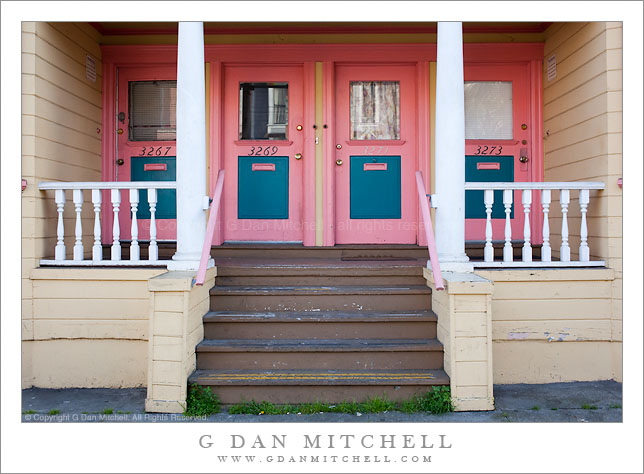
Four pink apartment doors with steps and white columns in the Mission District, San Francisco, California.
Walking in an area like the Mission District, I begin to see many things that would otherwise completely escape my notice. Although I’m sure I’ve seen them before, I recently became away of the prevalence of these building entrances with rows of four nearly identical doorways – this must have been some sort of common building design in San Francisco at some point. Here, as is also fairly common, the colors chosen for the paint were a bit unusual.
This photograph is not in the public domain and may not be used on websites, blogs, or in other media without advance permission from G Dan Mitchell.
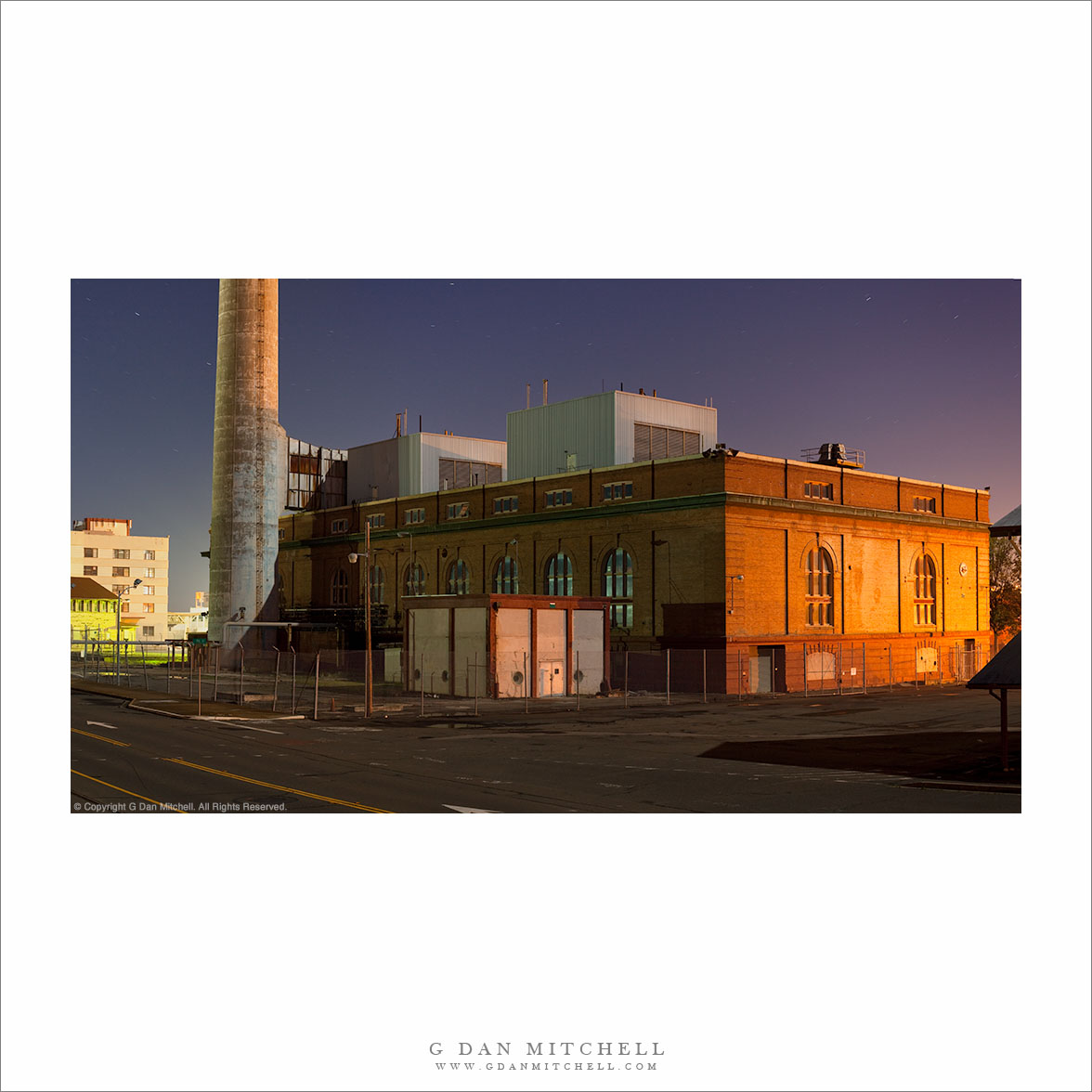
“Powerplant, Mare Island Naval Shipyard” — Power Plant building and other structures along Railroad Avenue at the historic Mare Island Naval Shipyard, Vallejo, California.
(Note: This post has been updated to include a newer interpretation of this photograph, as seen above. The original is also included later in this post.)
This is a bit of a first for me – a night photography stitched panorama. This image is composed of two separate exposures which were aligned and “stitched” into a single image in post. (As such, it could be a very large print!) Shooting from an elevated position, I shot almost directly north (as you can tell from the star trails in the larger version). The view looks up Railroad Avenue past the iconic power plant building with its smokestack that is visible from all over Mare Island.
I’m usually a bit casual about exposure time with long exposure night photographs. It isn’t that I don’t care – it is just that one has a ton of leeway when it comes to the very long exposures I typically use. For example, on a 3 minute exposure you would have to be off by three minutes to overexpose by one stop! So rather than use a stopwatch or an automatic timer I just count to myself. I’m usually will within a 10% error, and that is good enough. However, when stitching “good enough” often isn’t. The separate component frames really need to be quite similar, so in this case I resorted to using my watch to get relatively accurate 90 second exposures.
Another interesting factor in night photography is illustrated in this photo, namely the wildly varied colors of the light sources we deal with. There are three dominant sources in this image. The overall illumination comes from the full moon, which is quite similar to day light in terms of white balance. On the near wall of the brick power plant there is very “hot” and saturated yellow/red tinted light, probably from sodium vapor lamps. Near the left end of the image is an old wooden building that is illuminated by very green light, which I believe comes from mercury vapor lamps. I often chuckle a bit when people speak of “white balancing” the color in a scene like this. If you pick one source for your white balance you’ll throw the others even more out of line. My philosophy is usually to just go with what looks right!
Finally, the idea of making the stitched panorama came from the recently started Panocturnists web site, begun by people connected with The Nocturnes, the San Francisco Bay Area night photography group. I was intrigued by the idea of creating panoramic night photography, and I’ve done a few images along these lines on my two most recent visits to Mare Island.
(The photograph used in the original version of this post appears below.)
Photographer and visual opportunist. Daily photos since 2005, plus articles, reviews, news, and ideas.
Manage Consent
To provide the best experiences, we use technologies like cookies to store and/or access device information. Consenting to these technologies will allow us to process data such as browsing behavior or unique IDs on this site. Not consenting or withdrawing consent, may adversely affect certain features and functions.
Functional
Always active
The technical storage or access is strictly necessary for the legitimate purpose of enabling the use of a specific service explicitly requested by the subscriber or user, or for the sole purpose of carrying out the transmission of a communication over an electronic communications network.
Preferences
The technical storage or access is necessary for the legitimate purpose of storing preferences that are not requested by the subscriber or user.
Statistics
The technical storage or access that is used exclusively for statistical purposes.The technical storage or access that is used exclusively for anonymous statistical purposes. Without a subpoena, voluntary compliance on the part of your Internet Service Provider, or additional records from a third party, information stored or retrieved for this purpose alone cannot usually be used to identify you.
Marketing
The technical storage or access is required to create user profiles to send advertising, or to track the user on a website or across several websites for similar marketing purposes.