Tag Archives: flats

Salt Flat Reflections

Salt Flat Reflections, Death Valley
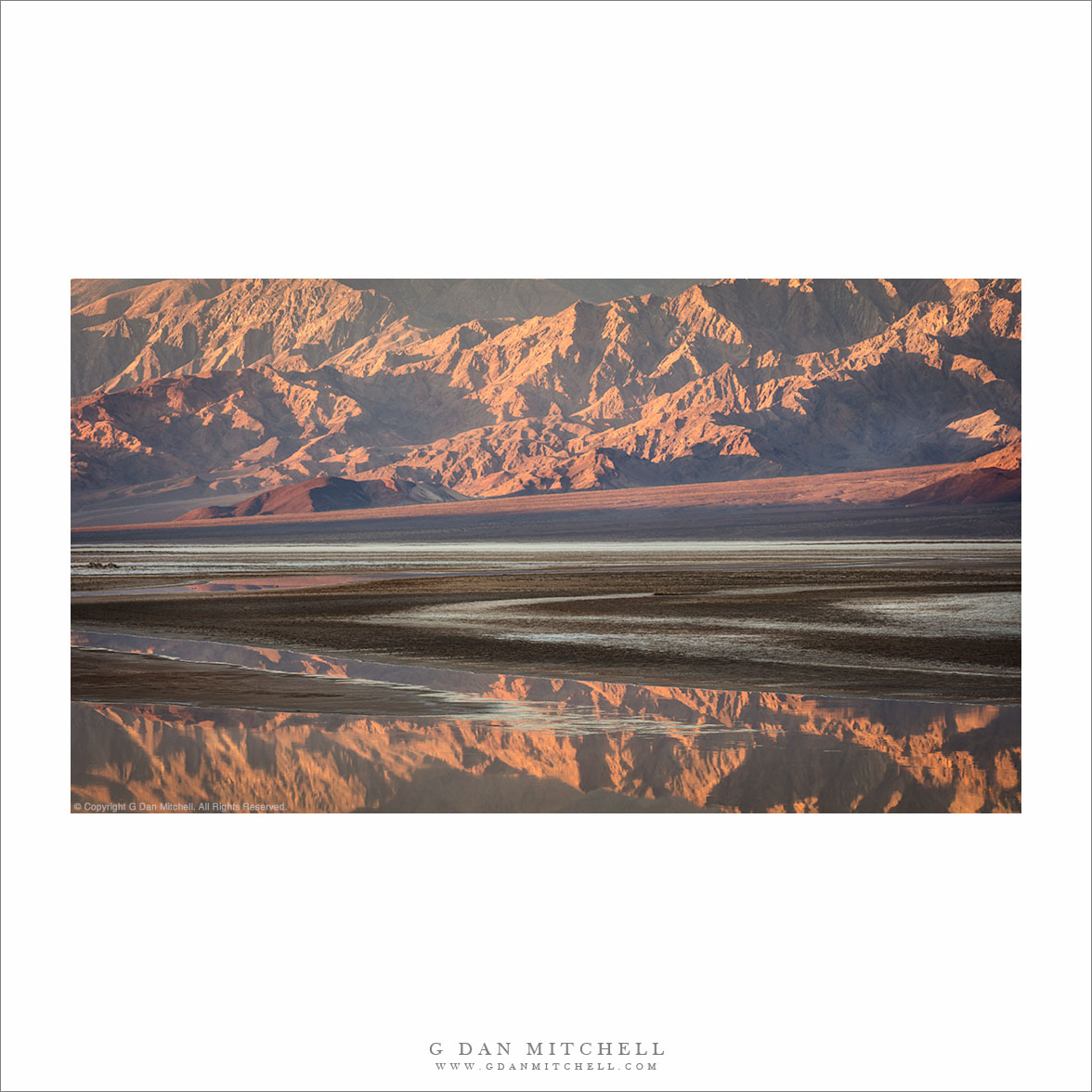
“Salt Flat Reflections” — The lower slopes of the Panamint Mountains are reflected in shallow water on Death Valley salt flats.

The experience of making this photograph was perhaps as enjoyable as the scene itself. I was up very early and walked out to the edge of the salt flat a bit more than a half hour before sunrise. From earlier scouting I had a pretty good idea of where I wanted to be. Out there next to the playa it was utterly silent and still, and I was the only person there to witness the morning light coming to the Panamint Range and then the valley.

It may seem counterintuitive to go to Death Valley to photograph a mountain range reflected in still water. But out in the valley, a good distance from the roadways, there is essentially always water. It may be in pools and slowly evaporating or, as here, it flows slowly all year long. The water in the photo is probably less than an inch deep, but that’s enough to produce a fine reflection.

G Dan Mitchell is a California photographer and visual opportunist. His book, “California’s Fall Color: A Photographer’s Guide to Autumn in the Sierra” (Heyday Books) is available directly from him. Blog | Bluesky | Mastodon | Substack Notes | Flickr | Email

Join the discussion — you are welcome to leave a comment or question. (Comments are moderated and may not appear immediately.)

This site uses Akismet to reduce spam. Learn how your comment data is processed.

(All media © Copyright G Dan Mitchell and others.)

At the Edge of the Salt Flats

At the Edge of the Salt Flats, Death Valley National Park.
“At the Edge of the Salt Flats” — Panamint mountains tower above as a small wash runs to the edge of the salt flats, Death Valley.

During my late-February visit to Death Valley National Park I spent two early mornings photographing this location. It is generally most interesting at dawn, when the morning light shines on the distant Panamint Mountains, so I was there well before sunrise. In order to find ideal locations here you really have to scout ahead of time. On the first of the two visits I slightly missed my target location in the darkness. I still got photographs, but before my return on the last morning of my trip, I checked it one more time and determined that following this runoff gully would get me where I needed to be.

There was another benefit from following the little gully. The soil on the higher ground to either side is quite soft and walking on it leaves obvious footprints. In many places the bottom of the gully is covered with small rocks, and it is easier (on me and the landscape1) to walk on this harder surface. Distances here are deceiving. If you started at sunrise (and could find a route) it would take you an entire, long day just to get the base of those mountains.


G Dan Mitchell is a California photographer and visual opportunist. His book, “California’s Fall Color: A Photographer’s Guide to Autumn in the Sierra” (Heyday Books) is available directly from him.

G Dan Mitchell: Blog | Bluesky | Mastodon | Substack Notes | Flickr | Email


All media © Copyright G Dan Mitchell and others as indicated. Any use requires advance permission from G Dan Mitchell.

Salt Flats to Mountain Peaks

Salt Flats to Mountain Peaks, Death Valley
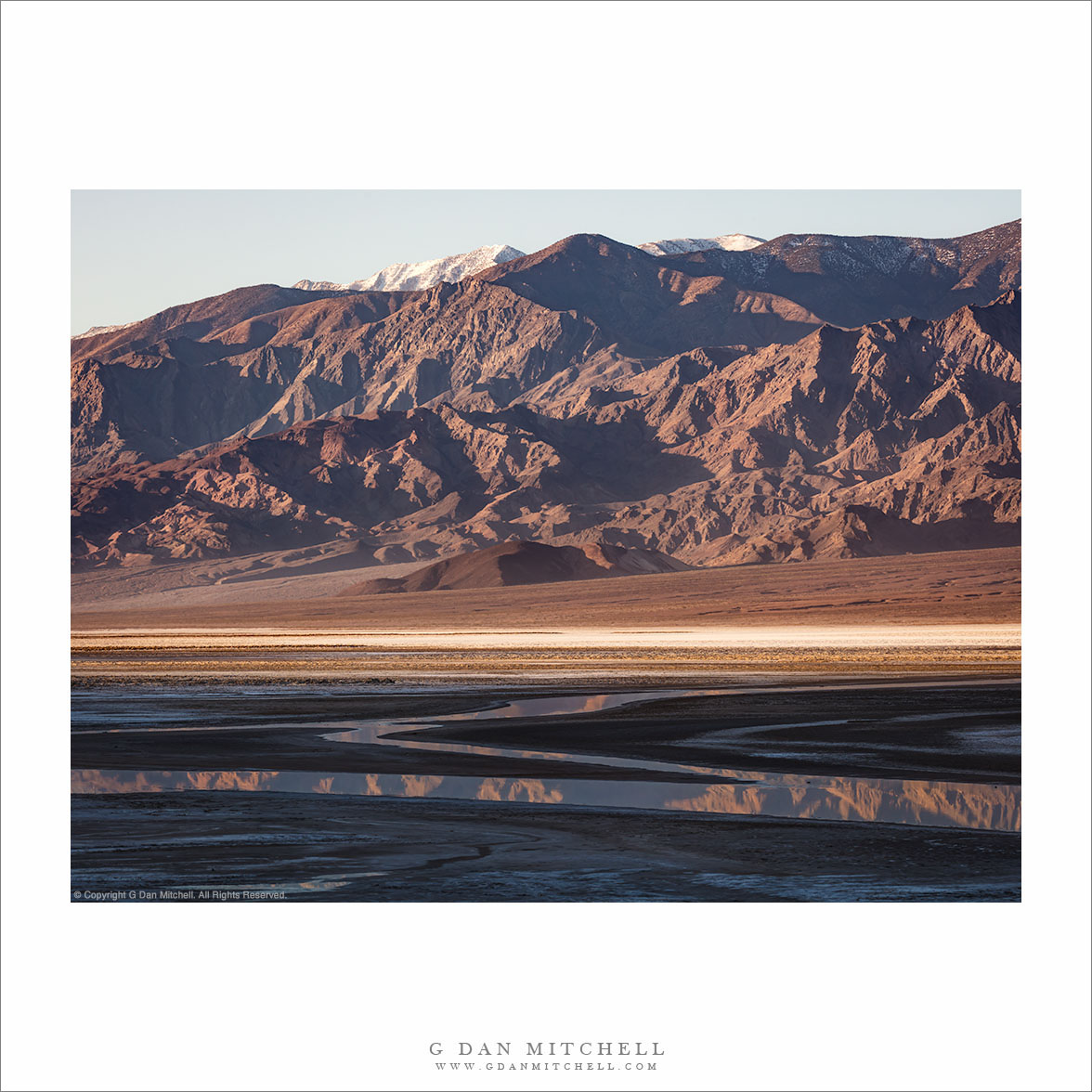
“Salt Flats to Mountain Peaks” — Snow-covered Telescope and Rogers Peaks and the Panamint Mountains tower above Death Valley salt flats in morning shadows

It still seems odd to find water flowing here, but out on the salt flats of Death Valley it does flow at all times of the year. It is extremely shallow and it moves very slowly — but the amount of moisture out there is still impressive. Hint: don’t walk on these flats — you aren’t going to enjoy the thick mud on your shoes, the sensation of sinking into it, or the tracks you leave behind.

These mountains face the rising sun, so I was out there before sunrise, getting set up and framing some compositions so that I could work rapidly as the sun arrived. It comes quickly, and it is only minutes from the first light on the high, snow-covered peaks until the line of light starts to creep across the flats. This isn’t the lowest spot in the valley, though it is below sea level. The highest of those distant peaks is over 11,000 feet tall.


G Dan Mitchell is a California photographer and visual opportunist. His book, “California’s Fall Color: A Photographer’s Guide to Autumn in the Sierra” (Heyday Books) is available directly from him.

G Dan Mitchell: Blog | Bluesky | Mastodon | Substack Notes | Flickr | Email


All media © Copyright G Dan Mitchell and others as indicated. Any use requires advance permission from G Dan Mitchell.

Evening Sky and Haze, Death Valley

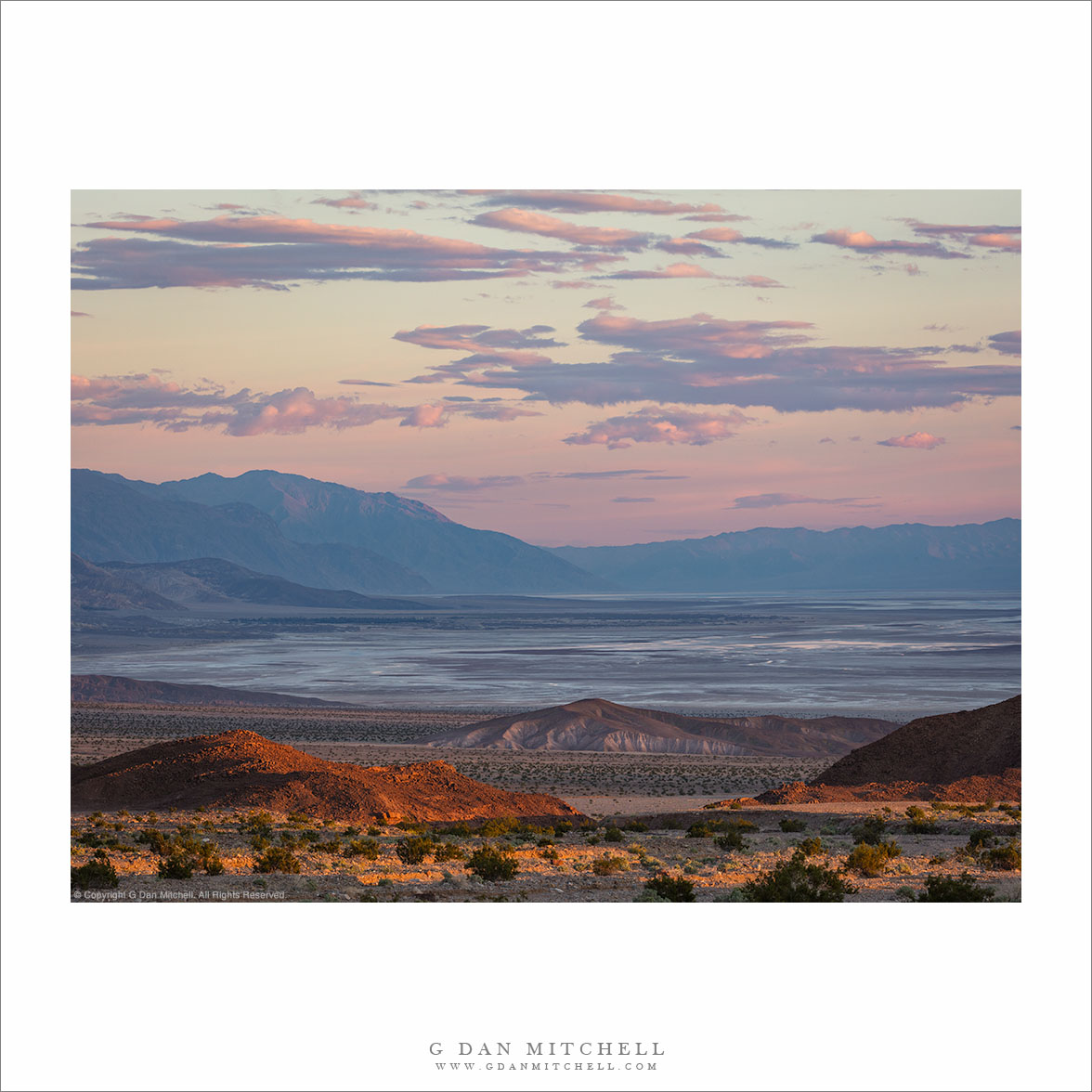
Death Valley National Park is a huge place — not just as measured by its total area but also by the immense spaces we view there. In many places we look across dozens of miles toward objects so far away that they are obscured by the atmosphere even on clear days. We might look at a “nearby” destination and think, “I’ll walk there.” If we try, hours later our intended destination will still be in the distance.

This photograph, made at sunset in the central part of the great valley, is an example. If I had gotten in my car and started driving, it would have taken me an hour and a half or longer to reach the base of those mountains in the distance. In this scene the valley has already fallen into the shadows of the Panamint range and a final bit of soft side-light glances across the large wash in the foreground.


G Dan Mitchell is a California photographer and visual opportunist. His book, “California’s Fall Color: A Photographer’s Guide to Autumn in the Sierra” is available from Heyday Books, Amazon, and directly from G Dan Mitchell.

Blog | About | Instagram | Flickr | Facebook | Threads | PostEmail

Links: Articles, Sales and Licensing, my Sierra Nevada Fall Color book, Contact Info.

Scroll down to share comments or questions. (Click post title first if viewing on the home page.)


All media © Copyright G Dan Mitchell and others as indicated. Any use requires advance permission from G Dan Mitchell.