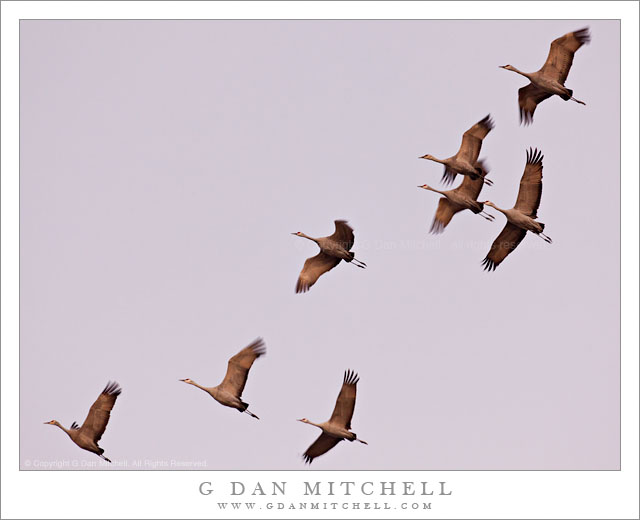
A flock of sandhill cranes against the dusk sky above the Merced National Wildlife Reserve, California.
The sandhill cranes are amazing creatures. On the ground they seem rather ungainly, but in the air they seem, to me at least, to fly with remarkable grace and strength. Several things can make them tricky to photograph. On the ground, they are frequently in less than photogenic locations such as turned under fields, and they are skittish, moving away quickly if you come too close. In flight they can appear and disappear quickly, and if you aren’t looking the right direction you can miss them as they fly over. And they seem to come in waves – you can wait for a while without seeing any of them, let down your guard and become distracted, the suddenly groups of them seem to appear.
I had fewer opportunities to photograph them close up at Merced National Wildlife Refuge on this evening than I had earlier in the day back north at Woodbridge Road. But a few did come close and I managed to photograph this portion of a large group that flew over as the evening light was turning portions of the sky pink and purple.
G Dan Mitchell is a California photographer whose subjects include the Pacific coast, redwood forests, central California oak/grasslands, the Sierra Nevada, California deserts, urban landscapes, night photography, and more. Blog | About | Flickr | Twitter | Facebook | Google+ | 500px.com | LinkedIn | Email
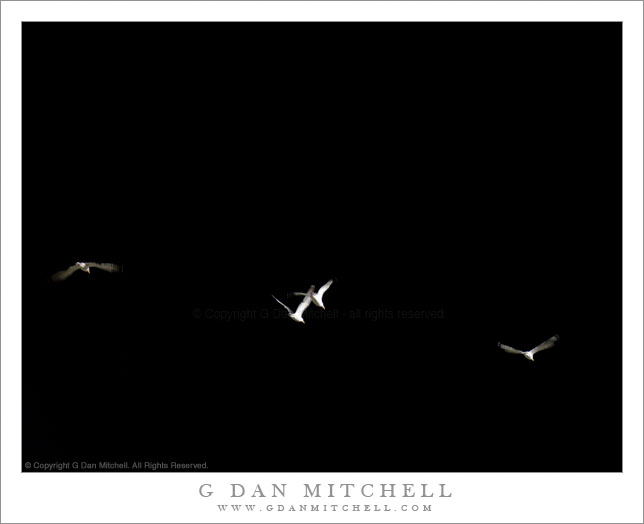
Seagulls fly through artificial lighting at night, San Francisco, California.
I wouldn’t mind if you speculated about how in the world I managed to get this king of lighting on a photograph of birds in flight. Let’s see, it couldn’t be on-camera flash since the light is coming from the side. Perhaps I concocted some elaborate multiple flash setup and then waited for the birds?
I’m afraid that the explanation is much more prosaic. To be honest, we were at a San Francisco Giants game on this evening. We go to Giants games for several reasons: the hope that the Giants might actually play well (not at the moment!), the great views from AT&T park, garlic fries (!)… and for me, photography. I always bring a camera and a lens, and partway through the game I usually take advantage of the upper areas of the stadium to photograph San Francisco and the Bay, often at sunset and dusk.
One more fact. Giants fans who attend games have discovered something astonishing about wildlife, namely that the sea gulls seem to be able to tell when it is the seventh inning or so. At about this point in the game, flocks of them begin to assemble over the park, circling above the field and the stands… and waiting for their chance to feast on the discarded food that is left all over the stadium. (My working theory is that they have somehow learned to associate a full stadium with the appearance of good stuff to eat about two or three hours later. They are apparently as fond of garlic fries as we are.)
So, on this evening when the gulls showed up they began to fly in and out of the stadium lighting, creating a somewhat stark and dramatic effect against the dark sky.
(Basic EXIF data may be available by “mousing over” large images in posts when this page is viewed on the web. Leave a comment if you want to know more.)
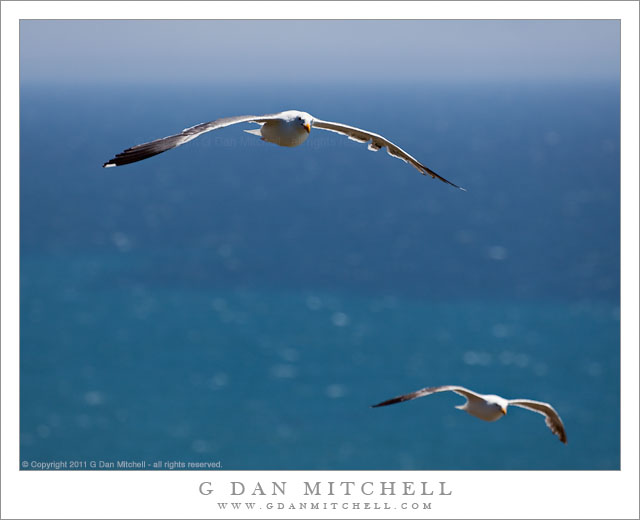
Two sea gulls glide along the top of coastal bluffs above the Pacific Ocean north of Santa Cruz, California.
Since I’ve related the basic story previously – more than once – I’ll keep it short this time. Since I live within an hour or less of the California coast, I head over that way frequently to photograph. Among my favorite subjects are the pelicans that travel up and down (but mostly, for some inexplicable reason up) the coast, riding the updrafts along the tops of coastal bluffs. I had some free time on this day, so I headed over with photographing the birds as one of my possible goals.
When I got to this familiar spot, there were no pelicans. (Eventually a few did fly past, but this was not a good day for pelicans.) Before moving on to other subjects I thought I’d at least stay here a while and practice the skills involved in photographing these birds in flight since even though there were no pelicans, there were plenty of other obliging birds. Most of the time it is difficult to get two gulls in the frame once they get close and start to fly past, but these two hung close enough together to be in the same frame, and their low trajectory placed them right in front of the deep blue water, with the fog-softened horizon near the top of the frame.
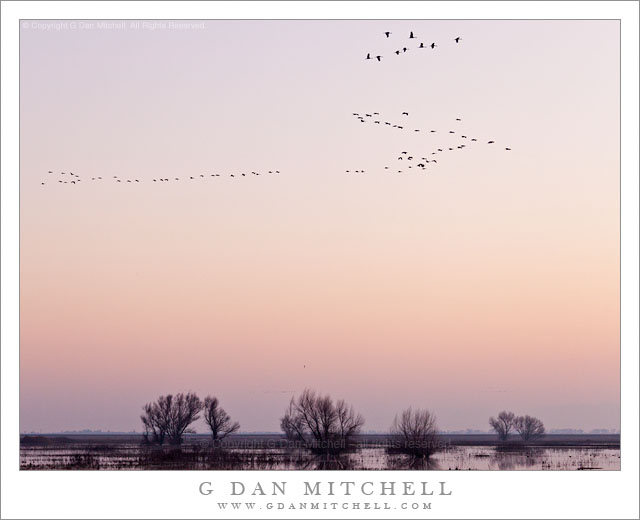
A solitary gull flies above California’s Pacific Ocean coastline with a fog bank and blue sky beyond.
With some free time earlier this week, and the excuse of driving my son to a summer-session class at UC-Santa Cruz, I headed north from Santa Cruz looking for things to photograph. Because there was a lot of fog, even in the middle of the day, fog was one of my general subject ideas. And I almost always make at least a quick stop at a couple of bluff-top locations that I know of where shore birds often glide by very close as they ride the updrafts from the ocean winds. It turned out that my first stop was precisely one of these locations. With nothing else specific in mind at this midday hour, I figured I would at least spend a bit of time honing my skills and tracking and photographing birds in flight.
Although sea gulls are not necessarily my favorite subjects, there sure were plenty of them to practice on! At the spot I picked, they first become visible perhaps 10-15 seconds away as they come around the edge of a bluff to the south. As they approach they tend to vary their altitudes, with some dropping low enough that they disappear behind the cliff and others going so high that only their shaded undersides are visible. But a few come very close at almost eye level.
I almost always learn something new when I photograph birds in flight and this session was no exception. While in retrospect it seems like one of those “Well, duh!” realizations, I figured out that really strong winds tend to upset the birds ability to remain level, and for this reason they are constantly adjusting to remain level. From moment to moment the wings move into interesting positions or they find themselves tilting wildly to get back on course. This is much more interesting than what they do in benign conditions, where they often seem to just… coast.
So, add one more thing to watch for as they fly past. This isn’t an easy thing, and I have the greatest admiration for those who are really great at photographing birds in flight – or “BIF,” as some call them. The first challenge is simply to keep the moving birds in the viewfinder when using a long focal length lens. (I advise practicing the process of simply following the birds without even firing the shutter at first.) But that’s not enough. You must also attempt to keep the bird(s) in a position within the frame that is aesthetically interesting and which will position the target under the active AF points on the camera. Easier said than done! Then there is the matter of trying also be aware of what the bird is doing – watching wing and head position and so forth. On top of that, you ideally also want to be aware of the what else is in the frame – sky, clouds, water, other birds – and factor that into the decision about when to press the shutter. There are exposure challenges, too, especially with birds like this gull that have white on their backs… and this portion of the bird is in direct sun.
Let’s just say that – for me at least – it takes a lot of exposures to get a few shots that I like.
(Basic EXIF data may be available by “mousing over” large images in posts. Leave a comment if you want to know more.)
Photographer and visual opportunist. Daily photos since 2005, plus articles, reviews, news, and ideas.
Manage Consent
To provide the best experiences, we use technologies like cookies to store and/or access device information. Consenting to these technologies will allow us to process data such as browsing behavior or unique IDs on this site. Not consenting or withdrawing consent, may adversely affect certain features and functions.
Functional
Always active
The technical storage or access is strictly necessary for the legitimate purpose of enabling the use of a specific service explicitly requested by the subscriber or user, or for the sole purpose of carrying out the transmission of a communication over an electronic communications network.
Preferences
The technical storage or access is necessary for the legitimate purpose of storing preferences that are not requested by the subscriber or user.
Statistics
The technical storage or access that is used exclusively for statistical purposes.The technical storage or access that is used exclusively for anonymous statistical purposes. Without a subpoena, voluntary compliance on the part of your Internet Service Provider, or additional records from a third party, information stored or retrieved for this purpose alone cannot usually be used to identify you.
Marketing
The technical storage or access is required to create user profiles to send advertising, or to track the user on a website or across several websites for similar marketing purposes.