
Tag Archives: geology

White Rim, Colorado River Valley

White Rim, Colorado River Valley

White Rim, Colorado River Valley. Canyonlands National Park, Utah. October 10, 2012. © Copyright 2013 G Dan Mitchell – all rights reserved.

The Colorado River winds through rugged country beyond the White Rim, Canyonlands National Park

On our second visit to Canyonlands National Park (the first had been back in April of the same year, when we briefly visited the “Island in the Sky” highlands of the park) we were somewhat stymied by less than astonishing light. Overall the skies were sort of partly cloudy, but that “partly” portion seemed to line up almost perfectly with where we were, and from afternoon on a large mass of clouds sat above us and to the west. For this photograph, that might have actually been a bit of a blessing, in that trying to photograph the tremendously intricate and detailed landscape visible from the “Grand View” overlook in full sun at this time of day would have been challenging, to say the least. This landscape, lit that way, would have contained some extremely bright features along with very deep shadows in the canyons, and the result probably would not have been all that great. The clouds, however, somewhat mute the contrasty light, making the bright areas a bit less bright and allowing diffused light down into areas that would otherwise be dark. At least there was a bit of light on the buttes in the far distance at the upper edge of the frame.

This scene is one of those “iconic” views that, well, everyone photographs. Generally, I’m not that much about photographing icons. In fact, often when I go to places like this I try to not know what the iconic shots are or where to find them, preferring to instead just sort of guess, follow hunches, poke around, and see what I discover. This may not be the most effective way to find the “cool stuff” in a new location, but it does let me start to develop my own relationship with a landscape from the very beginning. So when we went into Canyonlands the first time I basically had almost no idea what I was “supposed” to see and photograph. (For example, I had no idea that iconic “Mesa Arch” is in this park – drove past the road to it and said, “Ah, that’s where Mesa Arch is!” And, no, I did not photograph it.) However, as we wandered about and looked at stuff, we somehow managed to end up at several of “those places” – especially the Green River overlook (which I now recognize as one of the iconic views of this park) and Grand View. In addition, I’ve often advised others to not eschew icons in certain situations. One, of course, is when you find yourself in front of such an icon and have never photographed it before. But another is when one visits a location for the first time and does not yet have a deeper knowledge of the place. For example, I’ll occasionally get asked by first time visitors to Yosemite or Death Valley (places where I shoot a lot) about where the “secret spots” are that not everyone shoots. I tell them that getting to know a place to such an extent that you can find, “see,” understand and photograph the non-iconic subjects is not a reasonable goal for a first visit. Often that takes many visits, perhaps in different seasons, and the time to let the place “get under your skin” to the point that you have a real feel for it.* But everyone has to start somewhere, and photographing icons is a fine place to start when you are new to a place. They are, after all, usually quite spectacular spots – as I say, “They are icons for a reason.”

*For my part, during my first year photographing in Utah I spent over 30 days there during three long visits. It wasn’t until well into the third visit that I really began to feel that I was moving past the “Oh, wow, Utah!” state and starting to really understand the place.

G Dan Mitchell is a California photographer and visual opportunist whose subjects include the Pacific coast, redwood forests, central California oak/grasslands, the Sierra Nevada, California deserts, urban landscapes, night photography, and more.
Blog | About | Flickr | Twitter | FacebookGoogle+ | 500px.com | LinkedIn | Email

Text, photographs, and other media are © Copyright G Dan Mitchell (or others when indicated) and are not in the public domain and may not be used on websites, blogs, or in other media without advance permission from G Dan Mitchell.
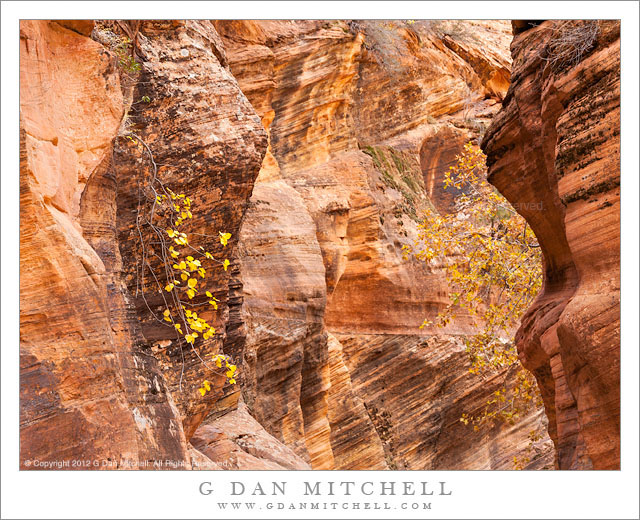
Slot Canyon Walls

Slot Canyon Walls - The sculpted walls of a narrow and curving slot canyon, Zion National Park
The sculpted walls of a narrow and curving slot canyon, Zion National Park

Slot Canyon Walls. Zion National Park, Utah. October 22, 2012. © Copyright 2012 G Dan Mitchell – all rights reserved.

The sculpted walls of a narrow and curving slot canyon, Zion National Park

On the first non-travel day of my most recent Utah visit, since we were passing through Zion National Park on our way to points beyond, we decided to spend the better part of the day shooting there. For a few reasons, including that it was a bit early for fall color there, we chose to not go to Zion Canyon, but to instead spend the time along the Mount Carmel Highway that cuts through the park from west to east. Our object was to photograph the wide range of interesting subjects found there: sandstone of all shapes, textures, and colors; trees, both evergreen and those with fall foliage, and more.

We ended up spending most of the day along this route. An observer might have wondered a bit about us. We would drive slowly along the road in one direction, frequently slowing down and pulling over, looking around a bit, then either getting back on the road or piling out and heading off in various directions – either up into rocks or down into a wash or canyon. Eventually we worked our way to one end of the road’s passage through the park… and we turned around and headed back. We did this loop several times. Why? First, things that you might miss while driving one direction become easier to see when you head the other way. Second, and perhaps most important, light is not a static thing. It changes in may ways – intensity, color, angle, direction, what it strikes and what it misses – as the day goes on, so while the <i>landscape</i> might have been, arguably, “the same,” the <i>lightscape</i> was in constant flux. I made this photograph in a short section of slot canyon, contriving to find a point of view from which almost nothing but the twisting and overlapping forms of the rocks would be visible, along with just a bit of foliage.

G Dan Mitchell is a California photographer whose subjects include the Pacific coast, redwood forests, central California oak/grasslands, the Sierra Nevada, California deserts, urban landscapes, night photography, and more.
Blog | About | Flickr | Twitter | FacebookGoogle+ | 500px.com | LinkedIn | Email

Text, photographs, and other media are © Copyright G Dan Mitchell (or others when indicated) and are not in the public domain and may not be used on websites, blogs, or in other media without advance permission from G Dan Mitchell.

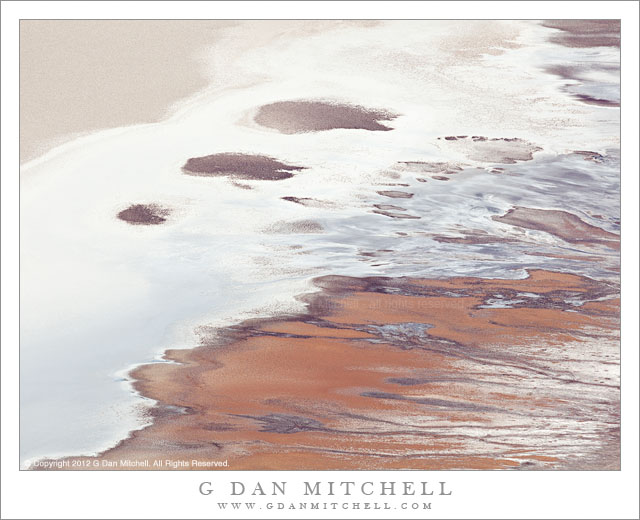
Salt Flat Patterns

Salt Flat Patterns
Salt Flat Patterns

Salt Flat Patterns. Death Valley National Park, California. March 30, 2011. © Copyright 2012 G Dan Mitchell – all rights reserved.

Detail of a section of Death Valley salt flats as seen from Dantes View

Death Valley is often not quite what it seems to be. Repeat visits and views from different perspectives – far away, very close up, from above – begin to reveal things that you might not see at first. From next to and on the salt flats in the lowest section of the Valley, you see a very desolate terrain – one of the most non-human terrains I know. Here, well below sea level, there are places that seem completely inhospitable and alien, landscapes of caked salt, worked and sharp-edged salt and dried mud, seeps of shallow water, occasional odd plants, and landscape that often seems to go on almost endlessly the same way. But just as looking more closely reveals surprises (such as living creatures in those millimeters-deep pools of salty water), the view from overhead shows patterns that cannot be readily seen up close.

This photograph was made from the summit of Dantes View. This high point along the eastern side of the valley is close to a mile above the Valley floor. The view can often be panoramic, stretching for tremendous distances in almost all directions, blocked only by the higher peaks of the Panamint Range to the west and a few other high points nearby. Although Dantes View is one of the best known “iconic” locations in the park, I have a complicated relationship with the place. First of all, I seem to attract awful weather when I go there, perhaps because I tend to do so in the season that is winter elsewhere in the state. Not too long ago I attempted to drive to the summit on a winter day and was turned back by a snow storm perhaps a half mile from the end of the road. In addition, it has been hard for me to warm up to the place as a photographic subject. In some ways, there is almost just too much in the view for me to see how to isolate a photograph out of that detailed immensity. I dealt with that here by using a very long lens and restricting my view to a small section of the valley floor, without much context of surrounding terrain, which I think produces a photograph that allows the features in this frame to be seen as abstractions.

G Dan Mitchell is a California photographer and visual opportunist whose subjects include the Pacific coast, redwood forests, central California oak/grasslands, the Sierra Nevada, California deserts, urban landscapes, night photography, and more.
Blog | About | Flickr | Twitter | FacebookGoogle+ | 500px.com | LinkedIn | Email

Text, photographs, and other media are © Copyright G Dan Mitchell (or others when indicated) and are not in the public domain and may not be used on websites, blogs, or in other media without advance permission from G Dan Mitchell.

Colorado River, Dead Horse Point

Colorado River, Dead Horse Point

Colorado River, Dead Horse Point. Deadhorse Point State Park, Utah. October 10, 2012. © Copyright 2013 G Dan Mitchell – all rights reserved.

The canyon of the Colorado River, from Dead Horse Point State Park, Utah

The light was a bit tricky when we drove out to Dead Horse Point to look at the famous view of the Colorado River as it loops below huge cliffs at the edge of Canyonlands National Park in Utah. It was nearing the middle of the day, so the soft morning and evening light was nowhere to be found. It was also hazy, with the slightly opaque air taking on distinctly blue colors. For all of these reasons, and also perhaps as a nod to old school landscape photography, I went with a black and white rendition of this photograph.

This is a truly remarkable bit of terrain. First, in the bottom of the canyon the Colorado River negotiates and abrupt horseshoe bend here beneath the tall cliffs leading up to the “Island in the Sky” portion of Canyonlands National Park. Above the river are a series of huge terraces form as the river eroded its way though the deep and old layers of sedimentary rock that characterize this area. Shooting with a slightly long focal length, I was able to eliminate most extraneous subjects and crop tightly around this area of massive cliffs and terraces.

G Dan Mitchell is a California photographer and visual opportunist whose subjects include the Pacific coast, redwood forests, central California oak/grasslands, the Sierra Nevada, California deserts, urban landscapes, night photography, and more.
Blog | About | Flickr | Twitter | FacebookGoogle+ | 500px.com | LinkedIn | Email

Text, photographs, and other media are © Copyright G Dan Mitchell (or others when indicated) and are not in the public domain and may not be used on websites, blogs, or in other media without advance permission from G Dan Mitchell.