“Tree Farm and Hills” — The bare winter trunks of a tree farm against a backdrop of low hills, Skagit Valley, Washington
This is perhaps a bit of a subtle photograph. While shooting in the Skagit Valley of Washington, my brother Richard and I took a break from photographing trumpeter swans and snow geese and went looking for bald eagles, which hang out nearby in large numbers. We eventually found several of them in various trees in the area, including in the upper branches of these large groves of trees that I think may be poplars that are part of a tree farm. (Our first attempt with the eagles was a classic. We saw a beautiful bird in a tree at the edge of the grove right alongside the road. We stopped. We carefully fitted the right long lenses. We got out. We aimed… and the eagle flew away.)
While standing around looking for the birds I was fascinated by the regular patters of these very slender and closely spaced trees in the tree farms that were along the road. The light was very muted due to overcast, and the trees themselves don’t provide a whole lot of light/dark contrast. I found a section of the grove that I liked and then worked my position so that I could get the diagonal of the more distant and out of focus ridge to cut across the background and angle down to the right.
G Dan Mitchell is a California photographer and visual opportunist. His book, “California’s Fall Color: A Photographer’s Guide to Autumn in the Sierra” (Heyday Books) is available directly from him.
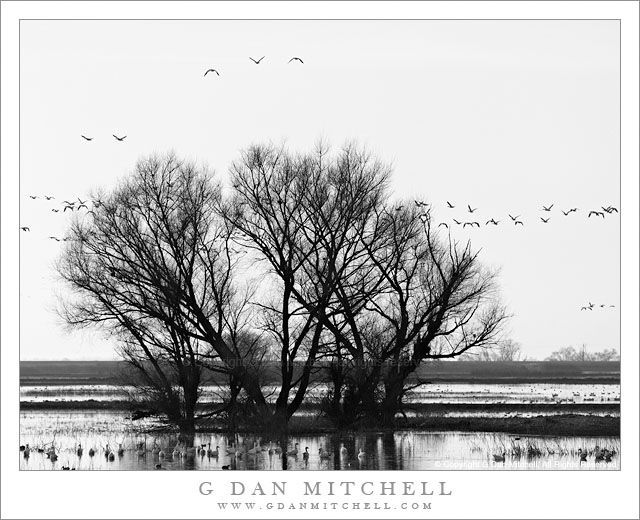
Migratory birds fly over a group of trees at the Merced National Wildlife Refuge as others congregate in a pond.
In my continuing mission to share as many photographs of this little grove of trees in as many ways as possible, I now present – The Trees In Black and White… ;-) I have shot this little group on two successive weeks now, and I’m starting to almost regard them as personal friends. They are located out along the “auto tour” route at the Merced National Wildlife Refuge in California’s Central Valley. From certain angles late in the day they stand in front of a beautiful, luminous glowing sky as the sun moves to the west.
I made this photograph in the early evening, before the golden hour light. Due to these lighting conditions and the typical characteristics of the Valley at this time of year, there was a great deal of atmospheric haze. While later light would reveal the ridge of the coast range in the distance, at this time the glowing haze blocked that view, and its effect can even be seen on the trees along the far levee. As large flocks of birds flew by – I think they were geese – they would pass behind and above the trees. Often they were in odd positions – too low to be visible behind the trees or so high that I would have had to expand the angle of view more than I wanted. But patience helps. I figure that eventually some birds will almost always fly past in the more or less right position, and here a lower string of birds was accompanied by a few flying higher. As I often do with this sort of subject, I compose a landscape around a combination of what I do see (the foreground water and birds, the levees, the trees) and what I imagine I might see if I’m lucky (birds occupying the space on either side and above the trees). Then I wait. I recall pressing the shutter release when the central three birds were centered above the tallest trees.
G Dan Mitchell is a California photographer whose subjects include the Pacific coast, redwood forests, central California oak/grasslands, the Sierra Nevada, California deserts, urban landscapes, night photography, and more. Blog | About | Flickr | Twitter | Facebook | Google+ | 500px.com | LinkedIn | Email
Migratory birds flly though the twillight winter sky above California’s Central Valley and the Coast Range.
I made this photograph when it was almost too dark to see clearly. In fact, when I packed up and drove away a few minutes later, it was so dark that I momentarily got mildly lost on my way out of the refuge! Long after the sun had set, and at the time when perhaps the most intense sky colors appear, the migratory birds were still in flight above the Central Valley, often silhouetted against the colorful dusk sky just above the horizon.
This photograph is going to get a bit more technical explanation than usual. I had a 100-400mm telephoto on the camera at this point since I had been photographing the birds in a variety of ways, including trying to fill the frame with one or a few birds. While some might say that shooting a prime lens of this length could have some image quality advantages, this photograph wouldn’t have happened if I had been shooting, say, a 400mm prime. Since I wanted to move quickly from targeting small sections of the surroundings or even individual birds to making photographs that attempt to portray the larger landscape within which the birds are found, I frequently found myself moving quickly to much shorter focal lengths. Here, I realized that I might be able to “zoom out” and include some of the birds in flight high above the valley and the distant mountains in the context of their surroundings. So I shot this at something like 130mm. In addition, because the scene includes subjects that are not that far away (like the trees) and those at much greater distances (like the hills), depth of field was an issue with the longer focal lengths. I couldn’t shoot wide open without some excessive focus issues, so I stopped down to f/11. Think about that for a moment: shooting in extremely low light, stopped down to try to maintain some depth of field… and needing use a shutter speed allowing me to get some definition out of birds flying through the scene. This is essentially being caught between a rock and a hard place… and another rock. With the camera on the tripod, but still aimed manually, I used a shutter speed of 1/13 second and turned image-stabilization on. With all of this stuff pushing boundaries of shutter speed and aperture… my only option was to increase the ISO to 1600. For landscape work. Here’s the thing… in the end, while there was more noise in this photograph than if ISO 100 were possible, it isn’t that bad and probably wouldn’t even be visible to viewers of a print. While I’m usually persistent in my view that little technical differences among cameras don’t amount to much, in this case it was because current cameras make it possible to shoot in ways that were essentially impossible a decade ago that I could get this photograph at all.
G Dan Mitchell is a California photographer whose subjects include the Pacific coast, redwood forests, central California oak/grasslands, the Sierra Nevada, California deserts, urban landscapes, night photography, and more. Blog | About | Flickr | Twitter | Facebook | Google+ | 500px.com | LinkedIn | Email
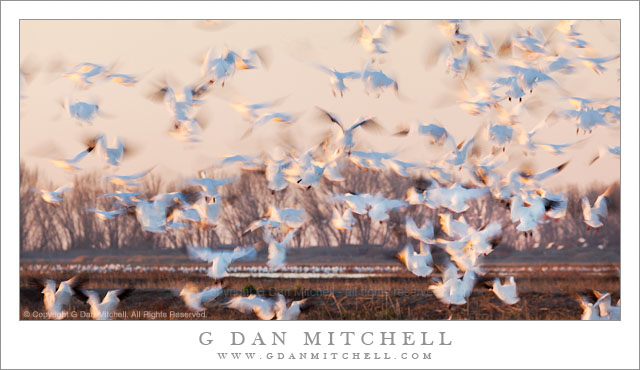
Motion-blurred photograph of low-flying Ross’s geese on a winter evening in California’s Central Valley.
From time to time I experiment with longer exposure photographs of birds in flight. The idea is that allowing the image to blur as the birds move might suggest their constant motion more effectively than the more typical approach of stopping the motion. Here not only was the exposure relatively long (I think it was 1/30 second) but I was shooting with a long telephoto which also amplifies the motion of subject and camera.
I’m thinking of this as a “study” for future photographs of these Ross’s geese and similar birds that will work with this idea of motion blur. Making this shot let me get a bit closer to understanding the most likely times to find the birds lifting off in the evening, and the best time to try to catch this with a bit of the last sunlight before sunset. I was also able to slightly better establish the shutter speed I would like to work with for this kind of image. The idea is to keep just barely enough shape in the birds that you can recognize what they are, but to allow the motion to blur things enough to eliminate the hyper-sharp realistic quality of the scene and to let the motion blur imply something about the actual flying motion of the birds.
G Dan Mitchell is a California photographer whose subjects include the Pacific coast, redwood forests, central California oak/grasslands, the Sierra Nevada, California deserts, urban landscapes, night photography, and more. Blog | About | Flickr | Twitter | Facebook | Google+ | 500px.com | LinkedIn | Email
Photographer and visual opportunist. Daily photos since 2005, plus articles, reviews, news, and ideas.
Manage Consent
To provide the best experiences, we use technologies like cookies to store and/or access device information. Consenting to these technologies will allow us to process data such as browsing behavior or unique IDs on this site. Not consenting or withdrawing consent, may adversely affect certain features and functions.
Functional
Always active
The technical storage or access is strictly necessary for the legitimate purpose of enabling the use of a specific service explicitly requested by the subscriber or user, or for the sole purpose of carrying out the transmission of a communication over an electronic communications network.
Preferences
The technical storage or access is necessary for the legitimate purpose of storing preferences that are not requested by the subscriber or user.
Statistics
The technical storage or access that is used exclusively for statistical purposes.The technical storage or access that is used exclusively for anonymous statistical purposes. Without a subpoena, voluntary compliance on the part of your Internet Service Provider, or additional records from a third party, information stored or retrieved for this purpose alone cannot usually be used to identify you.
Marketing
The technical storage or access is required to create user profiles to send advertising, or to track the user on a website or across several websites for similar marketing purposes.