
Tag Archives: high

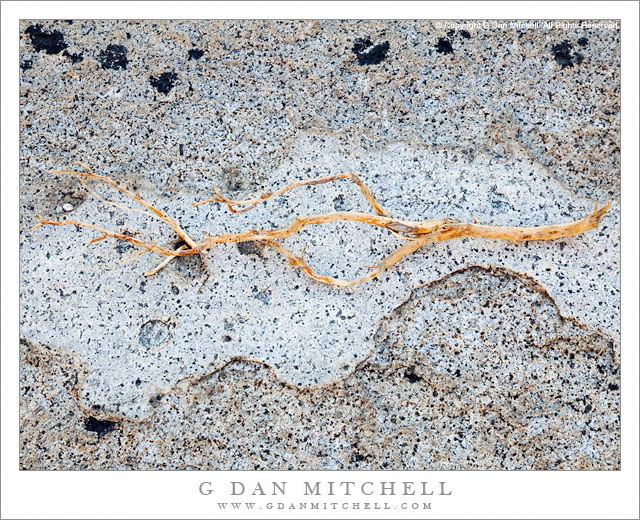
Dead Branch, Glaciated Granite

Dead Branch, Glaciated Granite

Dead Branch, Glaciated Granite. Yosemite National Park, California. June 28, 2010. © Copyright G Dan Mitchell – all rights reserved.

A dead branch lies on glacially-polished granite in the Yosemite National Park back-country.

I made a promise to someone to not say where this photograph was made – I’ll just say it is in Yosemite National Park. But the exact location really doesn’t matter too much, as these large expanses of glaciated granite slab are a common feature throughout the park, and you could find similarly interesting geology in thousands of locations.

I was a little surprised to find this weathered branch in this location, since it was a good distance from any trees and also not near any flowing water. Besides its location, a few other things about it caught my attention. First, its curving shapes lined up in a way tht seems to tie in with the bit of glacially-polished granite that lies beneath it. (And, yes, this is exactly where the branch was when I found it.) In a way, the larger shape of the lighter area of granite winding across the photograph from side to side almost seems like a much thicker echo of the curving shape of the branch. In addition, the warm brown tones of the branch seem to stand out a bit – though perhaps more in a larger print – against the relatively drab color of the rock.

G Dan Mitchell Photography | Flickr | Twitter | Facebook | Email
Text, photographs, and other media are © Copyright G Dan Mitchell (or others when indicated) and are not in the public domain and may not be used on websites, blogs, or in other media without advance permission from G Dan Mitchell.
Dawn, Alkali Lake, Eastern Sierra

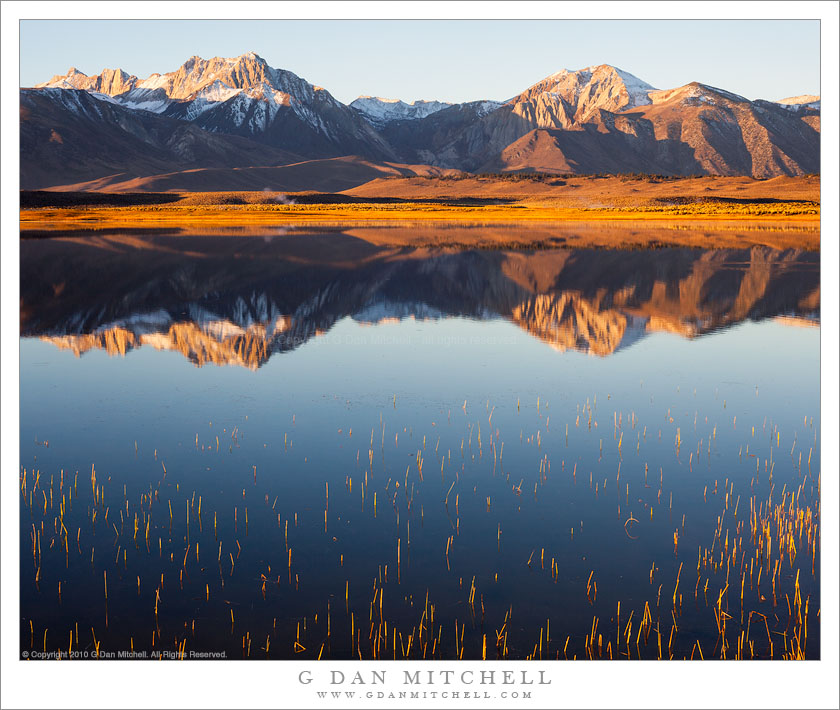
Dawn, Alkali Lake, Eastern Sierra
Dawn light on Alkali Lake and the peaks of the eastern Sierra Nevada near Convict Lake.

Dawn, Alkali Lake, Eastern Sierra. Owens Valley, California. October 10, 2010. © Copyright G Dan Mitchell – all rights reserved.

Dawn light on Alkali Lake and the peaks of the eastern Sierra Nevada near Convict Lake.

I posted a photograph very much like this one a month or so ago, but I like this place and the morning light so much that I’m posting this similar photograph. The location is on the shore of a small alkali lake out in Owens Valley/Long Valley, in an area that is full of hot springs. On this very cold early October morning, steam was rising from the many hot springs in the area as the sun rose, lighting the eastern face of the Sierra Nevada near Convict Lake, the sagebrush-covered hills below the Sierra, and finally the surface of the small lake.

For many years after I started visiting the east side of the Sierra Nevada I mostly ignored the high desert terrain such as the area around this lake. As time went on and I looked further east I began to venture out here, and I discovered a beautiful landscape that is affected by proximity to the Sierra but which is not really “Sierra Nevada” itself. The bulk of the eastern escarpment is a constant presence here, but the character of this place is more that of the basin and range country — dry, full of sagebrush, with playas and rocky outcroppings.


G Dan Mitchell is a California photographer and visual opportunist. His book, “California’s Fall Color: A Photographer’s Guide to Autumn in the Sierra” is available from Heyday Books and Amazon.

Blog | About | Flickr | FacebookEmail

Links to Articles, Sales and Licensing, my Sierra Nevada Fall Color book, Contact Information.


All media © Copyright G Dan Mitchell and others as indicated. Any use requires advance permission from G Dan Mitchell.

Basin Mountain, Afternoon Light and Haze

Basin Mountain, Afternoon Light and Haze

Basin Mountain, Afternoon Light and Haze. Round Valley, California. October 9, 2010. © Copyright G Dan Mitchell – all rights reserved.

Basin Mountain and the Sierra Nevada crest rise above Round Valley on a hazy afternoon.

There is a certain kind of afternoon light in the eastern Sierra that is hard to photograph – looking up at the range from Owens Valley into the afternoon sun the haze can be bluish and decrease detail and the light can be very bright. But it is a part of the experience of the “east side” that we all know, I think. I can’t say that I’ve tried to photograph it very often, but I stopped just off of highway 395 in the Round Valley area on this early October afternoon when I saw the rugged foothills rising above the sagebrush towards the Buttermilks and Basin Mountain and the Sierra crest around Mount Humphreys beyond.

For me, this is one sort of classic eastern Sierra view. Imagine a very warm or even hot afternoon. You are driving through high desert sagebrush country – which often surprises people who are headed to the Sierra and are thinking about high mountains and cool temperatures. The mountains to the west rise precipitously from the floor of Owens Valley, with peaks that can be nearly 10,000 feet higher than the lowlands in some places. You see snow on the peaks and sometimes on the slopes of the mountains. You know that there are places up there where you can park a car and walk out in cool mountain air and head up a trail through meadows and forests and cross a ridge into the alpine world – but the terrain gives little hint of this from below. The light gleaming on snow fields and rock projected into the sky reminds you of this other world high above.

This photograph is not in the public domain and may not be used on websites, blogs, or in other media without advance permission from G Dan Mitchell.

G Dan Mitchell Photography
Flickr | Twitter | Facebook Fan Page | Facebook | Friendfeed | Email

Tripods and Shooting in High Winds

I recently saw – and replied to – a question posted in a photography forum regarding tripods and shooting in high winds. The poster wrote something very similar to the following:

I realized that many shots from a recent trip are blurry because of wind shaking the tripod. Even hanging 10lb weight did not help. So now, I am looking for a new tripod that won’t be affected by wind.

What the writer has discovered is that no tripod is immune to strong winds, especially if you make long exposures and/or use long focal length lenses. Even if you had an absolutely rock-solid tripod, in a 40 mph wind your camera and lens will vibrate enough to create a slightly less sharp image.

So, what to do? You could get the heaviest tripod you can find and weight it down with bags of rocks and what not. But then you are stuck hauling around the dead weight of this tripod the other 95% of the time when you don’t need it.  Yes, get a good solid tripod and a good head with good camera brackets, but other things can help in high winds and, in fact, may be necessary even with the best tripod:

  • Use a shorter focal length if possible.
  • Use a higher shutter speed, even at the expense of a higher ISO, larger aperture, and accept the slightly increased noise or slight loss of DOF.
  • Consider using image-stabilization (IS) even with the camera on the tripod in extreme conditions.
  • Don’t extend the tripod legs all the way – if possible shoot from down low to the ground with the legs retracted.
  • try to brace the tripod against something – rocks, your legs, anything that will dampen vibrations a bit.
  • Try to use natural wind screens when you set up – sometimes being in the lee of a wall or tree or rock can diminish the wind enough to make a difference.
  • Time your shots for moments of less wind.
  • If your exposure times are not extremely long, gently resting a hand on the lens or camera body can dampen the wind-caused vibrations.
  • Rather than relying on a single exposure, make many redundant exposures – some will likely be less affected by the wind than others.
  • If you have a strap attached to your camera, take steps to make sure it doesn’t flap. Wrapping it around the tripod may be sufficient.
  • If conditions permit, consider removing your lens hood.

I recall once shooting on top of a bluff at the far reaches of Point Reyes, normally a very windy place and on this day windy enough to almost be scary. But the light was beautiful and I wanted to make photographs from the edge of the bluff. I ended up retracting the tripod legs so that the camera would be lower to the ground, sitting with the tripod braced between my legs, using IS, leaving a hand on the camera to dampen vibrations, raising the shutter speed, and making many exposures. In the end, a good percentage of the images were adversely affected by the wind… but among them were some good ones that were sharp.

Point Reyes Shoreline

G Dan Mitchell Photography | Twitter | Friendfeed | Facebook | Facebook Fan Page | Email