
Tag Archives: light

Juniper Tree and Sandstone Cliffs, Evening

Juniper Tree and Sandstone Cliffs, Evening - Soft evening light on a single juniper tree among boulders at the base of tall sandstone cliffs, Capitol Reef National Park
Soft evening light on a single juniper tree among boulders at the base of tall sandstone cliffs, Capitol Reef National Park

Juniper Tree and Sandstone Cliffs, Evening. Capitol Reef National Park, Utah. October 26, 2012. © Copyright 2012 G Dan Mitchell – all rights reserved.

Soft evening light on a single juniper tree among boulders at the base of tall sandstone cliffs, Capitol Reef National Park

This photograph was a serendipitous one that resulted from going to a somewhat unlikely place, and going there without a whole lot of enthusiasm, having only modest success at that place, and then while leaving happening to look up at the right moment and spot some very interesting and somewhat unusual post-sunset light. The plot began with an evening last-minute decision to go shoot “somewhere” in Capitol Reef, but without a specific objective in mind. We perhaps had some thoughts about shooting along the descent from Torrey, Utah toward the park boundary, but this is tricky late in the day due to the way the terrain slants up to the west, causing the sun to drop below the elevated horizon rather early and stealing the light from the foreground terrain.

When we passed the park boundary we still didn’t have a clear idea of what the evening’s “target” might be, so we drove slowly into the park, looking at many things but not seeing quite the photographic opportunities that might have caused us to stop. We finally decided to investigate a large canyon and drove to its entrance, parked, and walked in a ways. Because of the orientation of this canyon, the light here also left us rather soon. We made some photographs – a few of which might even turn out to be interesting – and then headed back out of the canyon. The way passed along the base of a very tall sandstone cliff formed from one of the thicker layers of sedimentary rock. Typically the rock would appear darker and redder, but the soft post-sunset light changed the tones to an almost pastel effect – and we both quickly decided to stop and do some shooting. This lone juniper trees was growing improbably in the middle of a pile of very large boulders that had fallen from the cliffs, and those cliffs were catching the late and soft light from the west.

G Dan Mitchell is a California photographer whose subjects include the Pacific coast, redwood forests, central California oak/grasslands, the Sierra Nevada, California deserts, urban landscapes, night photography, and more.
Blog | About | Flickr | Twitter | FacebookGoogle+ | 500px.com | LinkedIn | Email

Text, photographs, and other media are © Copyright G Dan Mitchell (or others when indicated) and are not in the public domain and may not be used on websites, blogs, or in other media without advance permission from G Dan Mitchell.
Trees and Receding Red Rock Hills

Trees and Receding Red Rock Hills - Sparse pines grow on low ledges in the high country red-rock sandstone, Zion National Park
Sparse pines grow on low ledges in the high country red-rock sandstone, Zion National Park

Trees and Receding Red Rock Hills. Zion National Park, Utah. October 22, 2012. © Copyright 2012 G Dan Mitchell – all rights reserved.

Sparse pines grow on low ledges in the high country red-rock sandstone, Zion National Park

Since I’ve posted several photograph of this particular terrain, there may not be a lot more to say about it beyond summarizing some of the basics. (And, yes, there will be more of this subject – though not too many more!) Out of the main park attraction of Zion Canyon and up in the high country, instead of being in a world of vertical cliffs that tower high above, it seems like we are more within than below the terrain. We can look down into washes and slot canyons, up to see sloping mountain sides, or straight across areas filled with slabs of curving sandstone on which various trees and bushes grow.

Here I lined up some backlit trees on a near ridge with those on a further ridge, with even more sloping ridges beyond. In the afternoon haze, the rocks combine their native red color with a bit of blue that comes from atmospheric haze, emphasized by backlight. And this same backlight lights up the needles of the trees, turning them almost white in places.

G Dan Mitchell is a California photographer whose subjects include the Pacific coast, redwood forests, central California oak/grasslands, the Sierra Nevada, California deserts, urban landscapes, night photography, and more.
Blog | About | Flickr | Twitter | FacebookGoogle+ | 500px.com | LinkedIn | Email

Text, photographs, and other media are © Copyright G Dan Mitchell (or others when indicated) and are not in the public domain and may not be used on websites, blogs, or in other media without advance permission from G Dan Mitchell.
Zion High Country, Evening

Zion High Country, Evening - High country of Zion National Park in evening light
High country of Zion National Park in evening light

Zion High Country, Evening. Zion National Park, Utah. October 14, 2012. © Copyright 2012 G Dan Mitchell – all rights reserved.

High country of Zion National Park in evening light

As an official member of the I Love Backlit Trees club, I’m more or less unable to resist shooting straight toward the sun near the start of end of the day to capture the light illuminating the fringes of trees from behind. Yes, it is a repeating subject of mine… The high country of Zion National Park along the Mount Carmel Highway is a great place to find such light if you are observant and think about where and when to look. Especially late in the day – but not quite all the way to sunset – the light slants across ridges and hills and picks off the trees, which here are separated enough to allow the light to catch whole trees. (This is a bit harder to find among the denser forests of my Sierra Nevada.)

This sort of shooting provides some challenges. One, of course, is the potential for a very wide dynamic range between the brightly lit leaves and needles of the trees and the shaded areas that may be behind and around them. Although the camera’s metering system may not show it, the sunlit portions of the trees are often extremely bright and can easily blow out completely – and the solution is to expose less… which diminishes the light in the shadows. Several solutions are possible. Here I made a single exposure with the brightest areas just at the limit of exposure, and if I had opened up more or lengthened the exposure the fringes of the trees would likely have gone all the way to pure white. (You can allow this to happen with a few specular highlights without much of a problem, but don’t over-do it!) With the single-exposure approach, I find that the shadow fader in ACR is my friend! It does a fine job of bringing back a bit of the detail in the darker areas that might otherwise be lost. Although I didn’t employ them in this photograph, there are some other approaches that can also work. One is to use exposure bracketing – making two or more images at different exposures, usually one for the shadows and one for the highlights, which are then manually combined in post by means of layer masks. This is labor intensive but can produce very wonderful results.

G Dan Mitchell is a California photographer whose subjects include the Pacific coast, redwood forests, central California oak/grasslands, the Sierra Nevada, California deserts, urban landscapes, night photography, and more.
Blog | About | Flickr | Twitter | FacebookGoogle+ | 500px.com | LinkedIn | Email

Text, photographs, and other media are © Copyright G Dan Mitchell (or others when indicated) and are not in the public domain and may not be used on websites, blogs, or in other media without advance permission from G Dan Mitchell.

Winter Haze and Trees, Central Valley

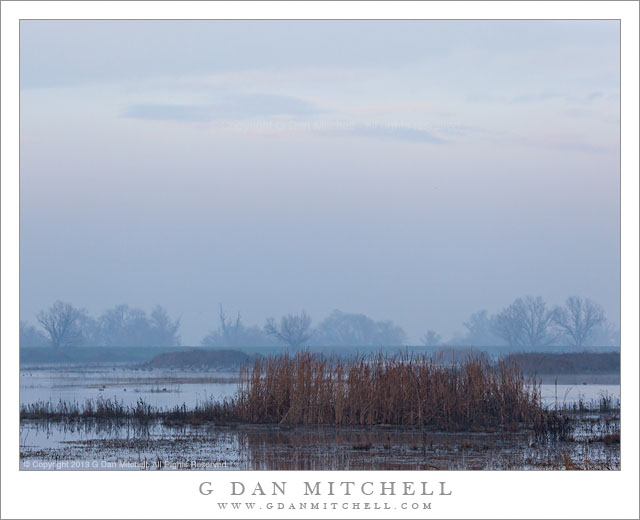
Hazy California Central Valley light on groves of trees as tule fog clears, Merced National Wildlife Refuge
Winter Haze and Trees, Central Valley

Winter Haze and Trees, Central Valley. Central Valley, California. December 11, 2012. © Copyright 2012 G Dan Mitchell – all rights reserved.

Hazy California Central Valley light on groves of trees as tule fog clears

In early December, 2012 I had my third opportunity of the season to photograph winter migratory birds. (The first time was last month when I made a quick foray to nearby Central Valley refuges, the second was shortly after that when I found myself with a free day in the Seattle area and drove up to Skagit Valley to photograph trumpeter swans and snow geese.) This was an especially great trip since not only were there birds about (Ross’s geese, a few odd snow geese, white-faced ibises, sandhill cranes, white pelicans, a few egrets and a single great blue heron) but the conditions turned out to be good almost all day and I was joined by a band of great folks: Michael Frye and Claudia Welsh, Dave and Charlotte Hoffman, and my wife Patty Mitchell. And what a day it turned out to be!

Things did not begin so promisingly. As Patty and I drove over from the south San Francisco Bay Area there was a lot of fog and continued to thicken until shortly after leaving Los Banos behind, where we encountered the classic pea soup Central Valley tule fog. Although it was so shallow that we could look up and see pre-dawn Venus and the new moon, ahead it was so thick that the road was barely visible in front of us. It was still thick when we reached the refuge and met the rest of the gang, and on the first part of our drive around the refuge the fog was so thick that we could barely seen any birds, although we could hear them. (One of the most mysterious experiences was hearing sandhill cranes nearby and being able to tell that they were airborne and moving but not see them at all until they would momentarily and briefly partially emerge from the murk and then just as quickly disappear.) Finally, as we came around the far side of the refuge we found a very large group of Ross’s geese close to the dirt road, and from here on things only got better. We had hours of shooting in the fog, which only slowly diminished and didn’t thin out enough to let sun through until probably noon or so. But this was actually a Good Thing, as on a perfectly clear morning the sense of mystery that fog imparts would have been missing… and the shooting probably would have been over in an hour or two. Instead, we continued until it was after 1:30, at which point we finally broke away long enough for lunch before returning for an evening shoot. Again, conditions that started out looking unpromising – the clouds of an incoming weather front were beginning to block the sky to the west – turned out to be perfect and even exceptional as the geese continued their show and the sky lit up brilliantly right at sunset.

I suppose that this photograph proves that I’m still a landscape photographer at heart. While looking around the refuge for birds, my eyes kept moving to the groves of large cottonwood trees and the smaller individual trees, many of which still held a bit of fall color. I’m also a really big fan of misty, hazy atmosphere, and we had that in spades. The fog did lift, but it left behind a beautiful luminous atmosphere and could glow in the right light.

G Dan Mitchell is a California photographer and visual opportunist whose subjects include the Pacific coast, redwood forests, central California oak/grasslands, the Sierra Nevada, California deserts, urban landscapes, night photography, and more.
Blog | About | Flickr | Twitter | FacebookGoogle+ | 500px.com | LinkedIn | Email

Text, photographs, and other media are © Copyright G Dan Mitchell (or others when indicated) and are not in the public domain and may not be used on websites, blogs, or in other media without advance permission from G Dan Mitchell.