Tag Archives: mountains

Snag, Sky

Snag, Sky
“Snag, Sky” — An old, twisted snag against a gray and cloudy Sierra Nevada sky

Old dead snags can be some of the most compelling sights in the High Sierra. They are everywhere —on the glaciated granite slabs, high atop ridges, within the first, lying in meadows. They are the other end of the life cycle begin by small trees at the edges of meadows. Sometimes to me they seem almost closer in spirit to rocks than to other living things, and some that die in dry rocky places continue to stand for a long time before finally decaying and fading away. Because they are stripped of small branches and needles, the reveal the complex and twisting shapes of the inner tree.

I came across this snag high in an area of granite slabs above a lake where we were camped. I visited it several times, intrigued by its shape and challenged to figure out a way to photograph it that did not include the surrounding living trees. Finally I found an angle that I could photograph with a long lens, tightly cropping a section of its form against the gray of a cloudy sky. In the end I decided on a monochrome rendition, feeling that it better captures the abstract from of the trunk and branches.


Leave a comment or question using the form. (Click the title to see the full article and to comment if you are viewing it on the home page.)

G Dan Mitchell is a California photographer and visual opportunist. His book, “California’s Fall Color: A Photographer’s Guide to Autumn in the Sierra” (Heyday Books) is available directly from him. Blog | Bluesky | Mastodon | Substack Notes | Flickr | Email

All media © Copyright G Dan Mitchell and others.

Aspen Color

Aspen Color
Colorful aspen trees near the peak of autumn color, eastern Sierra Nevada

Aspen Color. Eastern Sierra Nevada, California. October 9, 2015. © Copyright 2015 G Dan Mitchell – all rights reserved.

Colorful aspen trees near the peak of autumn color, eastern Sierra Nevada

Sometimes it is very difficult to find compositions among the many potential variations related to aspens — and then other times I just feel like pointing the camera at the wild colors and making an exposure. This grove moved me more in the direction of the latter approach! The grove itself is huge, stretching across a valley-bottom creek and then a good distance up a sub-alpine slope. The well watered trees near the bottom tend toward stocky vigor, while the upper reaches are populated by small, slender trees growing among boulders and talus fields.

I had visited this area twice during the previous two weeks, and on those visits I could tell that the color crescendo was coming. So by the time of this visit I was pretty certain that I would see good color and I wasn’t disappointed. The grove was in that wonderful state in which almost every possible aspen color appears at once. There were a few trees that were still solidly green, while others were completing the color change process and had already dropped many leaves. The trees in this photograph were somewhere in between, with spots of intense color ranging from yellow all the way to orange-red. But a few trees lagged behind, still quite green or just entering that telltale lime green phase that indicates that full color is not far away.


G Dan Mitchell is a California photographer and visual opportunist. His book, “California’s Fall Color: A Photographer’s Guide to Autumn in the Sierra” is available from Heyday Books and Amazon.
Blog | About | Flickr | Twitter | FacebookGoogle+ | 500px.com | LinkedIn | Email


All media © Copyright G Dan Mitchell and others as indicated. Any use requires advance permission from G Dan Mitchell.
Eastern Escarpment

Eastern Escarpment
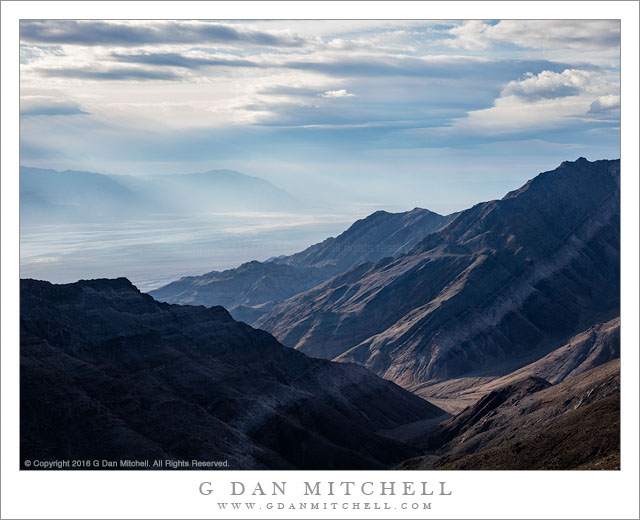
The eastern escarpment of the Sierra Nevada rises from desert hills to rugged aretes lit by dawn sun

Eastern Escarpment. Sierra Nevada, California. October 10, 2015. © Copyright 2015 G Dan Mitchell – all rights reserved.

The eastern escarpment of the Sierra Nevada rises from desert hills to rugged aretes lit by dawn sun

Depending on how you approach the range, the Sierra Nevada presents two quite different aspects to the visitor. For many decades, as a long time resident of the San Francisco Bay Area, I was only familiar with one of them. I always came to the range from the west, on long drives over coastal mountains and then across the Great Central Valley. As I approached the east side of the Valley I would encounter the low hills, at first almost imperceptible, that humbly mark the beginning of this might range. Because it tilts upward from the west, the western slopes are overall very gradual. Rising through these first low hills, the grass and oak covered landscape raises over a distance of many miles, and it is quite a while before the range starts to feel like “the mountains,” and many hours before the visitor arrives in the high alpine zone of rugged granite peaks. Even here, to the west of the crest there are plenty of gentle valleys and meadows.

The east side is a radically different world, as I finally began to understand two or three decades ago. The eastern base of the range is an arid near-desert place, made more so by Los Angeles’ historic draining of east side waters that once irrigated now-dry places and once filled today’s dusty playas with shallow lakes. The Sierra rises abruptly from this lower landscape, and in places you can look up nearly 10,000′ to the highest summits — you stand in desert and look at alpine peaks, and you see every zone in between. I made this photograph at dawn from one such valley location where the landscape that of sagebrush and playa and alkali lakes. From this spot I looked across low hills with the first coniferous trees toward the abrupt rise of the eastern foothills, backed by jagged and rugged slopes leading upward to high peaks.


G Dan Mitchell is a California photographer and visual opportunist. His book, “California’s Fall Color: A Photographer’s Guide to Autumn in the Sierra” is available from Heyday Books and Amazon.
Blog | About | Flickr | Twitter | FacebookGoogle+ | 500px.com | LinkedIn | Email


All media © Copyright G Dan Mitchell and others as indicated. Any use requires advance permission from G Dan Mitchell.
Slender Aspens, Autumn

Slender Aspens, Autumn
Slender aspen trees with fall foliage grow high on a Sierra Nevada slope

Slender Aspens, Autumn. Sierra Nevada, California. October 9, 2015. © Copyright 2015 G Dan Mitchell – all rights reserved.

Slender aspen trees with fall foliage grow high on a Sierra Nevada slope

Sierra Nevada aspens come in a tremendous variety of shapes and sizes. On rocky, dry slopes, where the trees seem to eke out an existence in truly marginal conditions, they are frequently small, with skinny branches and sometimes a bit of a haggard look. In other areas, perhaps influenced by the quality of the soil, they have stout trunks but never get very tall, instead growing in bent and twisted shapes. In a few places, often in the bottom of valleys, they may take on the classic aspen shape — tall trees with straight trunks — though this is less common in the Sierra than in some other places. Sometimes they grow very high on rugged slopes, like the trees in this photograph, and while they are relatively straight and shapely trees, they are also very small.

This group grows high on a slope above an area of dense, tall, and thick aspens, and those other trees usually attract more attention with their dense leaves and intense fall colors. But sometimes I almost like these smaller trees more, especially when some of their leaves have fallen and their bare, white trunks are more visible. Even more, I like to photograph them early and late in the day, when the light reflected into shaded areas warms and intensifies the colors and fills in the shadow.s


G Dan Mitchell is a California photographer and visual opportunist. His book, “California’s Fall Color: A Photographer’s Guide to Autumn in the Sierra” is available from Heyday Books and Amazon.
Blog | About | Flickr | Twitter | FacebookGoogle+ | 500px.com | LinkedIn | Email


All media © Copyright G Dan Mitchell and others as indicated. Any use requires advance permission from G Dan Mitchell.