Tag Archives: panamint

Red Cathedral, Zabriskie Point

Red Cathedral, Zabriskie Point
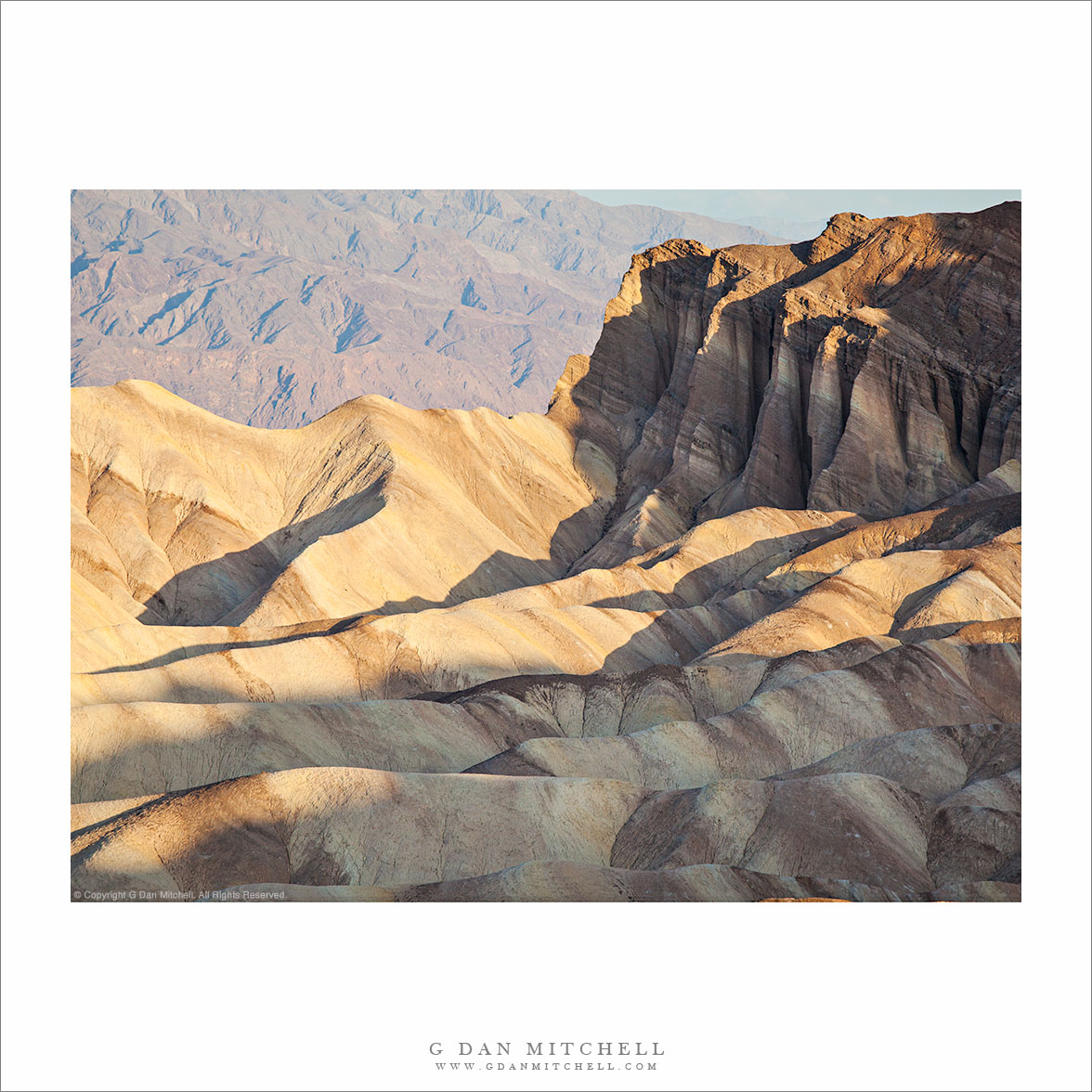
“Red Cathedral, Zabriskie Point” — Early morning light on the Red Cathedral and eroded terrain at Zabriskie Point, Death Valley National Park.

This photograph was made at what may be the most famous location in Death Valley, the overlook area at Zabriskie Point. The photograph does not include the famous view of the spire of Manley Beacon, which is just out of the frame to the left in this image. Instead, the photograph focuses on the “Red Cathedral,” a ridge to the right of Zabriskie that rises above the rest of the surrounding eroded hills, is a darker and reddish color, and presents a deeply eroded face.

It is not an easy subject to photograph, and I still have some additional ideas on how else I might approach the feature as a subject. Exposure is a challenge when shooting the Red Cathedral. At first, as light comes to other nearby areas, this feature remains dark. When the sun does finally arrive here – as it is in this photograph – it rakes across the foreground gullies, brightly illuminates the light-colored ridge to the right, and picks off a few small areas of the Red Cathedral while leaving others in deep shade. To add insult to injury, there is a good chance that a photographer will be set up in a position that eventually gives very flat front lighting to the ridge. I may this exposure very shortly after the sun hit Manley Beacon and just as it was starting to light up the foreground gullies and small hills.


Leave a comment or question using the form. (If you are reading this on the home page, click the article title to see the full article and the comment form.

G Dan Mitchell is a California photographer and visual opportunist. His book, “California’s Fall Color: A Photographer’s Guide to Autumn in the Sierra” (Heyday Books) is available directly from him. Blog | Bluesky | Mastodon | Substack Notes | Flickr | Email

All media © Copyright G Dan Mitchell and others.

From the Panamints to the Sierra

From the Panamints to the Sierra

From the Panamints to the Sierra. Death Valley National Park, California. April 1, 2009. © Copyright 2009 G Dan Mitchell – all rights reserved.

A landscape of high desert ridges and mountain ranges extends from Death Valley’s Panamint Range to the peaks of the southern Sierra Nevada in late afternoon light.

This lookout, high in the Panamint Range at the end of a gravel road, is one of my favorite places to be at the end of the day in Death Valley National Park. Perhaps because it is a bit less well-known, because it has a name that is harder to pronounce and remember than “Dantes View,” due to its location at the end of this gravel road which at one point passes along a very exposed section of the ridge, and because it is farther from some of the popular places to stay in the park the number of visitors here remains small. I frequently have the place completely to myself or perhaps share it with one or two others.

Behind the camera position is a stupendous view down into Death Valley itself, many thousands of feet below. But in the other direction, looking back towards the west, a series of rugged high desert valleys and mountain ranges extends all the way to the highest peaks of the southern Sierra Nevada range. In the morning, the front light can show the details of snow and rock on the summit of the Sierra, but in the evening the light crossing the intermediate ridges picks up late-afternoon haze and mutes the details of the scene.

G Dan Mitchell is a California photographer whose subjects include the Pacific coast, redwood forests, central California oak/grasslands, the Sierra Nevada, California deserts, urban landscapes, night photography, and more.
Blog | About | Flickr | Twitter | FacebookGoogle+ | 500px.com | LinkedIn | Email

Text, photographs, and other media are © Copyright G Dan Mitchell (or others when indicated) and are not in the public domain and may not be used on websites, blogs, or in other media without advance permission from G Dan Mitchell.

Badwater Salt Flats, Evening

Badwater Salt Flats, Evening

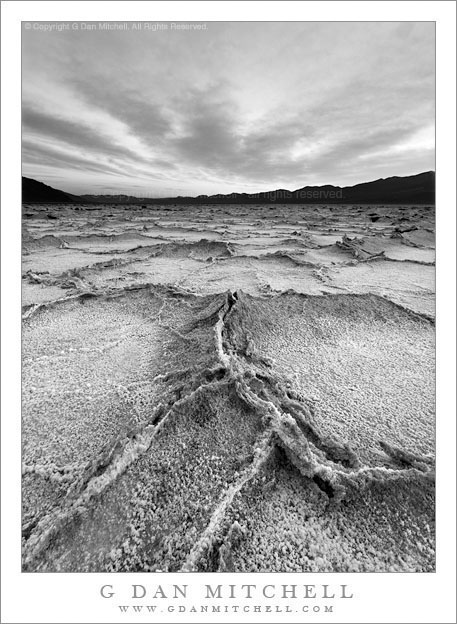
Badwater Salt Flats, Evening. Death Valley National Park, California. March 31, 2009. © Copyright 2009 G Dan Mitchell – all rights reserved.

Black and white photograph of rough patterns in the dried salt desert floor at Badwater Salt Flats, Death Valley National Park.

This is another of the “rediscovered photographs” that I uncovered while reviewing many years of raw files recently. Periodically I go through all of the old archived raw files, partly to cull out a few that I know that I’ll never use, but also because I know that whenever I revisit the old files I discover some photographs that I had forgotten or had never understood at the time I made them. Revisiting the old file archives, I’m sometimes shocked that I passed over certain images.

This one is from the salt flats at Badwater in Death Valley National Park. Technically, this was not shot at precisely “Badwater,” but it is close enough. I was out on the flats in the late afternoon, shooting as the sun dropped behind the Panamint Range. In my view, the best light – with the exception of days when clouds might tower above the Panamints – comes starting right about at the time that the sun passes the line of the ridge as it descends at the end of the day. This takes the incredibly bright and harsh sun off of the playa and provides softer light in the shadow of the range. However, this also presents a problem that almost everyone who has shot here must understand, namely that the illumination by the bright blue sky turns the “white” salt a surprisingly intense blue color. I’ve seen people handle this in a variety of ways: keep the intense, almost gaudy, blue color; do a lot of color correction to get colors that more closely correspond to what we recall seeing; mostly include the sky with its more intense colors; or let the colors go and do a black and white rendition.

Although I’ve “done” this subject in color a number of times, somehow this one seemed to call out for black and white. For one thing, it allowed me to use the interesting shapes of the evening clouds as a dramatic backdrop to the rough and broken shapes of the playa salt polygons. It also allowed me to try an interpretation that focuses on the dramatic potential of the scene.

G Dan Mitchell is a California photographer whose subjects include the Pacific coast, redwood forests, central California oak/grasslands, the Sierra Nevada, California deserts, urban landscapes, night photography, and more.
Blog | About | Flickr | Twitter | FacebookGoogle+ | 500px.com | LinkedIn | Email

Text, photographs, and other media are © Copyright G Dan Mitchell (or others when indicated) and are not in the public domain and may not be used on websites, blogs, or in other media without advance permission from G Dan Mitchell.

Abandoned Mining Cabin Ruins, Panamint Range

Abandoned Mining Cabin Ruins, Panamint Range

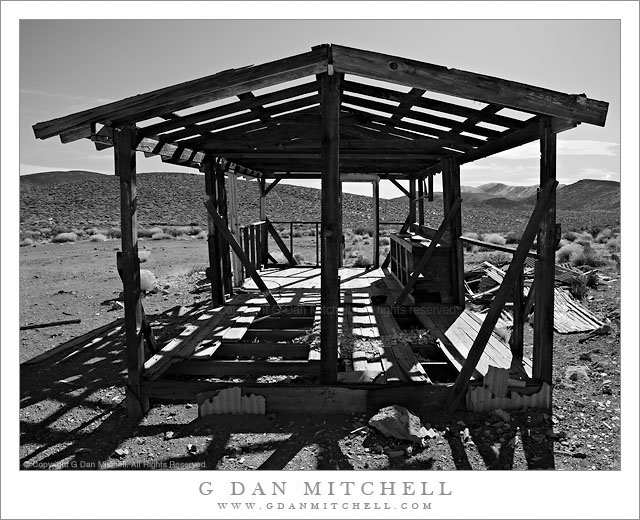
Abandoned Mining Cabin Ruins, Panamint Range. Death Valley National Park, California. March 29, 2011. © Copyright G Dan Mitchell – all rights reserved.

Black and white photograph of the ruins of an abandoned mining cabin high in the Panamint Mountain Range of Death Valley National Park.

There are a number of things that make Death Valley National Park, to the best of my knowledge, rather unique. One is the extensive history of human habitation inside the park boundaries, quite a bit of which is visible –  though some takes a bit more effort and attention to spot. The history of mining in the park is well-known, and many of the icons of the park have connections to this history. If you visit Furnace Creek, for example, you cannot miss the displays of old wagons and so forth used to move ore out of the Valley. It doesn’t take a lot of careful study to figure out that many park roads originated in an era of prospecting and mining. There are several well-known examples of structures left over from that era in and around the park, too.

It is largely because of this history that many areas of this national park are (or have been – some are now reverting to wilderness status) accessible by gravel road or four-wheel-drive routes. I would argue that you can’t really get to know this park if you just stick to the paved roads and the points of interest that they access. If you drive any of these other routes and keep your eyes open you will often be surprised by the left overs from relatively recent mining and prospecting, much of which isn’t really written about or described in the usual guides to the park. (And I’m not going to offer specific details about where to find such places here, since I don’t want to be even a little bit responsible for damage to them. If you do visit, treat them with care and respect.)

As I drove along a gravel road in one of the many mountain ranges of the park, returning from a site that is somewhat well-known, I began to notice evidence of fairly recent mining and prospecting. Faint tracks depart from the main “road” and cross valleys and hills, here and there tailing piles and mine entrances are visible, and sometimes you come across old structures such as cabins, storage bunkers, or wooden towers above mine entrances. I spotted the ruins of this old cabin above the road at one point and decided to walk up and investigate.

I’m almost always surprised at how “modern” many of the traces found at these places seem to be. I guess I am expecting something from the 1800s, but quite a few of these places look like they were build and occupied much later than that. I find modern things like linoleum flooring or modern-looking nails or electrical wire in many of them. There obviously isn’t much left of this cabin now, but from the detritus lying around near it and the form and materials found here, it must have been a reasonably comfortable place to live. As I walk around such places I often try to imagine what it must have been like to wake up every morning in this silent desert and head out for another day of physical labor.

G Dan Mitchell Photography | Flickr | Twitter (follow me) | Facebook (“Like” my page) | LinkedIn | Email
Text, photographs, and other media are © Copyright G Dan Mitchell (or others when indicated) and are not in the public domain and may not be used on websites, blogs, or in other media without advance permission from G Dan Mitchell.