Tag Archives: small

Sunset Virga

Sunset Virga
Sunset Virga

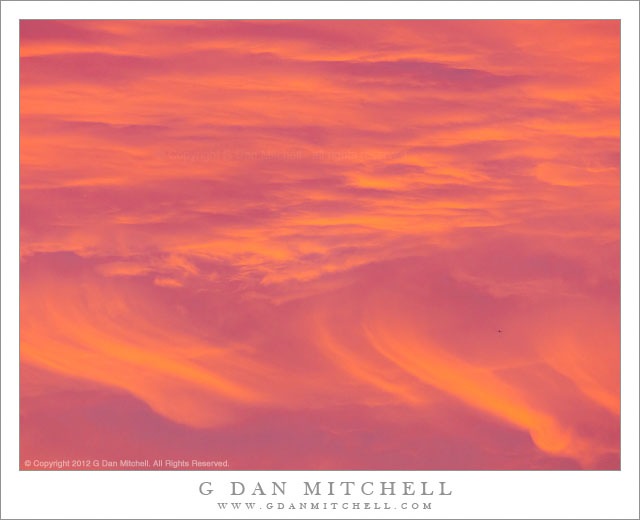
Sunset Virga. San Joaquin Valley, California. December 11, 2012. © Copyright 2012 G Dan Mitchell – all rights reserved.

Falling virga drifts below sunset clouds of an incoming late-autumn Pacific storm front

First off, the word “virga” refers to streaks or columns of precipitation that fall from clouds but do not make it to the ground. Virga can often create beautiful, delicate, and gossamer atmospheric effects, especially when the light is just right. In this case the condition was back and top-lit by low sunset light flowing upwards toward the base of high clouds from an incoming winter Pacific storm front.

This evening was (yet another) of those on which earlier unpromising conditions exploded with color right at the end of the day. We had spent the morning photographing birds (mostly geese) at a Central Valley wildlife refuge, taken a short lunch break, and then returned to the refuge for late afternoon and evening photography. The geese were wonderful and we made a lot of photographs, but it seemed like the light was going to “die” before sunset as those high clouds began to drift in from the west. That’s OK, as there are ways to photograph in that more subdue light, but I think we may have been mildly disappointed that the clouds appeared to preclude special sunset colors. So we went about our business of photographing birds, not thinking too much about the sky. Speaking for myself, though, at some point I began to notice a bit of color in the clouds behind the birds. I stopped for a moment and looked to the east (where the sunset colors first are seen before the sweep across the sky toward the setting sun) and noticed that some color was developing. In short order, the underside of the clouds began to light up, and right at sunset we were treated to an absolutely brilliant display of intense color to the west. Since I was shooting with a long telephoto I decided to try a few detail shots of small sections of the sky. If you look very carefully, you might be able to spot a jetliner heading into the sunset.

G Dan Mitchell is a California photographer and visual opportunist whose subjects include the Pacific coast, redwood forests, central California oak/grasslands, the Sierra Nevada, California deserts, urban landscapes, night photography, and more.
Blog | About | Flickr | Twitter | FacebookGoogle+ | 500px.com | LinkedIn | Email

Text, photographs, and other media are © Copyright G Dan Mitchell (or others when indicated) and are not in the public domain and may not be used on websites, blogs, or in other media without advance permission from G Dan Mitchell.

Autumn Leaves, Layered Sandstone with Diagonal Crack

Autumn Leaves, Layered Sandstone with Diagonal Crack

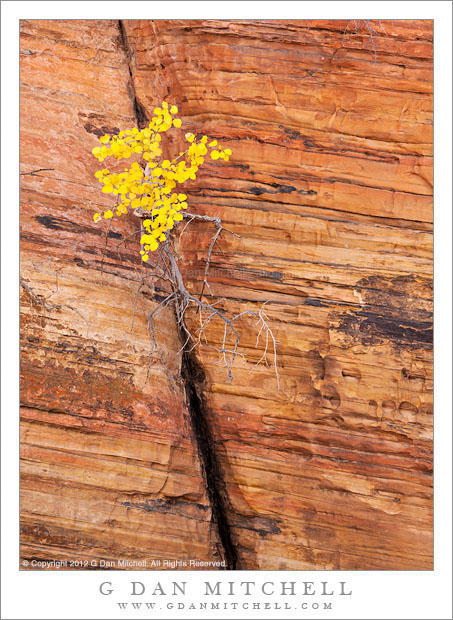
Autumn Leaves, Layered Sandstone with Diagonal Crack. Zion National Park, Utah. October 22, 2013. © Copyright 2013 G Dan Mitchell – all rights reserved.

A small plant with yellow autumn leaves grows from a diagonal crack in wall of layered sandstone, Zion National Park

I’ll start off by admitting that I now don’t recall exactly where I made this photograph on this day when we visited Zion National Park. I’m virtually certain that it in the high country along the Mt. Carmel Highway that crosses the park from east to west, but where on that highway I’m not certain. Of course, some crack in the rock with a bush growing out of it hardly is likely to be an iconic, named location!

What I do recall is that we spent a good portion of this first trip’s first day in Zion along this road, and to some extent driving back and forth along it a few times, watching for new subjects as the day’s light evolved. At times a cliff that had been in sun earlier in the day would be in shadow later, so we had a choice to photograph in soft light or harsh. All along this roadway there were the usual interesting subjects – sedimentary rock formations of all sorts and all colors – but also at this time of year the fall color show was beginning. I believe that this little vignette might have been down in one of the washes or slot canyons that we dropped into in search of this color.

G Dan Mitchell is a California photographer and visual opportunist whose subjects include the Pacific coast, redwood forests, central California oak/grasslands, the Sierra Nevada, California deserts, urban landscapes, night photography, and more.
Blog | About | Flickr | Twitter | FacebookGoogle+ | 500px.com | LinkedIn | Email

Text, photographs, and other media are © Copyright G Dan Mitchell (or others when indicated) and are not in the public domain and may not be used on websites, blogs, or in other media without advance permission from G Dan Mitchell.

Room for the Big Deep Bend

Room for the Big Deep Bend
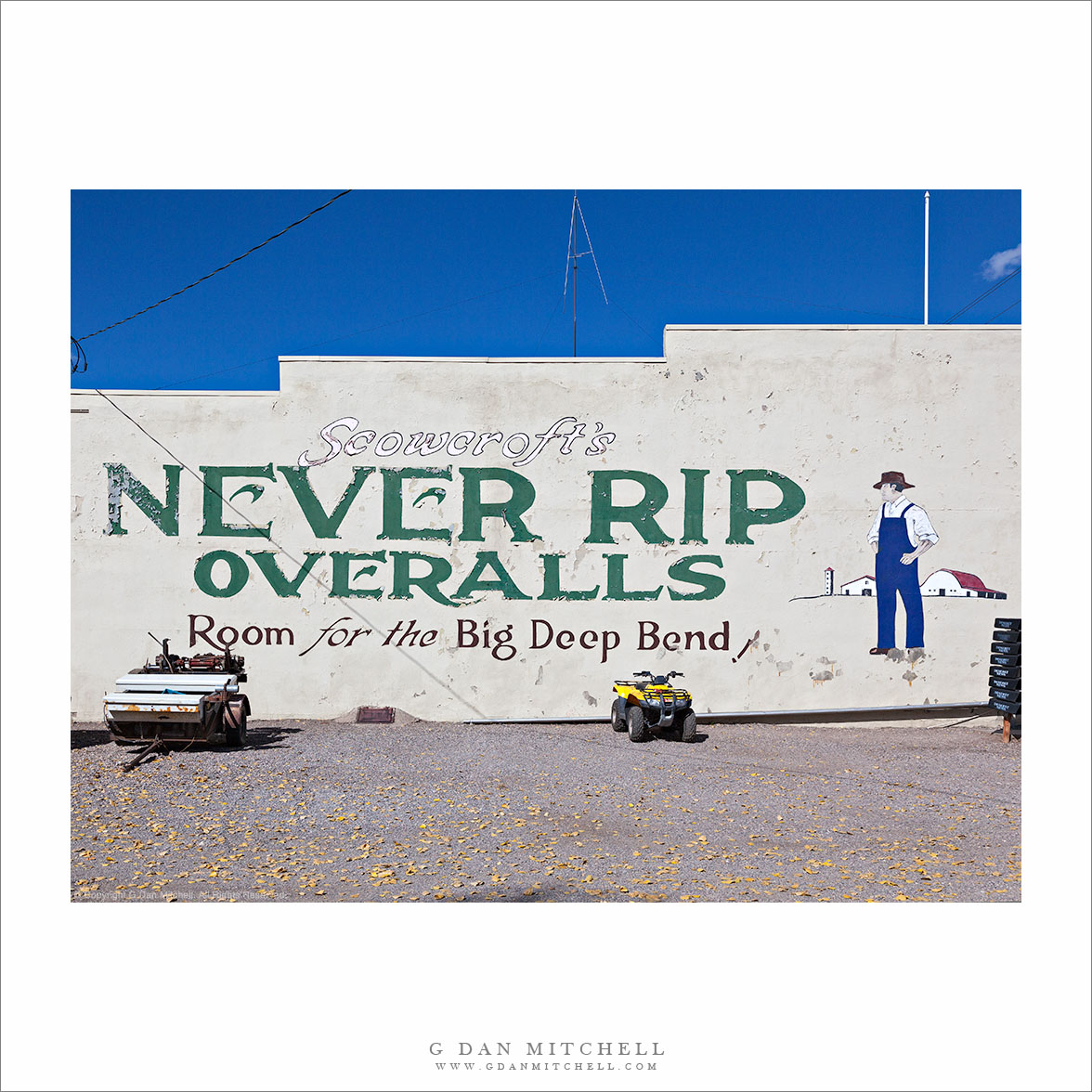
“Room for the Big Deep Bend” — Scowercroft’s Never Rip Overalls – Room for the Big Deep Bend

At about the time I made this photograph, we were staying in Torrey, Utah for a few days. Instead of doing the obvious thing and heading east to visit Capitol Reef National Park again, we headed west towards points unknown but including the Fish Lake area. We passed through small towns whose lives seemed more divorced from the tourist trade than others we had been through along route 12, and eventually turned off the main highway to head up to Fish Lake. It turned out that, at least partially as a result of my decision to not do too much research ahead of time, we had missed the main fall color season there and that, in fact, the whole place was pretty much shutting down for the season. We poked around a bit here before reversing direction and heading back to highway 24.

Rather than end our exploration quite so soon, we continued on along highway 24, soon turned off into the Valley where Koosharem is located. I cannot recall now what drove the decision to go there – perhaps the unusual name of the place or maybe the possibility of getting to mountains on the far side of the valley – but there we went. We initially pretty much drove right through Koosharem and on out into the country on the other side of town, but we soon stopped and decided that this was not the direction we really wanted to go. We turned around and headed back towards Koosharem. This time a few things caught our attention, including the plain architecture of certain buildings in the town and the surprising – to us, anyway – appearance of this antiquated looking, though clearly kept up, sign on the side of this building next to a leave littered parking area that also held an ATV and some sort of small trailer. I wondered about this sign and the advertising copy it contained, and I later found out that Scowercroft and Sons was a fairly large manufacturer of clothing centered in Ogden.


Leave a comment or question using the form. (Click the title to see the full article and to comment if you are viewing it on the home page.)

G Dan Mitchell is a California photographer and visual opportunist. His book, “California’s Fall Color: A Photographer’s Guide to Autumn in the Sierra” (Heyday Books) is available directly from him. Blog | Bluesky | Mastodon | Substack Notes | Flickr | Email

All media © Copyright G Dan Mitchell and others.

Some Thoughts on Aperture and DOF and Related Issues

(This post is slightly adapted from something I recently posted in a photography forum in which hyperfocal distance, “DOF calculation” software, and related issues were under discussion.)

Shooting as a way to learn to understand how things like depth of field or “hyperfocal distance” work is a great idea – it is perhaps the best way to understand these concepts. I firmly believe that it is better than relying on tools such as software DOF (“depth of field”) calculators or tables. Fortunately, it is easy to do some basic experiments related to aperture and DOF and the so-called hyperfocal distance.

(The term hyperfocal distance can be interpreted in a couple of ways. In photography, this is often thought of as the distance at which you might focus in order to place objects at different distances in focus. If there is an object that is 15 feet from the camera and there are important subjects at infinity, the hyperfocal distance lies beyond the object that is 15 feet away and closer than the far away objects that might be in focus with the lens set to “infinity.”)

To find out about the effect of aperture on DOF, try the following:

  1. Put the camera on a tripod and compose some reasonable test image that includes subjects at various distances from the camera position, with a primary subject somewhere between the closest and the furthest.
  2. Focus on your primary subject within the scene.
  3. Shoot a series of images at apertures ranging from the largest to perhaps f/16 – shoot at f/1.4, f/2, f/2.8, etc. You might want to go as far as f/22 on full frame.*
  4. If you want to be a bit more methodical, you can use your DOF tables/software to “calculate” your hyperfocal distance, focus there, and repeat the process – but, frankly, I wouldn’t bother.
  5. Spend some time – likely well under an hour – looking over the results on your computer. If possible, make a few small prints to confirm the relevance (or not) of what you observe on the screen.

Another great way to understand the effect of aperture on the depth of field in your shot is to shoot in live view mode on your DSLR. Here you can press the DOF preview button, zoom in the live view display to 5x or 10x magnification, and pan around the magnified image on the rear display to see a very good approximation of the effect of your aperture choice on elements of the scene at various distances from the camera.

SIMPLIFICATION: A SECRET

Let me share a little secret. From reading some photography forum posts, you might get the idea that lots of photographers are going around making careful and technical calculations of precise hyperfocal distance and DOF and all the rest and then making exactingly accurate choices about aperture for each shot. In general, it doesn’t work that way in the real world, where photographers often tend to select aperture in basically three ways:

  1. In a shot where the subject doesn’t have a lot of depth and DOF isn’t really an issue, we tend to shoot at some default aperture that we believe is more or less optimal for overall resolution, corner resolution, and perhaps vignetting. On full frame, this might frequently be roughly f/8, though there are reasons to vary from that a bit sometimes.
  2. When working a subject on which we want very large DOF, we tend to go straight to the smallest aperture that we feel will produce large DOF and very good resolution. For me, this is typically f/16 on full frame, it might be no smaller than f/11 on cropped sensor cameras. There are situations in which I might use a smaller aperture, but they are very rare and will involve acceptance of some tradeoffs.
  3. When faced with a shot in which we want very narrow DOF, we tend to open up as much as we think we can, perhaps tending toward the largest aperture on the lens we are using. There are some additional factors to consider here, but I’ll leave them out for now in the spirit of simplifying.

So, a simple generalized approach:

  • Shoot at some middle-of-the-road aperture when DOF isn’t a major concern.
  • Shoot at the smallest acceptable aperture when you want large DOF – f/16 on full-frame or f/8-f/11 on crop.
  • Open way up when you want to minimize DOF.

This approach works in a wide range of real-world photographic situations, and it is especially useful to begin with it when you have to work quickly. There will be situations in which these are simply starting points, and you’ll need to make some modifications – for example, in very low light you might not be able to use that very small aperture if you are shooting hand-held, or your largest aperture might produce DOF that is too narrow for some subjects, and so on. But starting with this simple basic concept, using live view DOF preview when appropriate, and learning from experience will likely move you a lot further along on the road towards understanding and making effective use of aperture/DOF than trying to rely on some DOF calculator. (Depite their appearance of accuracy, these calculators depend on a bunch of assumptions that may not match up with your photography.)

* You can stop down further on cameras with larger sensors before you run into issues with diffraction blur, a softening of the overall image that occurs with the smallest apertures. To generalize, while you can stop down to roughly f/16 on a full frame and still produce very sharp images, you might want to avoid such a small aperture on your cropped sensor DSLR, perhaps avoiding anything smaller than about f/11… and you might want to be a bit cautious about using f/11.

© Copyright 2012 G Dan Mitchell – all rights reserved.

G Dan Mitchell is a California photographer whose subjects include the Pacific coast, redwood forests, central California oak/grasslands, the Sierra Nevada, California deserts, urban landscapes, night photography, and more.
Blog | About | Flickr | Twitter | FacebookGoogle+ | 500px.com | LinkedIn | Email

Text, photographs, and other media are © Copyright G Dan Mitchell (or others when indicated) and are not in the public domain and may not be used on websites, blogs, or in other media without advance permission from G Dan Mitchell.