
Tag Archives: sunrise

First Light, Southern Death Valley

First Light, Souithern Death Valley - As seen from Aguereberry Point, first dawn light spills across the lower end of Death Valley.
As seen from Aguereberry Point, first dawn light spills across the lower end of Death Valley.

First Light, Southern Death Valley. Death Valley National Park, California. January 5, 2012. © Copyright 2012 G Dan Mitchell – all rights reserved.

As seen from Aguereberry Point, first dawn light spills across the lower end of Death Valley.

I have previously photographed from this location high in the Panamint Range and overlooking a vast portion of Death Valley National Park and its surroundings. The view stretches east to 11,000+’ peaks in Nevada and west to the crest of the Sierra Nevada, and great distances north and south to places and features that I cannot identify. My previous visits had all been late in the day, and I had often wondered what the location might be like at the start of the day. So, on this visit to Death Valley, a trip to Aguereberry Point before dawn was on my agenda.

As usual, I awoke well before dawn at my camp site back at Stovepipe Wells. (You can often tell if there are other photographers about – in the dark period an hour or more before sunrise you hear people quietly get up, quickly start their engines, and drive away.) I headed up into the Panamints and turned off at the start of the six-mile gravel road that goes to this point, and arrived just before the first colorful light began to light up the sky – and I was pleased to see that there were some interesting clouds. I have been fascinated by this view over the shoulder of a ridge dropping down toward the Valley above Trail Canyon, so I composed a photograph that juxtaposed this diagonal with the end of the Black Mountains across the valley and the light-filled atmosphere beyond where the very first sun was coming across lower Death Valley.

G Dan Mitchell is a California photographer whose subjects include the Pacific coast, redwood forests, central California oak/grasslands, the Sierra Nevada, California deserts, urban landscapes, night photography, and more.
Blog | About | Flickr | Twitter | FacebookGoogle+ | 500px.com | LinkedIn | Email

Text, photographs, and other media are © Copyright G Dan Mitchell (or others when indicated) and are not in the public domain and may not be used on websites, blogs, or in other media without advance permission from G Dan Mitchell.
Ridge Above Tucki Wash, Dawn

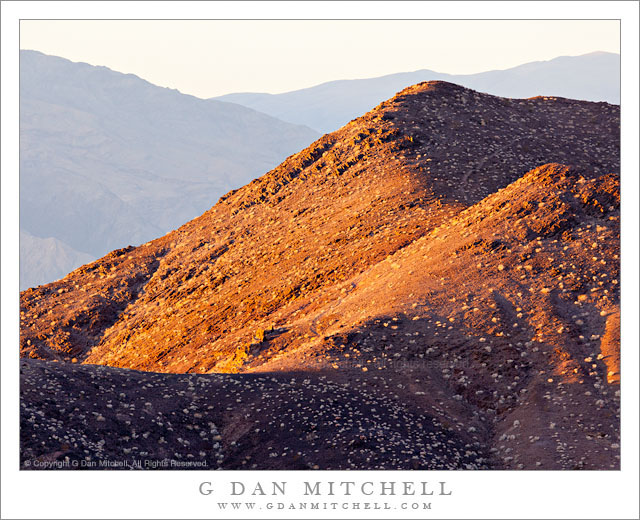
Ridge Above Tucki Wash, Dawn - First dawn light on a stratified ridge above Tucki Wash along the base of the Panamint Range, Death Valley National Park.
First dawn light on a stratified ridge above Tucki Wash along the base of the Panamint Range, Death Valley National Park.

Ridge Above Tucki Wash, Dawn. Death Valley National Park, California. January 5, 2012. © Copyright 2011 G Dan Mitchell – all rights reserved.

First dawn light on a stratified ridge above Tucki Wash along the base of the Panamint Range, Death Valley National Park.

I spent a good portion of the week following New Year’s Day in Death Valley National Park. My goals were to earlier in the seasons when the days were shorter and more “good light” was available, to perhaps encounter cloudy skies from a passing weather system or two, and to both shoot some new subjects and shoot some familiar ones in somewhat different ways. I think that I succeeded with most of these goals, though those storm front clouds were elusive. (This is a very strange and troubling season for California weather. At a time when the Sierra are usually covered in winter snows… all of the high trans-Sierra passes are still open, and the east side of the range looks pretty much like it might normally look in, say, July.)

On one morning I decided to visit a favorite overlook high in the Panamint Range very early in the morning. I’ve shot here a number of times in the past, but always late in the day during sunset and dusk hours. While getting up an hour and a half before dawn to drive to such a place is always a bit of a challenge, at least the sunrise isn’t quite as early at this time of year. On the other hand, it is colder! (Those unfamiliar with the Death Valley seasons may think of it as an entirely hot and dry place, but it gets quite cold there this time of year.) When I got up the temperature down in the Valley at my camp site at Stovepipe Wells was in the thirties. Surprisingly, the temperature rose into the low fifties as I ascended into the mountains, and when I reached my goal at a bit above 6000′ it was no colder than the Valley at this hour.

I arrived before dawn, but just as the pre-dawn light show was beginning. On this morning I had perhaps the best clouds of the entire trip, and they lit up shortly after I arrived and got my equipment ready. (Photos of that moment will likely come a bit later.) As the sun finally rose above the horizon the interesting light began to work its way down, starting with the higher peaks and then descending past the lower ridges to finally reach the Valley itself. This photograph shows the first light striking an unnamed (as far as I’ve been able to determine) spur ridge the projects eastward into the Valley from the massive bulk of Tucki Mountain. In the far distance are the low mountains and washes along the far side of the Valley, and the are also just beginning to pick up the first light.

Shooting in these rapidly evolving conditions that are not entirely predictable is more of an action sport than a sedate and contemplative experience, at least during the first minutes of light as it works its way across and down the landscape, often surprising me by showing up in places I had not thought to look. At one point I had photographed the cloud-filled sky but lamented a bit that the mountains below that shot were a bit dark and drab. I look away for a moment and when I looked back this intense and saturate light had hit those very mountains… so I turned and quickly began to photograph them.

G Dan Mitchell is a California photographer whose subjects include the Pacific coast, redwood forests, central California oak/grasslands, the Sierra Nevada, California deserts, urban landscapes, night photography, and more.
Blog | About | Flickr | Twitter | FacebookGoogle+ | 500px.com | LinkedIn | Email

Text, photographs, and other media are © Copyright G Dan Mitchell (or others when indicated) and are not in the public domain and may not be used on websites, blogs, or in other media without advance permission from G Dan Mitchell.

Alcatraz Island, Dawn Sky

Alcatraz Island, Dawn Sky

Alcatraz Island, Dawn Sky. San Francisco, California. December 10, 2011. © Copyright 2011 G Dan Mitchell – all rights reserved.

Dawn light gently lights the morning clouds about San Francisco Bay haze and Alcatraz island.

After photographing the lunar eclipse over the Golden Gate Bridge – along with many hundreds of other photographers – I stuck around and turned my attention to other subjects, too. As sky began to lighten with the approaching dawn, and the eclipsed moon sank into the high clouds and generally murky atmosphere over the Pacific coast, I began to see other photographers look around and notice other elements of this urban landscape. But, surprisingly the larger number simply packed up their gear and left as soon as it became hard to see the moon!

I was quite surprised, to say the least. One one hand, it was something to see that so many photographers and other viewers had gotten up at a very early pre-dawn hour just to assemble and together watch this celestial event. On the other, once along the shore of this beautiful bay at sunrise on a mysteriously hazy morning, I’d expect that they might want to look around and try to sustain the experience. (OK, it was cold. They probably wanted coffee. And breakfast. But, still!) In any case, within a surprisingly short period of time, where people had been lined up almost tripod-to-tripod a few minutes earlier, there were few at all left to see the sunrise color come to the high clouds above the bay, here with the misty shape of Alcatraz along the horizon.

G Dan Mitchell is a California photographer whose subjects include the Pacific coast, redwood forests, central California oak/grasslands, the Sierra Nevada, California deserts, urban landscapes, night photography, and more.
Blog | About | Flickr | Twitter | FacebookGoogle+ | 500px.com | LinkedIn | Email

Text, photographs, and other media are © Copyright G Dan Mitchell (or others when indicated) and are not in the public domain and may not be used on websites, blogs, or in other media without advance permission from G Dan Mitchell.

Tuolumne River Below Glen Aulin, Morning

Tuolumne River Below Glen Aulin, Morning

Tuolumne River Below Glen Aulin, Morning. Yosemite National Park, California. September 16,2011. © Copyright 2011 G Dan Mitchell – all rights reserved.

Early light on morning clouds above the Tuolumne River Canyon below Glen Aulin, Yosemite National Park.

This is the same bend in the Tuolumne River, located below Glen Aulin and before the river descends toward Waterwheel Falls and eventually the abomination of Hetch Hetchy Reservoir, that was shown in a photograph of late afternoon light that I posted here a few days ago. This time it was early morning. We had been up well before sunrise and had wandered off in various directions to find early morning photographic subjects. My main goals were the cascading water along the edge of this section of the river (a bit of which is visible in the lower portion of the frame) and a granite bowl to the right of this view. As I came over the rise above this area before descending I saw the beautiful sparse clods to the west, probably extending to the edge of the Sierra and still with pastel colors from dawn light.

A technical observation about this photograph. This scene presented a technical challenge in the form of an extremely wide dynamic range between the bright and red-saturated first direct sunlight on the ridge at upper left and the much darker areas of forest in shade along the river and in the foreground. With a digital exposure, in a scene like this one, the primary rule for me is “don’t blow out the highlights.” If I had overexposed the sky the clouds would have turned into pure white, texture-free blotches and that bit of early sun on the rocks would have lost detail and taken on a very strange coloration. However, an exposure that protects the highlights in a scene like this one can leave the shadows nearly black. While it is possible to “fix” that a bit in post, the result is not necessarily very good when the dynamic range is very large. One “traditional” solution would have been to use a graduated neutral density filter (or “GND”) that blocked some of the brightest areas at the top of the frame while not affecting the lower 2/3 or so. But I don’t use them, and in this case the result would not have been totally wonderful since the same filtering that would reduce sky brightness would also make the large granite dome at the right end up nearly black at the top.

So instead of filtering at the time of exposure, I decided that I would use the roughly comparable, but more flexible, “exposure blending” techniques in post. With that in mind I made several photographs at different exposures – some at shorter shutter speeds to avoid the blown out highlights and others at increasingly slower shutter speeds to reveal the shadow detail that my eyes could see but which the camera otherwise could not. During the post-production phase, I selected two of the exposures, one that was as bright as possible but without blowing out the sky and sunlight, and the other two stops lighter to reveal that shadow detail in a way that seemed consistent with what I recall the scene actually looked like. The two source images were carefully adjusted during raw conversion and their two layers carefully aligned. With the darker image (the one with the “good” sky) on the top, I began to “paint” out the mask to reveal the details of the foreground forest, river, and rocks. (In answer to the expected question, this is not the same as HDR. That is a more or less automated process that works in a different way. Exposure blending is typically a manual process that relies a great deal on the photographers judgment and recall of the actual scene.)

G Dan Mitchell is a California photographer whose subjects include the Pacific coast, redwood forests, central California oak/grasslands, the Sierra Nevada, California deserts, urban landscapes, night photography, and more.
Blog | About | Flickr | Twitter | FacebookGoogle+ | 500px.com | LinkedIn | Email

Text, photographs, and other media are © Copyright G Dan Mitchell (or others when indicated) and are not in the public domain and may not be used on websites, blogs, or in other media without advance permission from G Dan Mitchell.