
Tag Archives: travel

Red Cliffs, Dawn

Red Cliffs, Dawn
Red Cliffs, in dawn light, in front of Death Valley and distant desert mountains.

Red Cliffs, Dawn. © Copyright 2023 G Dan Mitchell.

Red Cliffs, in dawn light, in front of Death Valley and distant desert mountains.

During my January visit to Death Valley National Park I ended up exploring this scene over a period of several days. My ability to travel more widely in the park was limited by storm-related road closures, so I took a closer look than usual at areas nearer main attractions. The first time I was in this area I missed the good light but saw potential, so I returned later on scout more thoroughly. (That led to a lovely, solitary hike up a long wash that doesn’t seem to get many visitors.) I went back for a third time, arriving well before sunrise and photographing until the light became less compelling.

There’s a whole lot of “Death Valley stuff” in this photograph. The foreground includes eroded badlands terrain with multi-colored soils. Above this a band of rugged red cliffs catches the day’s first direct sunlight. Further in the distance immense salt flats are still in shadow, and near the limits of visibility another big mountain range rises through the atmospheric haze.


G Dan Mitchell is a California photographer and visual opportunist. His book, “California’s Fall Color: A Photographer’s Guide to Autumn in the Sierra” is available from Heyday Books, Amazon, and directly from G Dan Mitchell.

Blog | About | Twitter | Flickr | FacebookEmail

Links to Articles, Sales and Licensing, my Sierra Nevada Fall Color book, Contact Information.

Scroll down to leave a comment or question. (Click this post’s title first if you are viewing on the home page.)


All media © Copyright G Dan Mitchell and others as indicated. Any use requires advance permission from G Dan Mitchell.
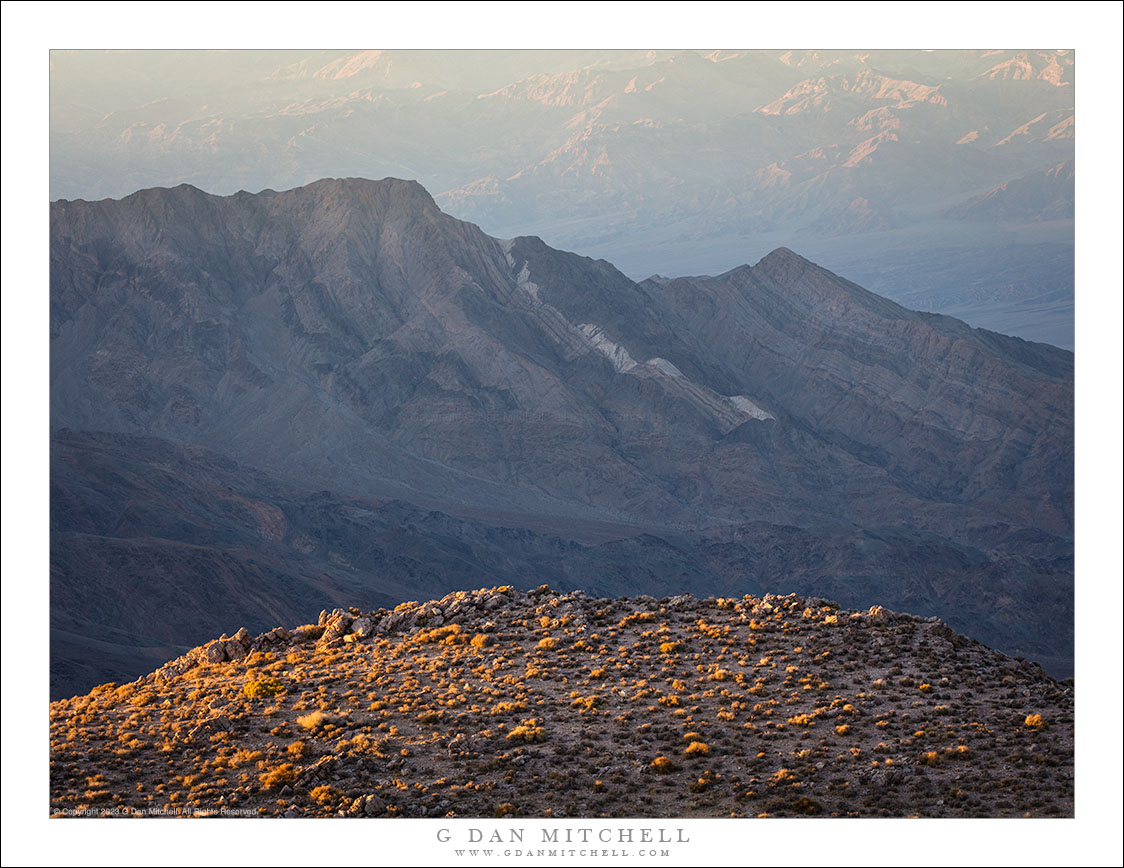
Distant Mountains

Distant Mountains
The east escarpment of the Panamint Range rises above Death Valley Hills in morning light.

Distant Mountains. © Copyright 2023 G Dan Mitchell.

The east escarpment of the Panamint Range rises above Death Valley Hills in morning light.

As I keep saying when I post Death Valley photographs (yeah, broken record…) the distances there are immense. As a result, atmospheric haze often has a distinct effect on photographs of the larger landscape. This can be challenging — the effect on colors is not always attractive. But it also can enhance the sense of depth in the image. A friend of mine refers to the effect as “atmospheric recession,” though I understand that the better known term may be “atmospheric perspective.” The colors shift, contrast decreases, and fine details can be diminished.

This photograph clearly makes use of the effect. I was photographing across Death Valley from an elevate position with a very long focal length. The low foreground hills are a good distance away, but not so far that they are strongly affected by haze — thus the greater contrast and especially the dark shadows. But the lower slopes of the Panamint are many miles away, and the haze has a big effect of their appearance.


G Dan Mitchell is a California photographer and visual opportunist. His book, “California’s Fall Color: A Photographer’s Guide to Autumn in the Sierra” is available from Heyday Books, Amazon, and directly from G Dan Mitchell.

Blog | About | Twitter | Flickr | FacebookEmail

Links to Articles, Sales and Licensing, my Sierra Nevada Fall Color book, Contact Information.

Scroll down to leave a comment or question. (Click this post’s title first if you are viewing on the home page.)


All media © Copyright G Dan Mitchell and others as indicated. Any use requires advance permission from G Dan Mitchell.
Mountains and Fan, Morning

Mountains and Fan, Morning
Morning light on desert mountains and an immense alluvial fan, Death Valley National Park.

Mountains and Fan, Morning. © Copyright 2023 G Dan Mitchell.

Morning light on desert mountains and an immense alluvial fan, Death Valley National Park.

The scale of the landscape in Death Valley is difficult to comprehend. Vistas often encompass huge distances — it isn’t uncommon to be looking at mountains that are tens of miles away, sometimes many tens of miles. Entering this landscape on foot often reveals this truth: An alluvial fan that looks relatively manageable from a distance might take a hour or several to cross.

I made this photograph just after dawn. It looks across Death Valley toward the base of the Panamint Range, rugged and tall mountains topped by Telescope Peak, the highest point in the park. I used a long lens, which drastically compresses the distance. If you were to set out to walk to that wash on the distant alluvial fan at the base of the mountains it would take you at least a day to get there.


G Dan Mitchell is a California photographer and visual opportunist. His book, “California’s Fall Color: A Photographer’s Guide to Autumn in the Sierra” is available from Heyday Books, Amazon, and directly from G Dan Mitchell.

Blog | About | Twitter | Flickr | FacebookEmail

Links to Articles, Sales and Licensing, my Sierra Nevada Fall Color book, Contact Information.

Scroll down to leave a comment or question. (Click this post’s title first if you are viewing on the home page.)


All media © Copyright G Dan Mitchell and others as indicated. Any use requires advance permission from G Dan Mitchell.
Moving On: Fujifilm XPro2 to XT5

The XPro is dead! Long live the XPro! That’s not the main subject of this essay, but based on tea-leaf reading and my own experience with the XT5 I think that’s where we are headed. I’ll get to why I think so near the end of this article.

This article is primarily aimed at Fujifilm users (and potential users) considering the retro XPro design versus the recently released (DSLR-style) mirrorless XT5. It is partly about techie camera stuff, but it is also a story about letting go of preconceptions and adapting to something new.

Since some readers may be unfamiliar with the cameras, here’s a quick summary.

XPro2 — The XPro2 is one of three Fujifilm “XPro” bodies — originally the XPro1 , the subsequent XPro2, and the most recent XPro3. These are rangefinder-style cameras with retro appeal due to their similarity to classic rangefinder film cameras and the inclusion of full manual controls. A key feature is the hybrid viewfinder system combining an old-school optical viewfinder (OVF) and a modern electronic viewfinder (EVF). The XPro2 has a 24MP APS-C sensor, while the newer XPro3 has a 26MP sensor.

XT5 — The XT5 is the most recent (as of this writing) in Fujifilm’s series of XT cameras that combine a small DSLR-like mirrorless body with a full set of manual controls, similar to what is found on the XPro bodies. This new camera uses an updated 40MP sensor — previous models (XT1-4) used 16MP, 24MP, and most recently 26MP sensors.

Fujifilm XT5 (l) and XPro2 (r) with Fujifilm 27mm f/2.8 lenses.

Because virtually all models in a generation of Fujifilm cameras use the same sensor, Fujfilm owners are more attentive to other functional differences between them. That is why I’ll focus on those things and say little about the sensor.

Continue reading Moving On: Fujifilm XPro2 to XT5