Tag Archives: tree

Alpenglow, Mount Conness

Alpenglow, Mount Conness

Alpenglow, Mount Conness. Yosemite National Park, California. June 18, 2011. © Copyright G Dan Mitchell – all rights reserved.

The last evening light illuminates domes near Tenaya Lake and the summit of Mount Conness with briilliantly colorful alpenglow, Yosemite National Park.

The tall peak at upper left is the summit of Mount Conness, one of the highest peaks in Yosemite National Park. The peak is located on the park boundary and the Sierra Nevada crest a bit north of Tioga Pass, and is visible from many places in the Tuolumne/Tioga high country. It is also a popular destination for peak baggers. The left foreground granite dome is the lower face of Polly Dome, which drops to the shoreline of Tenaya Lake. The left slope of Pywiak dome is visible in the shadows at lower right and beyond is the more brightly illuminated Medlicott dome.

I forgive you if you don’t believe the colors that you see in this photograph. I barely believe them myself, and I was (obviously!) there for the show. What happened on this evening was a near perfect example of a light phenomenon that Sierra photographers watch for and are occasionally lucky enough to experience. I have learned to see the signs that indicate that this light is possible, but also to understand that even when the conditions offer this potential that they rarely deliver.

On certain cloudy evenings in the Sierra it appears that there will be no sunset color – everything is hazy and drab and washed out. But if things play out just right, this very set of drab conditions (that induce some photographers to put away their gear too soon!) can produce some of the most striking and intense color possible if a few things fall into place just right. On this evening I had stopped for a moment at Olmsted Point, thinking to photograph ice-covered Tenaya Lake with a long lens and including the mass of Mount Conness in the distance. When I arrived there, things were about as unpromising as they could possibly be. A dull, greenish-blue haze hung in the air, overcast washed out the light, and Conness was obscured by clouds. I had actually put my gear back in the car when I looked back up and noticed that the summit of Conness had briefly poked through the clouds, accentuating its bulk and the sense that it towered over the foreground mountains. The light was still awful (I have the photos to prove it! ;-) but I thought I’d see if I could get something with the peak emerging from its shroud.

But still nothing much happened. I turned the camera to photograph some nearby trees and a blackbird that was looking for snacks. Then I noticed that there was some brighter light to the southwest and I began to consider the possibility that the cloud cover might end a bit to the west – and that is requirement #1 for the light conditions I’m describing. If the cloud deck ends to the west, as the sun reaches the horizon it may briefly break under the clouds and send brilliantly colorful light up into the clouds in the Sierra from below, creating a miles-wide light panel of the most astonishing colors. But still, it was hazy and the peaks were shrouded in clouds. But then I noticed that the clouds around Conness were beginning to drift off to the east and thin a bit. I mentioned (knock on wood!) to one of the other photographers that there was a possibility of “miracle light,” but that I wasn’t making any promises!

Then the thinning clouds began to pick up a slight pink tinge and the left side of Conness began to get some light directly from the west. Then, within a minute or so, the colors went absolutely crazy. People around me were audibly gasping as the color changed. At one point several of us spontaneously looked up to the west when we noticed the light suddenly increase out of the corners of our eyes. At the same time, the clouds almost completely dissipated from the area around the peak and because the whole sky was filled with brilliantly colorful clouds, this light began to suffuse even the depths of the canyon and slopes facing away from the sunset with this amazing light.

Never put your camera away until the last light is gone. :-)

G Dan Mitchell Photography | Flickr | Twitter (follow me) | Facebook (“Like” my page) | LinkedIn | Email
Text, photographs, and other media are © Copyright G Dan Mitchell (or others when indicated) and are not in the public domain and may not be used on websites, blogs, or in other media without advance permission from G Dan Mitchell.

Alpenglow, Mammoth Peak

Alpenglow, Mammoth Peak

Alpenglow, Mammoth Peak. Yosemite National Park, California. July 22, 2010. © Copyright G Dan Mitchell – all rights reserved.

Alpenglow lights the face of Mammoth Peak beyond a small tarn near the summit of Tioga Pass, Yosemite National Park.

This was very close to the last exposure I made on this productive late-July day last year. After photographing for a few hours in the vicinity of Tioga Pass, I ended up right at the pass as the day came to an end. Braving hordes of mosquitos – comes with the territory! – I worked the area around the pass itself, building compositions out of juxtapositions of the water in the small meltwater ponds, shoreline meadow and boulders, grasses growing along the edge of the water, the surrounding pine forests, and the more distant peaks of Kuna Crest. In this photograph, what is very nearly the very last direct light of the day is bathing the slopes of Mammoth Peak, which still had a fair amount of snow on its flanks even in late July.

This scene posed a few technical challenges. First, there is obviously a great distance between the foreground granite boulder and the very distance mountain. I wanted the foreground to be in optimal sharpness, so I used a relatively small aperture to maintain sufficient sharpness on the far ridge. There was also a fairly large dynamic range in the scene, ranging from soft but direct light on the snow fields of the peak to the dark areas within the forest on the other side of the pond. I wasn’t certain that I’d be able to handle the full dynamic range in one exposure, so I made three – one longer exposure to get a bit more light from the shadows and another shorter one on the dark side to avoid blowing out the brighter areas of the sky. In post, I discovered that there was enough detail in the shadows that I could get everything I needed from a single exposure, though I had to do some work with curves to get create an image the conforms more closely to the way I saw the scene at the time.

G Dan Mitchell Photography | Flickr | Twitter (follow me) | Facebook (“Like” my page) | LinkedIn | Email
Text, photographs, and other media are © Copyright G Dan Mitchell (or others when indicated) and are not in the public domain and may not be used on websites, blogs, or in other media without advance permission from G Dan Mitchell.

Mammoth Peak Reflected in Tioga Tarn

Mammoth Peak Reflected in Tioga Tarn

Mammoth Peak Reflected in Tioga Tarn. Yosemite National Park, California. July 22, 2010. © Copyright G Dan Mitchell – all rights reserved.

Mammoth Peak in sunset light, reflected in the still surface of Tioga Tarn, Tioga Pass, Yosemite National Park.

This view of Mammoth Peak on Kuna Crest in the Yosemite High Country from the Tioga Tarns at the top of Tioga Pass is a classic Sierra Nevada scene. The foreground tarns are lush green in the early summer after the snow melts out and fall into shadow early in the evening as the sun drops behind the ridge between this area and Gaylor Lakes. Mammoth Peak, however, has an almost unobstructed line of sight to the west, so this peak continues to hold the sunset light until the last possible minute. (Don’t let the peaceful appearance of the scene fool you – I was being devoured by clouds of mosquitos as I made these exposures.)

In order to deal with the extremely large dynamic range between the Mammoth Peak snow fields in direct sun and the very dark shadows of the nearby forest I resorted to exposure blending and a few other post-processing techniques. With exposure blending, I make two exposures, one optimized for the brightest areas of the scene and the second a slightly longer exposure to capture a bit more of the shadow detail. In post I began with the darker frame, since that presented Mammoth Peak the way I remembered it. Then I placed to other exposure beneath it and used a mask layer to reveal some of the lighter areas from the lower layer.


G Dan Mitchell is a California photographer and visual opportunist. His book, “California’s Fall Color: A Photographer’s Guide to Autumn in the Sierra” (Heyday Books) is available directly from him.

G Dan Mitchell: Blog | Bluesky | Mastodon | Substack Notes | Flickr | Email


All media © Copyright G Dan Mitchell and others as indicated. Any use requires advance permission from G Dan Mitchell.

Lodgepole Pine, Evening Shadows

Lodgepole Pine, Evening Shadows

Lodgepole Pine, Evening Shadows. Yosemite National Park, California. July 22, 2010. © Copyright G Dan Mitchell – all rights reserved.

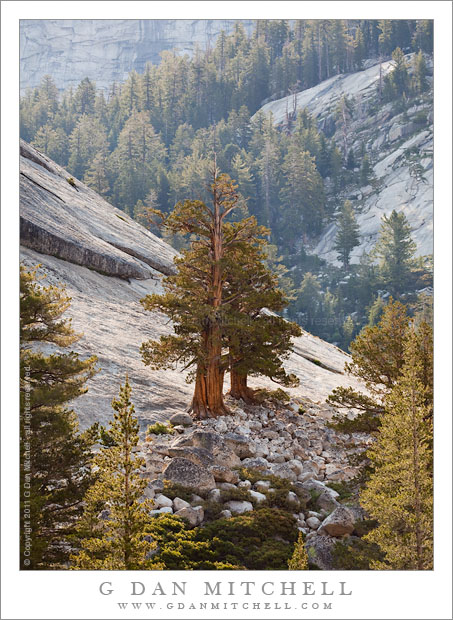
The evening shadow cast by a nearby high ridge approaches a lone lodgepole pine and an old snag near Tioga Pass, Yosemite National Park.

One of my favorite kinds of light is that found at the edges of shadows from higher peaks as they move across lower terrain. (A secret: Among other “tricks,” I like to find and follow these margins when I shoot in Yosemite Valley, too.) Because this light most often happens during the relatively early and late hours of the day, the color quality of the light tends to be warm and the angle low. As the patterns of light and shadow move across the landscape, individual elements may get picked out the light and can often be isolated against darker backgrounds, as in this photograph.

The Sierra is full of trees pretty much like this one, and such meadows with the isolated small and large trees and scattered boulders are not hard to find. This particular tree is in one of the extensive meadow areas in the general area of Tioga Pass. The photograph was made in the very late afternoon as the tall ridge to the west was blocking the sun.

Despite the still and tranquil nature of the scene, this is an example of a sort of shot that reveals the wrongness of the idea that all landscape is done slowly and methodically and with all the time in the world to work. Sometimes that is the case, but when you work the margins of shadows (or many similar dynamic subjects) there may only be brief seconds when the light is where you want it. An observer might find it humorous to watch the photographer run to get into position and then work very quickly.

G Dan Mitchell Photography | Flickr | Twitter (follow me) | Facebook (“Like” my page) | LinkedIn | Email
Text, photographs, and other media are © Copyright G Dan Mitchell (or others when indicated) and are not in the public domain and may not be used on websites, blogs, or in other media without advance permission from G Dan Mitchell.