Tag Archives: wildlife

Gull, Sky, and Fog

Gull, Sky, and Fog
Gull, Sky, and Fog

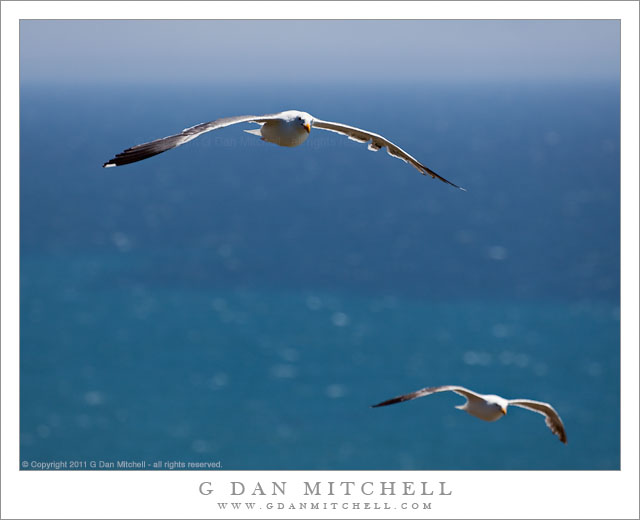
Gull, Sky, and Fog. Pacific Coast Near Santa Cruz, California. July 12, 2011. © Copyright 2011 G Dan Mitchell – all rights reserved.

A solitary gull flies above California’s Pacific Ocean coastline with a fog bank and blue sky beyond.

With some free time earlier this week, and the excuse of driving my son to a summer-session class at UC-Santa Cruz, I headed north from Santa Cruz looking for things to photograph. Because there was a lot of fog, even in the middle of the day, fog was one of my general subject ideas. And I almost always make at least a quick stop at a couple of bluff-top locations that I know of where shore birds often glide by very close as they ride the updrafts from the ocean winds. It turned out that my first stop was precisely one of these locations. With nothing else specific in mind at this midday hour, I figured I would at least spend a bit of time honing my skills and tracking and photographing birds in flight.

Although sea gulls are not necessarily my favorite subjects, there sure were plenty of them to practice on! At the spot I picked, they first become visible perhaps 10-15 seconds away as they come around the edge of a bluff to the south. As they approach they tend to vary their altitudes, with some dropping low enough that they disappear behind the cliff and others going so high that only their shaded undersides are visible. But a few come very close at almost eye level.

I almost always learn something new when I photograph birds in flight and this session was no exception. While in retrospect it seems like one of those “Well, duh!” realizations, I figured out that really strong winds tend to upset the birds ability to remain level, and for this reason they are constantly adjusting to remain level. From moment to moment the wings move into interesting positions or they find themselves tilting wildly to get back on course. This is much more interesting than what they do in benign conditions, where they often seem to just… coast.

So, add one more thing to watch for as they fly past. This isn’t an easy thing, and I have the greatest admiration for those who are really great at photographing birds in flight – or “BIF,” as some call them. The first challenge is simply to keep the moving birds in the viewfinder when using a long focal length lens. (I advise practicing the process of simply following the birds without even firing the shutter at first.) But that’s not enough. You must also attempt to keep the bird(s) in a position within the frame that is aesthetically interesting and which will position the target under the active AF points on the camera. Easier said than done! Then there is the matter of trying also be aware of what the bird is doing – watching wing and head position and so forth. On top of that, you ideally also want to be aware of the what else is in the frame – sky, clouds, water, other birds – and factor that into the decision about when to press the shutter. There are exposure challenges, too, especially with birds like this gull that have white on their backs… and this portion of the bird is in direct sun.

Let’s just say that – for me at least – it takes a lot of exposures to get a few shots that I like.

G Dan Mitchell Photography
About | Flickr | Twitter | FacebookGoogle+ | 500px.com | LinkedIn | Email

Text, photographs, and other media are © Copyright G Dan Mitchell (or others when indicated) and are not in the public domain and may not be used on websites, blogs, or in other media without advance permission from G Dan Mitchell.
(Basic EXIF data may be available by “mousing over” large images in posts. Leave a comment if you want to know more.)

Pelican Flock, Waddell Creek Beach

Pelican Flock, Waddell Creek Beach

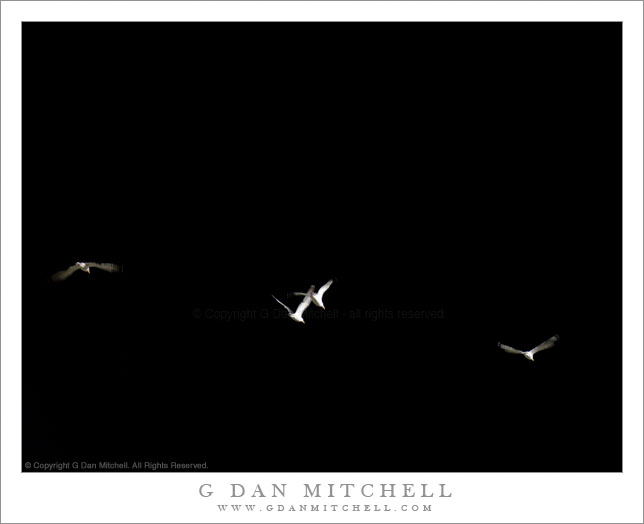
Pelican Flock, Waddell Creek Beach. Waddell Beach, California. May 30 2011. © Copyright G Dan Mitchell – all rights reserved.

A flock of pelicans turns toward Waddell Creek Beach along the Pacific coast of California.

This group was photographed a few seconds before I photographed the single overhead pelican that I posted a couple of days ago. Here the flock had turned back towards the land in preparation for rising to the edge of a much higher bluff just to the north.

Since I so recently described the circumstances of this shoot, I’ll keep this text short!

G Dan Mitchell Photography | Flickr | Twitter (follow me) | Facebook (“Like” my page) | LinkedIn | Email
Text, photographs, and other media are © Copyright G Dan Mitchell (or others when indicated) and are not in the public domain and may not be used on websites, blogs, or in other media without advance permission from G Dan Mitchell.

Elk Walking Across Grassland

Elk Walking Across Grassland

Elk Walking Across Grassland. Point Reyes National Seashore, California. May 30, 2011. © Copyright G Dan Mitchell – all rights reserved.

Tule Elk walking across grassland at Point Reyes National Seashore, California.

I know I promised that the previous one would be the last… but, yes, one more tule elk photograph. (For now? ;-) This one was slightly apart from the others in the group as they began to move off to the right, and I managed to time this photograph so that the others were out of the frame. Beyond that… perhaps not a lot new to say about photographs of tule elk at Point Reyes! :-)

G Dan Mitchell Photography | Flickr | Twitter (follow me) | Facebook (“Like” my page) | LinkedIn | Email
Text, photographs, and other media are © Copyright G Dan Mitchell (or others when indicated) and are not in the public domain and may not be used on websites, blogs, or in other media without advance permission from G Dan Mitchell.
Three Elk, Point Reyes

Three Elk, Point Reyes

Three Elk, Point Reyes. Point Reyes National Seashore, California. May 30, 2011. © Copyright G Dan Mitchell – all rights reserved.

Three tule elk grazing on hills above Drakes Beach at Point Reyes National Seashore, California.

This is one more – and possibly the last – in the series of tule elk photographs that I made at the Point Reyes National Seashore on Memorial Day. A group of perhaps eight or ten bull elk were grazing along the top of the hills above Drakes Bay when we encountered them in beautiful late afternoon light. As soon as I got out with my camera they moved just a bit further away, but still well within photography range.

There is a typical sequence in how I usually photograph creatures such as these. Because I never know how long they will stick around, I begin my just shooting them in any way that seems even somewhat interesting, perhaps muttering to myself, “At least I have tule elk shots in my portfolio now!” But after getting a few “insurance” shots right off the bat, I start to be more selective and more observant. Initially, I’m looking for a variety of interesting individual shots. These might include a single animal separate from the group, perhaps the full group, and perhaps sub-groups of two or three. I also pay a lot of attention to their positions, watching to make sure that faces are visible. (In this shot, the leftmost elk is partially obscured, but because his eyes are still visible and because of the way his antlers align with those of the front animal, on balance I don’t think this is a big problem.) I also watch for distracting elements, and may stop shooting if they are present. For example, the rear end of an elk is bright white and, uh, not the most photogenic part of the beast – so I wait until an animal presenting its backside to the camera either moves out of the frame or rotates into a better position.

I also try to think the same way I think when photographing a group of people. Their faces and eyes are the most important things, with the relationships their positions create among them being a very close second. Here two of the elk are looking almost at me, but slightly past my left shoulder. The third animal seems to be looking more toward the other two, creating a different sort of relationship among the animals. These things are so fleeting that I sometimes don’t see them until they have happened, so I have learned to not be conservative about exposing a lot of frames!

To the extent that I have control over such things, I also like to think about the angle of the light on the subjects. Sometimes you have no choice – you simply have to shoot from where you are. However, with these elk I did have some range of options. They were along a road, and I chose to stop a bit before their position because the light coming from the left would light them in a more dramatic and interesting fashion than if I had gotten closer and shot them with the light right behind me. In addition, I try to look beyond the animals themselves and be aware of how they position themselves against background subjects. This particular shot isn’t a great example, but in others I might wait for the moving animals to position themselves in a place where the background elements relate to them in some interesting way.

With all of this detail, you might get the idea that I’m standing there making a series of careful and logical calculations about how to shoot these guys. That’s not really what happens at all. Much of it turns out to happen in a quick and intuitive and almost subconscious manner “in the moment.” I’ve probably written here before about my belief in the important of “practice” (something I learned from my musical background) when it comes to being able to work and see quickly and effectively.

G Dan Mitchell Photography | Flickr | Twitter (follow me) | Facebook (“Like” my page) | LinkedIn | Email
Text, photographs, and other media are © Copyright G Dan Mitchell (or others when indicated) and are not in the public domain and may not be used on websites, blogs, or in other media without advance permission from G Dan Mitchell.