
Another Horsetail Fall Post

UPDATE: As of 2020 I am no longer posting annual updates concerning this subject — and I am editing older posts on the subject in light of the need to be more responsible about not encouraging the onslaught. I also no longer recommend going to the Valley to see it. Unfortunately, too much exposure (yes, I played a part in it, unfortunately) has led to absurd crowds, traffic jams, littering, destruction of areas in the Valley where too many people go to see it… and the park has increasingly — and appropriately — cracked down. Parking options have been eliminated, at least one viewing location has been closed. Good news! The rest of Yosemite Valley is still there and often exceptionally beautiful at this time of year.
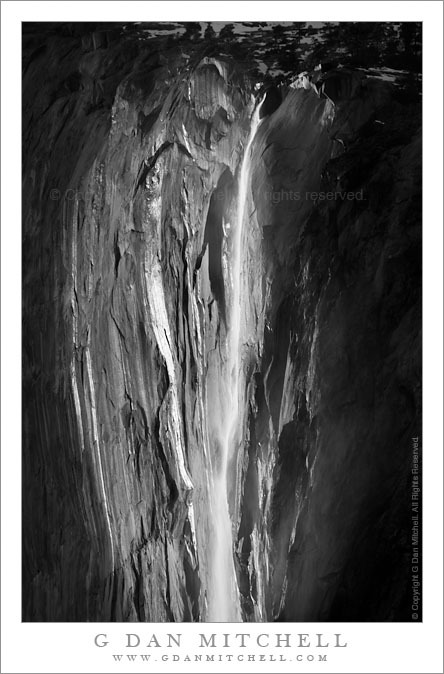
Horsetail Fall, Early Evening

Every winter, for roughly a week or so starting just after mid-February, the sun and various geological features line up so that sunset light falls on the seasonal and ephemeral Horsetail Fall near the east end of the face of El Capitan. Sometimes the light of the setting sun may illuminate this waterfall from behind and briefly make the waterfall and its misty spray glow in sunset colors.

Since it is that time of year again, I’m going to briefly share a few bits of information and perspective about Yosemite Valley’s Horsetail Fall. For more, see an earlier article.

But before you get too excited…

  • This is another extremely dry winter in California, with Sierra snowpack far below normal. There is very little snow in the drainage the feeds the fall, and forecasts suggest that it will remain dry. In other words, there probably won’t be enough water to start the fall.
  • The “event” has gotten out of control as thousands of people showed, parking everywhere and trampling through forests. The park service decided that something has to change. This year access to the typical viewpoints will be more difficult, with extremely limited parking (by advance permit only), and roads near the viewing area will be closed to parking or shut down completely. If you don’t have one of those permits, you have a long walk ahead of you… and probably a long return walk in the dark.
  • Third, what you see in photographs (including my own) is not what you are likely to see in person.

My best advice this year? Probably don’t bother. Between the uncooperative weather and the access restrictions, you are perhaps more likely to experience a #HorseFailFall than Horsetail Fall.

Also, while seeing this phenomenon can be special, it is but one of many, many special experiences to be found in the Sierra. Too often these days, social media convinces use that such experiences are Super Mega Peak Astonishing Ultra Wonders. This poses some dangers, and you should consider resisting. It falsely transforms quiet, contemplative experiences into the equivalent of a sports event, unfortunately creating greater distance between observers and the experience they crave. It also brings crowd that threaten the very places that they come to see.

Perhaps consider something else?

Fortunately, winter in Yosemite Valley has a whole lot to offer besides this event. Fog often forms in quiet meadows at dawn, clouds frequently float among cliffs and peaks, you might get lucky and see some snow, some wildlife is much easier to see in winter,  the crowds are generally  a lot smaller, and some interesting events take place, such as the Yosemite Renaissance Exhibit opening near the end of the month in the Visitor Center Museum Gallery. (I’ll be in the park during this period as a Yosemite Renaissance “artist in residence,” photographing and attending the opening of the exhibit.)


G Dan Mitchell is a California photographer and visual opportunist. His book, “California’s Fall Color: A Photographer’s Guide to Autumn in the Sierra” is available from Heyday Books and Amazon.
Blog | About | Flickr | Twitter | FacebookGoogle+ | LinkedIn | Email


All media © Copyright G Dan Mitchell and others as indicated. Any use requires advance permission from G Dan Mitchell.
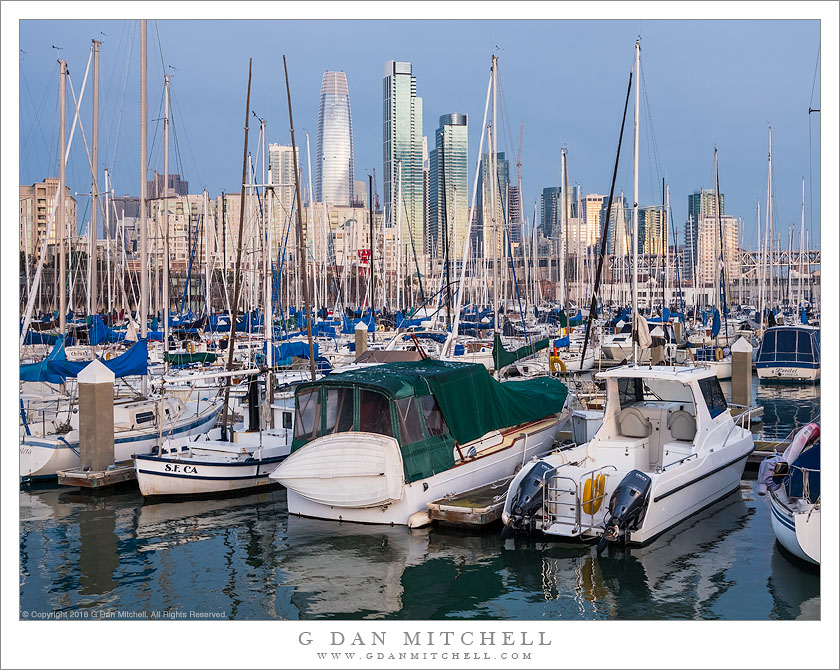
South Beach Harbor, Morning

South Beach Harbor, Morning
Morning light on South Beach Harbor and buildings of downtown San Francisco

South Beach Harbor, Morning. © Copyright 2018 G Dan Mitchell – all rights reserved.

Morning light on South Beach Harbor and buildings of downtown San Francisco

On this late-January morning I was up — you know the drill… “hours before dawn” — to catch a train up the Peninsula to San Francisco for a morning of street photographer and a visit to the San Francisco Museum of Modern Art, where an extensive show of Walker Evans photography was nearing the end of its run. (At some point I should write a bit about my response to the show. A quick summary: great show, some brilliant work, some work I identify with personally, some work that makes me wonder why it is on the wall.) For these trips I’m usually up around 4:00 AM, giving me a half hour for coffee and a quick breakfast before I walk to catch a bus to the train station, where I catch one of the “baby bullet” express trains that has me in San Francisco an hour later.

The weather was in flux, and when by the time I arrived it was clear that a dome of solid high clouds was over San Francisco. However, as I left the train just before sunrise I was able to see some light on the underside of the clouds that was apparently coming from a gap in the cloud cover across the Bay to the east. I quickly headed over to the nearest shoreline location and ended up at the South Beach Harbor. I found some unusual light here as the sun rise. The light was coming through a narrow gap between the western edge of the cloud shield and the low, East Bay hills. Meanwhile, the clouds over and to the north of San Francisco kept the sky there somewhat dark. As the light hit the shoreline area where I had gone, the foreground boats and buildings and so forth were lit by this lovely filtered light and set off against that darker sky. The conditions did not last long — soon the sun rose above that cloud gap and the light soon became gray and flat.


G Dan Mitchell is a California photographer and visual opportunist. His book, “California’s Fall Color: A Photographer’s Guide to Autumn in the Sierra” is available from Heyday Books and Amazon.
Blog | About | Flickr | Twitter | FacebookGoogle+ | LinkedIn | Email


All media © Copyright G Dan Mitchell and others as indicated. Any use requires advance permission from G Dan Mitchell.
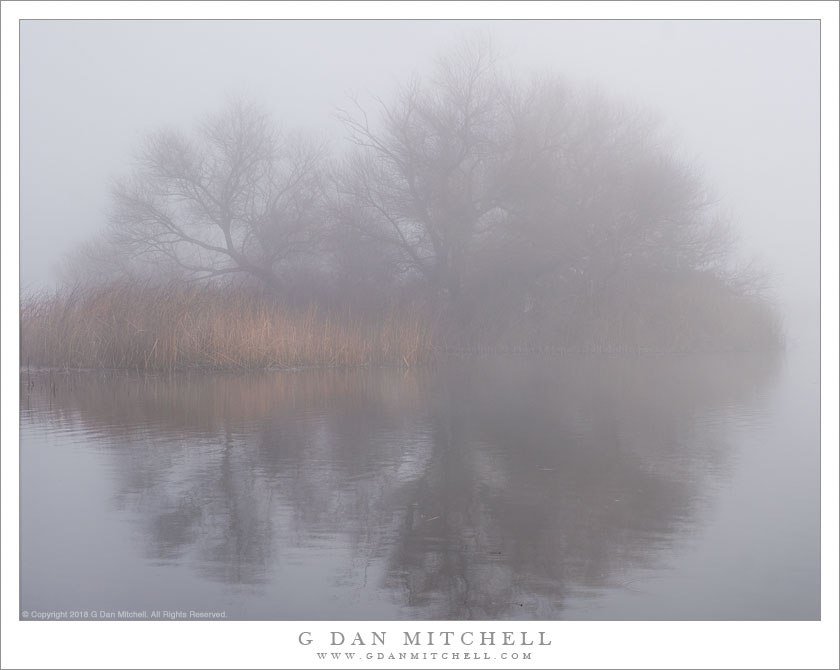
Island With Trees, Thinning Fog

Island With Trees, Thinning Fog
Sunlight begins to illuminate a small wetland island as San Joaquin Valley tule fog thins

Island With Trees, Thinning Fog. © Copyright 2018 G Dan Mitchell – all rights reserved.

Sunlight begins to illuminate a small wetland island as San Joaquin Valley tule fog thins

We all know that (apparently false) story about the number of words that Inuit people have for the myriad types of snow. I suspect that it would be possible to have a similarly diverse vocabulary of descriptions for fog, dependent upon its thickness, temperature, quality and color of light, tendency to move, effect on sound, time of day, season, persistence, and much more. Photographing in California is something of a laboratory in the nature of fog, in that we have so many types. Living in the San Francisco Bay Area I am very familiar with the type of fog created by the marine influence — often cold and gray and damp, and frequently a feature of the late-spring and summer months. Photographing Central Valley birds (and driving across the great valley while traveling to and from the Sierra Nevada) has given me ample opportunities to know the tule fog, mostly a winter phenomenon caused by cool and damp conditions over land.

On winter days when I photograph in the valley I experience transitions though many different types of fog and fog-light. I often start before dawn, when the fog and darkness can close the world down to what I can (barely) see in my headlights, or by the glow of commercial signs and streetlights as I pass through towns. Before sunrise the fog can glow in colors ranging from sky blue to the gaudy reds, oranges, yellows, and purples of first light on clouds above the fog. Eventually that color dissipates and the fog can simply become gray. Then, as it things (often from the top down), and light begins to filter down to the ground level, the colors of grasses and trees and water being to appear faintly.


G Dan Mitchell is a California photographer and visual opportunist. His book, “California’s Fall Color: A Photographer’s Guide to Autumn in the Sierra” is available from Heyday Books and Amazon.
Blog | About | Flickr | Twitter | FacebookGoogle+ | LinkedIn | Email


All media © Copyright G Dan Mitchell and others as indicated. Any use requires advance permission from G Dan Mitchell.
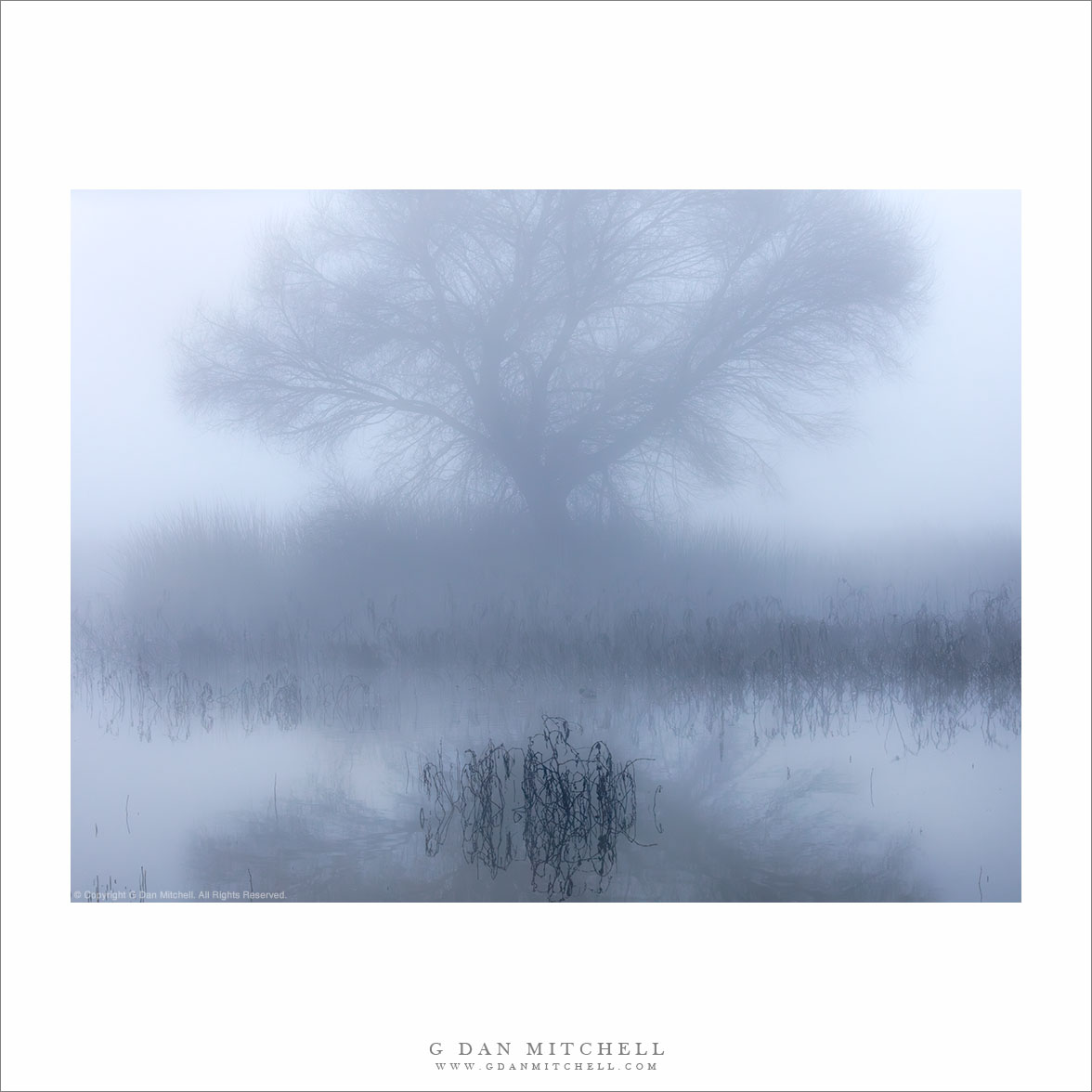
Fog, Tree, And Pond

Fog, Tree, And Pond
“Fog, Tree, And Pond” — A tree reflected in a wetland pond in dawn tule fog, San Joaquin Valley

I love fog, and I especially love the thick and mysterious tule fog of California’s Central Valley — comprised of the northern Sacramento Valley and the southern San Joaquin Valley, and draining to the Pacific Ocean via San Francisco Bay. This fog is mostly a winter thing, when the moisture rises from the ground, farmland, and ponds as the temperature drops at night. It often reaches its peak in the early morning, just after dawn. (It also creates some very challenging driving conditions — so bad that lots of people simply try to avoid them.)

If you stop and get out of your car, the world of tule fog is quiet and mysterious and still. Your universe closes down to a radius of perhaps a couple hundred feet or less, and you can sense as much about your surroundings by sound as you can by vision — you might hear but not see a flock of crane passing overhead. Surprising to some who are new to these conditions, while the tule fog is incredibly dense, it is often astonishingly shallow. On occasion I have seen conditions so bad that it was almost impossible to drive… but I could look up and see clouds in the sky overhead. The tops of trees and utility poles might poke out of the top of the fog layer. This, of course, can produce some very special light, since this thick fog may also be intensely illuminated by that overhead sky and sun, to the point that at times it can almost hurt to look into the brightness. Those were not the conditions when I made this photograph, but the astonishing blue color (which I actually had to tone down a bit in post) is the result of the glowing fog picking up the color of the blue morning sky.


Leave a comment or question using the form. (If you are reading this on the home page, click the article title to see the full article and the comment form.

G Dan Mitchell is a California photographer and visual opportunist. His book, “California’s Fall Color: A Photographer’s Guide to Autumn in the Sierra” (Heyday Books) is available directly from him. Blog | Bluesky | Mastodon | Substack Notes | Flickr | Email

All media © Copyright G Dan Mitchell and others.

Photographer and visual opportunist. Daily photos since 2005, plus articles, reviews, news, and ideas.