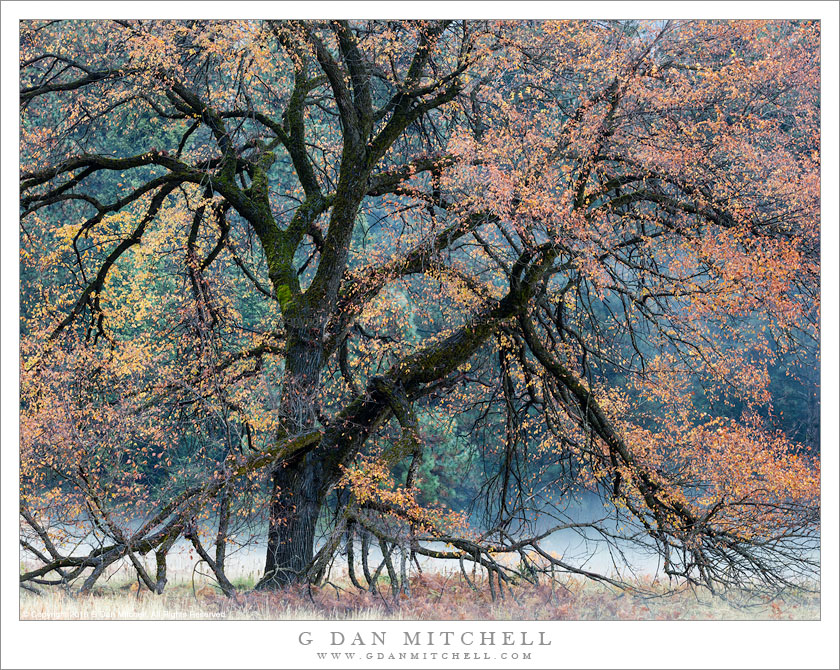
A tree with autumn leaves, surrounded by broken branches, with thinning ground fog below
When we think of Yosemite Valley the first things that come to mind are likely to be towering cliffs, waterfalls, peaks, domes, and other monumental things. The Valley is a place built on a grand scale, but more subtle surprises await if you are there at the right time. Especially between late fall and early spring, when the conditions are right beautiful ground fog frequently appears in meadows, drifting back and forth and gradually thinning as the morning warms.
On this morning I intended to be in the Valley early, but other things distracted me on my way there from Oakhurst (including fog in another valley!), and I arrived in the Valley a bit later than planned. At that point I had more or less written off my plan to go fog-hunting, so I was thrilled to catch the very tail end of the morning fog in a few spots here and there. This tree, a somewhat well-known elm, was just out of the fog that still lay across the surface of the meadow beyond.
The porch and entrance to an urban residence, Pasadena, California
This is another photograph I made during the blue hour time just after sunset and before actual darkness, while walking around near downtown Pasadena, California. We started our walk in late afternoon sun, continued as the sunset came on and golden hour arrived, and continued walking on into and past dusk. Later on the walk we turned down a street lined with small, old residential units — homes, apartments, and so on.
Somehow this front door at the top of the cement steps reminded me of an earlier time, perhaps when I was a child. The architecture seems old enough to come from more or less that era. I also like the little unexpected things in the scene, some of which I wasn’t really aware of until later when I looked at the photograph: the hummingbird feeder, the watering can sitting on the porch, that odd slender “thing” to the left of the door, the slightly peeling paint, the faint suggestion of things inside the window at the right.
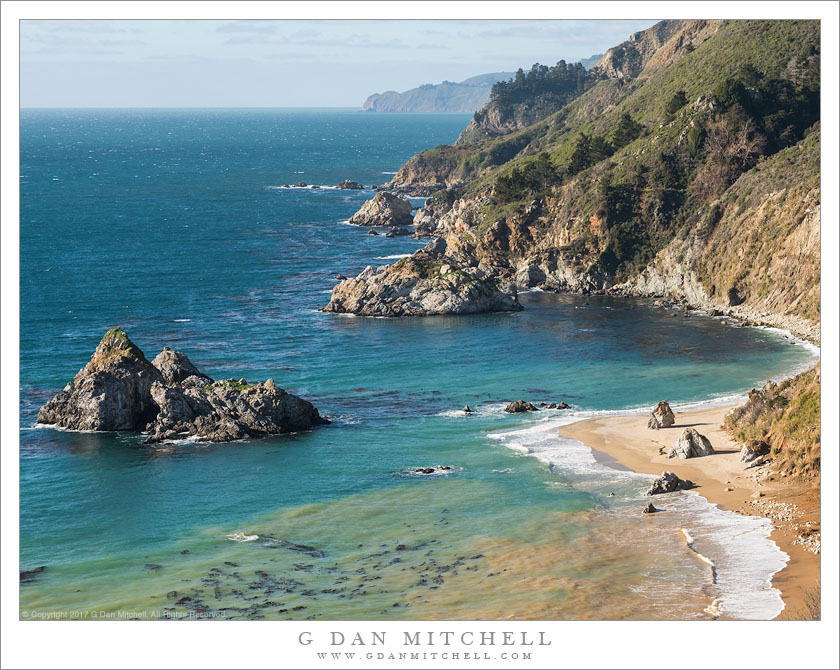
Sediment from flowing streams and landslides colors the water along the Big Sur Coast near Julia Pfeiffer Burns State Park
Some viewers who know this coast very, very well might understand why this photograph could have been titled, “Not McWay Fall.” In an example of looking the “wrong” direction, this photograph looks north along the Big Sur coast in the afternoon, when the light comes in from the west and perhaps begins to warm a bit, and on a beautiful winter day, on the heels of a big storm, when the air is very, very clear and the water is intensely blue.
Looking closely you probably also notice some other colors in the water. Various things can color the coastal waters — seasonal or time of day variations, the quality of the light, reflections, algae, and much more. There are a few spots along this coast where the water is always a surprising color, for example where sandy shoals in shallow, protected water lighten it. Several things were at work here on this day. Coastal creeks were in full flow, carrying their sediment loads down to the coast and emptying into the ocean. In this particular location there was a very large and probably still active landslide that had delivered a lot of earth to the beach, where the surf was gradually pulling it into the water and staining the ocean brown.

 G Dan Mitchell is a California photographer and visual opportunist. His book, “California’s Fall Color: A Photographer’s Guide to Autumn in the Sierra” is available from Heyday Books and Amazon.