
Tag Archives: 2

Telling Stories About Our Photographs

I am as guilty as (OK, more guilty than) anyone else when it comes to writing a lot of words about my photographs! This is ironic in a way, since I believe that, for the most part, successful photographs should be able to say whatever they have to say without a lot of verbal explanation or justification. (There are clearly exceptions to this “rule,” and this is not to say that there isn’t a lot to talk about in photographs.) But some people seem to enjoy the descriptions, so I offer a bit of back story about every photograph, and I love to discuss the photos with folks who share my interest.

Recently I read a post about a fine landscape photograph that someone had produced – the photograph was one of those that is good enough to make me think about how I might create such an image. As I write this now, I have forgotten whose post it was and precisely which photograph it was about. But something that struck me about this post was the tremendously compelling and somewhat scary story that the photographer told about getting the photo. It included things like standing for days in tremendously difficult and seemingly dangerous weather conditions, traveling miles and miles across difficult terrain to find precisely the image that he/she had previsualized, and the tremendous good fortune of finding this perfect image after days and days of enduring challenges that normal people would not or perhaps could not endure.

Some such stories may be true. (Though more often I suspect that they are considerably embellished, but what’s wrong with a bit of fun fiction now and then? :-) But sometimes I wonder if the effect of the photograph would be the same without the spine-tingling story-telling? And I wonder to what extent some viewers tend to look at (or not) photographs that are not accompanied by such compelling and daring tales? What is the balance between viewers being intrigued by the apparently adventure-filled lives lived by photographers and viewers reacting to the intrinsic quality of the photographs themselves?

With this in mind, I offer two descriptions of events associated with the creation of photographs. Think about how the stories affect your perception of the images – for better or worse. ;-)

Story #1

It was a tough morning in the arid desert valley. The oppressive early season heat had arrived and it was over 90 degrees shortly after sunrise. Raging wind threatened a dust storm, and I had been suffering in the heat and dust and dryness for many days. However, this remote location being a place of remarkable extremes, the surrounding mountain peaks were topped by several inches of recent snowfall, rendering many areas inaccessible to anyone unprepared for serious alpine travel. So I faced a choice — endure another day in the sun-blasted furnace of the valley or attempt to struggle up into the alpine zones of the towering mountains and make a photograph. Continue reading Telling Stories About Our Photographs
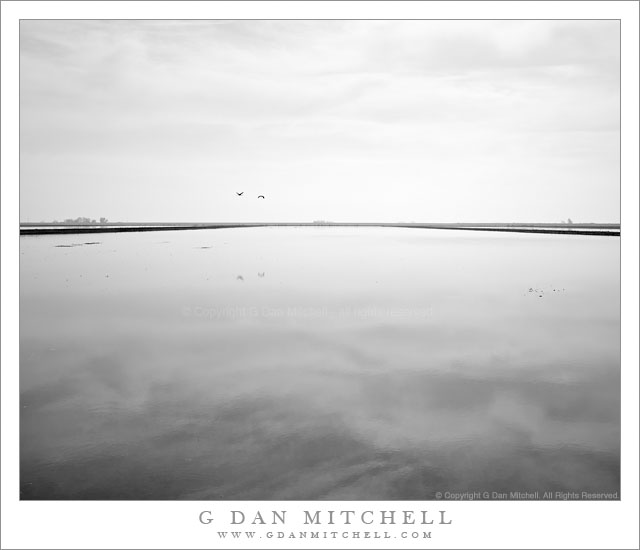
Flooded Farmland, Winter

Flooded Farmland, Winter

Flooded Farmland, Winter. Central Valley, California. January 23, 2011. © Copyright G Dan Mitchell – all rights reserved.

Sky is reflected in the water of flooded winter farmland, Central Valley, California.

A few days ago I didn’t know that this spot existed. However, I happened to run into a colleague while getting a cup of coffee last week, and as we talked she mentioned that she had just visited the Cosumnes River Wildlife Preserve. We talked more, it sounded interesting, and she sent me some information about how to find the place, along with the description of how to get to the place where I made this photograph.

I started at this location very early in the morning, but it was so foggy that photography was almost impossible – at least the kind of photography that I had in mind. Although I was able to hear the birds that congregate out here, I was barely able to see them at all. So after driving to the end of this road where it runs into the Cosumnes River, I turned around and headed up the Central Valley a few more miles to find the Consumnes River Wildlife Preserve.

A few hours later the sun was beginning to shine through the fog at the Preserve and I felt that my work there was done. I checked the time, at it seemed like I might have just enough time to detour back out on this road and see if the prospects were any better now that the fog was thinning. Again I drove to the end of the road, but along the way I noticed these flooded fields and made a mental note to take a look at them on my return drive. So, on the way back I pulled over and noticed that the faint high clouds were reflecting in the surface of the shallow water, and shortly after I framed my photograph a couple of birds flew across the scene.

G Dan Mitchell Photography | Flickr | Twitter | Facebook | Email
Text, photographs, and other media are © Copyright G Dan Mitchell (or others when indicated) and are not in the public domain and may not be used on websites, blogs, or in other media without advance permission from G Dan Mitchell.

Canon Double-Rebates Offer Expiring This Weekend!

For Canon shooters looking to save a bit of money on certain bodies, lenses, and flashes… the current double rebate offer expires on Saturday, January 8. There are deals on individual items, but if you purchase lenses, etc. with one of several qualifying bodies the “instant rebate” becomes a lot more substantial.

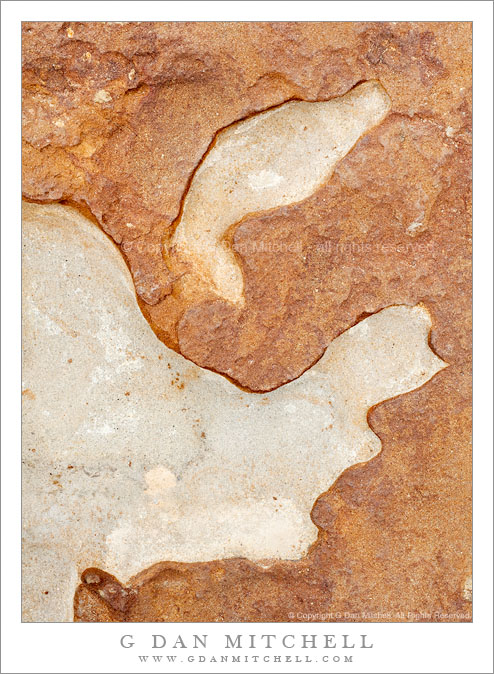
Point Lobos Rock Patterns #2 – July 10, 2010

Point Lobos Rock Patterns #2 - July 10, 2010

Point Lobos Rock Patterns #2 – July 10, 2010. Point Lobos State Reserve, California. © Copyright G Dan Mitchell – all rights reserved.

Detail of patterns in eroded shoreline rocks, Point Lobos State Reserve.

Another photograph of eroded rock patterns near the water not far from Weston Cove at Point Lobos. Here the top layer of reddish rock has worn away in places, leaving a much lighter layer of what I guess is some kind of sandstone below. I’m no geologist, but this section of seashore has fascinating rock formations on the small and large scale where many strata have been exposed by the surf. In some places there a big gobs of conglomerate rock, composed of many smaller rocks “glued” together. In other places very thin layers lie one on top of the other and they have been partially uncovered and worn away by the surf, creating amazing patterns.

This photograph is not in the public domain and may not be used on websites, blogs, or in other media without advance permission from G Dan Mitchell.

G Dan Mitchell Photography | Twitter | Friendfeed | Facebook | Facebook Fan Page | Email

Technical Data:
Canon EOS 5D Mark II
Canon EF 50mm f/1.4 USM
ISO 100, f/16, 1/6 second

keywords: point, lobos, state, reserve, park, california, usa, north america, carmel, big, sur, monterey, peninsula, coast, shore, sea, ocean, pacific, scenic, travel, nature, geology, texture, form, shape, rock, erosion, sand, stone, sedimentary, landscape, detail