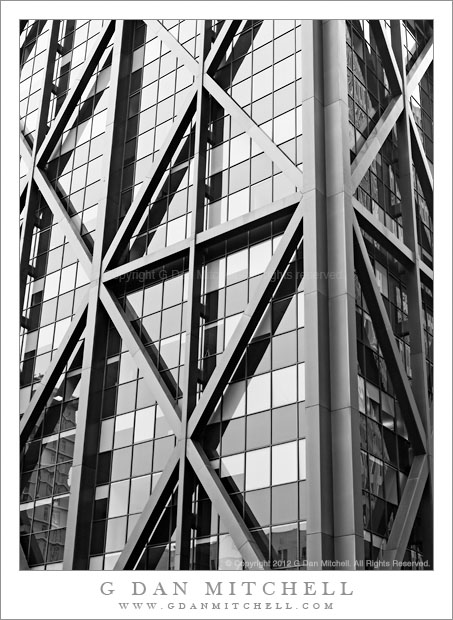
Tag Archives: and

Photographic Myths and Platitudes – Primes Make You a Better Photographer

(This is another in my series of occasional posts based on my replies to questions about photography that come up from time to time. This question was under discussion in an online photography forum, where the discussion began with a new photographer asking whether the acquisition of certain equipment would make him a better photographer. Those with experience in photography know the answer to this question, but it comes up, explicitly or implicitly, all the time, so I think it is worth another look here. The following text is a slightly edited and expanded version of my original answer. This is also part of my “Photographic Myths and Platitudes” series of posts. )

For the moment I’ll leave the full-frame question aside * – not that there isn’t a lot to say about it in the context of your desire to become a better photographer – and just respond to the following:

“My goal here is to become a better photographer. I feel zooms make me lazy, and that primes would make me think more about my photography.”

Sorry to say, but that is nonsense, plain and simple.

This notion that somehow primes are more “serious” than zooms comes up from time to time, and certain folks who post about photography (though not so often people who actually do a ton of photography) encourage this odd and unfounded line of thinking. I’ve speculated about where it comes from at times, and some of the following come to mind:

  • There is a certain mindset among some folks who desire to be viewed as artists that holds that being “different” is the most important characteristic of artists. (It isn’t, by the way.) And by doing something different, like using only primes, they may feel that they have established their different-ness from a world in which most others use zooms most often.
  • There is another notion that modern is not as good as “classic,” and therefore sticking to older equipment types is better. While there can be a risk of being too infatuated with new stuff just because it is new (perhaps the opposite form of gear obsession from the extreme of automatically dismissing the new) it just doesn’t make sense to automatically assume that, for example, because Henri Cartier-Bresson shot with primes that  you should, too. (HCB, by the way, did not choose the gear he used because it was “classic” – he chose the newly developed and quite modern small 35mm film cameras for a variety of reasons relating to his specific needs.)
  • There is also an odd notion that assigns an almost moral imperative to doing things the hard way, and that then presumes that those who do things in a more efficient or practical way must not be as serious as artists. Therefore, if shooting with zooms is “too easy,” shooting with primes must be better. This is often paired with the derisive advice to “zoom with your feet” or a claim that “zooms will make [you] lazy.” (Artists typically have no interest in making their work harder; they are generally far more concerned with making it better, and will use any tools or methods that accomplish the latter goal.)
  • Finally, there is the unfortunate notion, not unique to photography, that being “better” is largely the result of having the best or the “right” equipment – e.g., if I use this sort of camera or this sort of lens I will be more of an artist than if I use that camera/lens. The seed of truth in this – photography does require equipment – is too often built up into a false notion that photography is largely or even primarily about what gear you use.

The “zooms will make you lazy” business completely baffles me. Yes, folks doing point and shoot photography often may use a zoom that way, just zooming to get the shoot of their kids or the waterfall that most fills the frame, without bothering to move from their current position. But that fact that casual amateurs can use a zoom lens on their point and shoot cameras that way does not mean that the use of a zoom always means that this is the way one shoots. Continue reading Photographic Myths and Platitudes – Primes Make You a Better Photographer
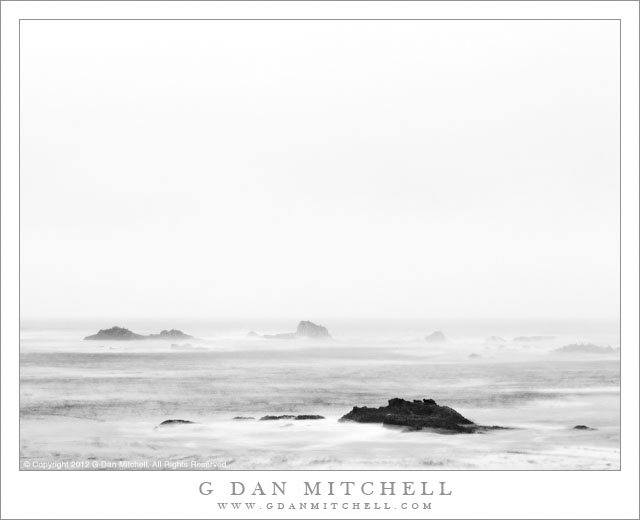
Rocks and Surf, Point Lobos

Rocks and Surf, Point Lobos - Long exposure black and white photograph of offshore rocks, surf, and fog at the Point Lobos State Reserve, California
Long exposure black and white photograph of offshore rocks, surf, and fog at the Point Lobos State Reserve, California

Rocks and Surf, Point Lobos. Point Lobos State Reserve, California. July 21, 2012. © Copyright 2011 G Dan Mitchell – all rights reserved.

Long exposure black and white photograph of offshore rocks, surf, and fog at the Point Lobos State Reserve, California

This photograph is from last summer and a visit to Point Lobos when I decided to work with very long exposures in daylight muted by coastal fog. A set of these photographs has sat in my raw file collection since then, as I wasn’t quite sure how I wanted to render them in the post-processing stage. I used a 9-stop neutral density filter to darken the scene a great deal and permit the very long exposure that allowed the surf to blur and become diffused. However, these filters invariably have an effect on color balance that is not very lovely – they add a slight almost purple cast to the image. As I thought about them as color images, I could not find a color balance that worked – so I put them aside.

Last week, spurred by another rapidly filling hard drive, I began to go through more of my older raw files to see what could be deleted. Indeed, there were quite a few files that could go – duplicates, errors, some images that really will never live up to what I had expected them to be. But as I do every time I engage in this activity, I found several photographs that I had either overlooked originally or which needed to be processed in ways that I hadn’t thought about at the time. It occurred to me that this one might become one of my “minimalist seascape” photographs if I went for a high key interpretation in black and white.


G Dan Mitchell is a California photographer and visual opportunist. His book, “California’s Fall Color: A Photographer’s Guide to Autumn in the Sierra” (Heyday Books) is available directly from him.

G Dan Mitchell: Blog | Bluesky | Mastodon | Substack Notes | Flickr | Email


All media © Copyright G Dan Mitchell and others as indicated. Any use requires advance permission from G Dan Mitchell.

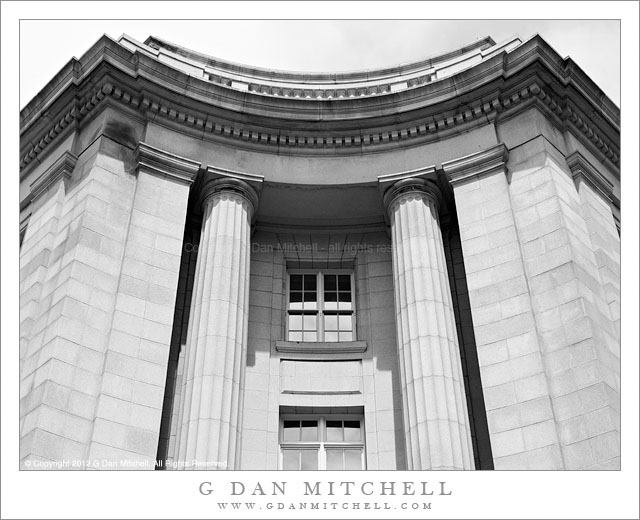
Corner View, 50 United Nations Plaza

Corner View, 50 United Nations Plaza - The curved architecture of the corner of the building at 50 United Nations Plaza, San Francisco.
The curved architecture of the corner of the building at 50 United Nations Plaza, San Francisco.

Corner View, 50 United Nations Plaza. San Francisco, California. August 5, 2012. © Copyright 2012 G Dan Mitchell – all rights reserved.

The curved architecture of the corner of the building at 50 United Nations Plaza, San Francisco.

This building is located in the Civic Center area of San Francisco. To the east of City Hall – the opposite side from the Opera House, a place with which I am more familiar – is a large plaza, and beyond that as you might walk toward Market Street you may pass by this building, with its classic architecture.

I’m not familiar with the history of the building, though I assume that it might be in some way related to the United Nations Plaza. The building, which occupies most of a block, is currently being refurbished, and portions at the far end of the building are fenced off. This corner, with its columns and curving shape, seems quite formal, especially when juxtaposed with the rest of the City life in this particular area.

G Dan Mitchell is a California photographer whose subjects include the Pacific coast, redwood forests, central California oak/grasslands, the Sierra Nevada, California deserts, urban landscapes, night photography, and more.
Blog | About | Flickr | Twitter | FacebookGoogle+ | 500px.com | LinkedIn | Email

Text, photographs, and other media are © Copyright G Dan Mitchell (or others when indicated) and are not in the public domain and may not be used on websites, blogs, or in other media without advance permission from G Dan Mitchell.

Exterior, One Maritime Plaza

Exterior, One Maritime Plaza - Exterior detail of the One Maritime Plaza building, San Francisco.
Exterior detail of the One Maritime Plaza building, San Francisco.

Exterior, One Maritime Plaza. San Francisco, California. August 4, 2012. © Copyright 2012 G Dan Mitchell – all rights reserved.

Exterior detail of the One Maritime Plaza building, San Francisco.

This photograph focuses on details of the exterior frame of Maritime Plaza Building, in the general area of the financial district and not far from the Embarcadero and San Francisco’s waterfront. I photographed in “interesting” light – the weather provided a combination of high clouds, lower clouds that were dropping sprinkles of rain, and incoming ocean fog. Oddly, even with tall these sources of atmospheric opacity, there was still some light. Some came through the clouds, while some came from nearby areas that were a bit more clear.

As I have been doing a bit more recently, I chose to shoot towards a corner of the building, allowing the darker side on the right to seem to recede a bit. Meanwhile, the strongest ambient light fell on the “front” of the building facing to the left. I chose a black and white rendition of this photograph partly because, frankly, there wasn’t much interesting color in this subject, but also because I felt that black and white abstracted the image a bit more.

G Dan Mitchell is a California photographer whose subjects include the Pacific coast, redwood forests, central California oak/grasslands, the Sierra Nevada, California deserts, urban landscapes, night photography, and more.
Blog | About | Flickr | Twitter | FacebookGoogle+ | 500px.com | LinkedIn | Email

Text, photographs, and other media are © Copyright G Dan Mitchell (or others when indicated) and are not in the public domain and may not be used on websites, blogs, or in other media without advance permission from G Dan Mitchell.