
Tag Archives: broken

Broken Branches

Broken Branches
Broken Branches

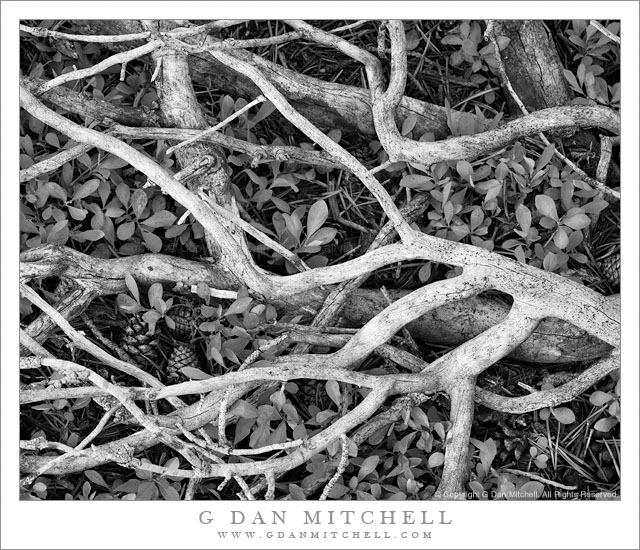
Broken Branches. Yosemite National Park, California. September 18, 2011. © Copyright 2011 G Dan Mitchell – all rights reserved.

The broken branches of a fallen tree on the ground in the back-country of Yosemite National Park.

These branches belong to what is left of a tree that fell in the area around our campsite in the north east section of the back-country of Yosemite National Park. On a couple of mornings during the time we were there doing photography, I began my morning by wandering a bit through this section of forest, meadow, and dried-up ponds, looking for whatever little miniature landscapes I might find.

Dried and broken branches of fallen and dead trees intrigue me, though they can make very difficult subjects to photograph. Light and color are tricky – too much light and it is difficult to get shadow detail without washing out the highlights; too little light and the subject can go flat and pick up blue tones. And sometimes the patterns are so complex and disorganized as to nearly defy my efforts to make any sort of compositional sense out of them.

G Dan Mitchell is a California photographer whose subjects include the Pacific coast, redwood forests, central California oak/grasslands, the Sierra Nevada, California deserts, urban landscapes, night photography, and more.
Blog | About | Flickr | Twitter | FacebookGoogle+ | 500px.com | LinkedIn | Email

Text, photographs, and other media are © Copyright G Dan Mitchell (or others when indicated) and are not in the public domain and may not be used on websites, blogs, or in other media without advance permission from G Dan Mitchell.
Badwater Salt Flats, Evening

Badwater Salt Flats, Evening

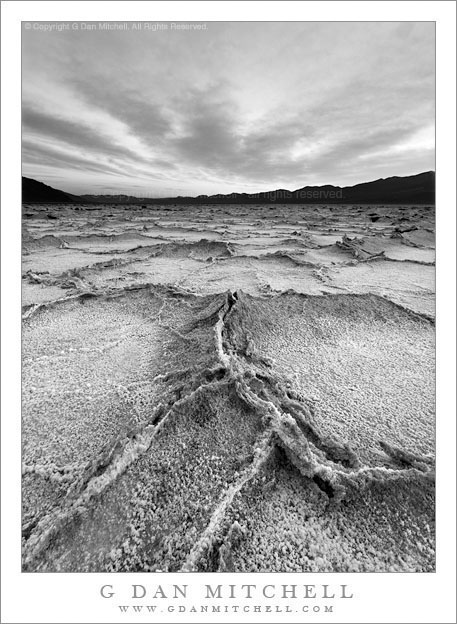
Badwater Salt Flats, Evening. Death Valley National Park, California. March 31, 2009. © Copyright 2009 G Dan Mitchell – all rights reserved.

Black and white photograph of rough patterns in the dried salt desert floor at Badwater Salt Flats, Death Valley National Park.

This is another of the “rediscovered photographs” that I uncovered while reviewing many years of raw files recently. Periodically I go through all of the old archived raw files, partly to cull out a few that I know that I’ll never use, but also because I know that whenever I revisit the old files I discover some photographs that I had forgotten or had never understood at the time I made them. Revisiting the old file archives, I’m sometimes shocked that I passed over certain images.

This one is from the salt flats at Badwater in Death Valley National Park. Technically, this was not shot at precisely “Badwater,” but it is close enough. I was out on the flats in the late afternoon, shooting as the sun dropped behind the Panamint Range. In my view, the best light – with the exception of days when clouds might tower above the Panamints – comes starting right about at the time that the sun passes the line of the ridge as it descends at the end of the day. This takes the incredibly bright and harsh sun off of the playa and provides softer light in the shadow of the range. However, this also presents a problem that almost everyone who has shot here must understand, namely that the illumination by the bright blue sky turns the “white” salt a surprisingly intense blue color. I’ve seen people handle this in a variety of ways: keep the intense, almost gaudy, blue color; do a lot of color correction to get colors that more closely correspond to what we recall seeing; mostly include the sky with its more intense colors; or let the colors go and do a black and white rendition.

Although I’ve “done” this subject in color a number of times, somehow this one seemed to call out for black and white. For one thing, it allowed me to use the interesting shapes of the evening clouds as a dramatic backdrop to the rough and broken shapes of the playa salt polygons. It also allowed me to try an interpretation that focuses on the dramatic potential of the scene.

G Dan Mitchell is a California photographer whose subjects include the Pacific coast, redwood forests, central California oak/grasslands, the Sierra Nevada, California deserts, urban landscapes, night photography, and more.
Blog | About | Flickr | Twitter | FacebookGoogle+ | 500px.com | LinkedIn | Email

Text, photographs, and other media are © Copyright G Dan Mitchell (or others when indicated) and are not in the public domain and may not be used on websites, blogs, or in other media without advance permission from G Dan Mitchell.

Alcatraz and Yerba Buena Islands, San Francisco Bay, Foggy Morning Light

Alcatraz and Yerba Buena Islands, San Francisco Bay, Foggy Morning Light

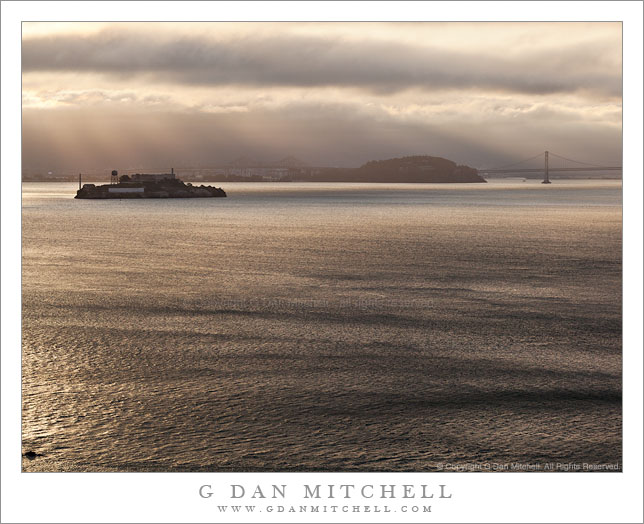
Alcatraz and Yerba Buena Islands, San Francisco Bay, Foggy Morning Light. San Francisco, California. March 21, 2009 © Copyright 2009 G Dan Mitchell – all rights reserved.

San Francisco Bay morning fog over begins to break up over Alcatraz and Yerba Buena Islands and the San Francisco Oakland Bay Bridge.

I made this photograph back around the start of spring in 2009. I recall shooting from the Marin Headlands back toward the Bay as the fog began to break up, still obscuring the view but allowing beams of light to begin to come through the gloom and light up portions of the Bay. Alcatraz Island is at upper left and beyond that is the Treasure Island and Yerba Buena Island complex.

Many things intrigued me about this scene. Although it is in shadow still, Alcatraz stands out as the clearest object in the scene. The patterns on the water were amazing, created by a combination of the normal surface waves, the wakes of ships that had passed, and the mottled and mixed lighting of areas of fog and sun. Beyond the main subjects and over the East Bay shoreline around Oakland, light beams come down from the clearing fog.

This photograph is also an example of why I save and later review all of my raw files. Either because I don’t understand the image when I first make it or perhaps I move on to the next project too quickly sometimes it is not unusual when a photograph “slips through the cracks” and I end up overlooking it. This was one of those photographs… which I now find hard to understand.

G Dan Mitchell Photography
About | Flickr | Twitter | FacebookGoogle+ | 500px.com | LinkedIn | Email

Text, photographs, and other media are © Copyright G Dan Mitchell (or others when indicated) and are not in the public domain and may not be used on websites, blogs, or in other media without advance permission from G Dan Mitchell.

(Basic EXIF data may be available by “mousing over” large images in posts when this page is viewed on the web. Leave a comment if you want to know more.)

Fractured Granite Ledges

Fractured Granite Ledges

Fractured Granite Ledges. Yosemite National Park, California. July 27, 2011. © Copyright 2011 G Dan Mitchell – all rights reserved.

Exfoliated and fractured granite ledges form patterns in late afternoon light, Yosemite National Park.

While this particular spot happens to be in the neighborhood of Tenaya Creek, similar features may be found throughout Yosemite and in many other parts of the Sierra. These rocks have probably been eroded in just about every way possible. They have been broken away from the underlying rock via exfoliation. The area was obviously glaciated. No doubt freezing water helped to widen the patterns of cracks and break up the rocks.

I made the photograph in late afternoon light when the sun was just barely above a low ridge beyond the upper edge of the photograph. The zoom was cranked out as wide as it goes in order to capture a good width and density of these wonderfully broken up rocks and the trees and other plants that somehow manage to live on and among them.

G Dan Mitchell Photography
About | Flickr | Twitter | FacebookGoogle+ | 500px.com | LinkedIn | Email

Text, photographs, and other media are © Copyright G Dan Mitchell (or others when indicated) and are not in the public domain and may not be used on websites, blogs, or in other media without advance permission from G Dan Mitchell.

(Basic EXIF data may be available by “mousing over” large images in posts. Leave a comment if you want to know more.)