
Tag Archives: brush

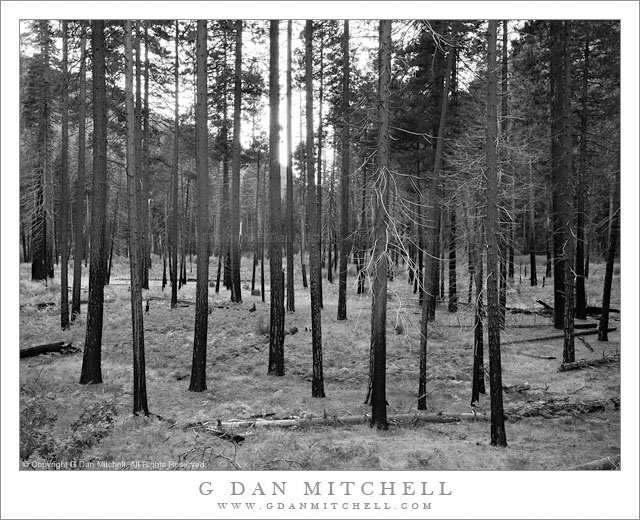
Burned Forest, Yosemite Valley, Autumn

Burned Forest, Yosemite Valley, Autumn

Burned Forest, Yosemite Valley, Autumn. Yosemite National Park, California. October 31, 2010. © Copyright G Dan Mitchell – all rights reserved.

Evening light in a burned section of the forest on the floor of Yosemite Valley.

I’ve been sitting on this photograph for a while, so I figure I’ll post it now. I made it last fall – on Halloween, actually! – during a fall color trip to the Valley. Late on my final evening I finally stopped and walked out across the old terminal moraine that crosses the lower Valley not far upstream from Pohono Bridge. (When you drive into the Valley, the road splits, and before long you’ll see the south end of this feature to your left as you go up a short climb.) I started at the north end and as I walked south looking for a photograph it was a very quite, still, and cold evening.

I finally found a spot where I could go down the lower side of the hill just a bit and find a relatively clear shot through the trees that wasn’t blocked by foliage closer to my position. This area has been burned, and I assume that it is the result of one of the management burns that often occur late in the season. These fires attempt to strengthen the forest by reintroducing the natural process and cycles of fire. The result is interesting charring patterns along the lower portions of the trees, temporary burned undergrowth, and then as the recovery takes place a much more open and airy sort of forest as you see in this photograph.

G Dan Mitchell Photography | Flickr | Twitter (follow me) | Facebook (“Like” my page) | LinkedIn | Email
Text, photographs, and other media are © Copyright G Dan Mitchell (or others when indicated) and are not in the public domain and may not be used on websites, blogs, or in other media without advance permission from G Dan Mitchell.
Spring Flooding, Merced River

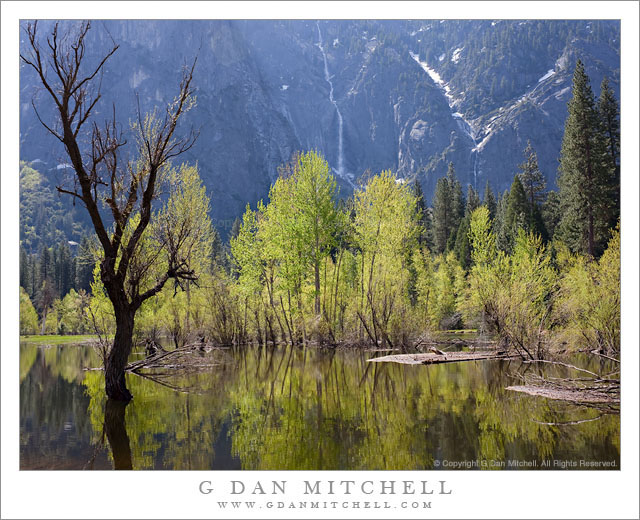
Spring Flooding, Merced River

Spring Flooding, Merced River. Yosemite Valley, California. May 7, 2011. © Copyright G Dan Mitchell – all rights reserved.

The Merced River overflows its banks during the spring runoff and floods surrounding meadows and lowlands in Yosemite Valley.

I’m tempted to go on about how the spring runoff is my favorite time of year in Yosemite Valley – but I’ve probably already written about how autumn is my favorite time, or how much I love winter in the Valley, and… :-)

In any case, there is a lot to like about spring in Yosemite Valley. For example, seasonal waterfalls that many visitors never see come to life. I believe that the thin fall across the Valley in this photograph is Sentinel Fall. There is another small one to its right in the v-shaped gully, but I do not know its name. The meadows come back to life and the trees begin to get their leaves, and there is green everywhere. Especially in a heavy snowfall year like this one, the Merced River rises as the snow begins to melt, and riverbanks overflow and meadows flood – as is happening in this photograph of a section of the river near Leidig Meadow along the north side of the Valley.

I’m surprised that there are not more photographs produced in this part of the Valley. I suppose the explanation may include the fact that few of the main iconic sights are directly visible from here, the current prohibition against parking along the road in this area, and the fact that parts of the river trail were underwater. But in the right light – which here can occur at times other than the typical early/late hours – Leidig Meadow and this curving section of the river with its shoreline trees can be very appealing, especially when the far canyon wall is muted by shadows.

I shot this a bit later in the day, not during the typical “golden hour” times at all. To get here I drove past this section of the road and walked back, alternately walking along the roadway (and occasionally leaving the narrow road as cars approached) and following the trail where it was not submerged. To make this photograph I walked down to the very edge of the rising Merced River and managed to find one spot that wasn’t too muddy.

G Dan Mitchell Photography | Flickr | Twitter (follow me) | Facebook (“Like” my page) | LinkedIn | Email
Text, photographs, and other media are © Copyright G Dan Mitchell (or others when indicated) and are not in the public domain and may not be used on websites, blogs, or in other media without advance permission from G Dan Mitchell.
Abandoned Mining Cabin Ruins, Panamint Range

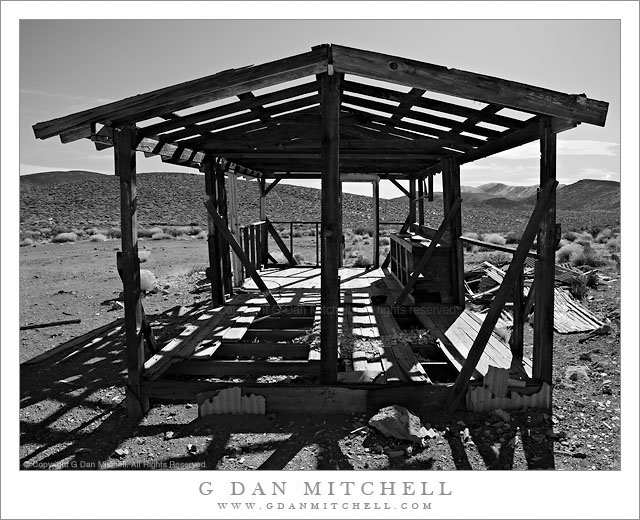
Abandoned Mining Cabin Ruins, Panamint Range

Abandoned Mining Cabin Ruins, Panamint Range. Death Valley National Park, California. March 29, 2011. © Copyright G Dan Mitchell – all rights reserved.

Black and white photograph of the ruins of an abandoned mining cabin high in the Panamint Mountain Range of Death Valley National Park.

There are a number of things that make Death Valley National Park, to the best of my knowledge, rather unique. One is the extensive history of human habitation inside the park boundaries, quite a bit of which is visible –  though some takes a bit more effort and attention to spot. The history of mining in the park is well-known, and many of the icons of the park have connections to this history. If you visit Furnace Creek, for example, you cannot miss the displays of old wagons and so forth used to move ore out of the Valley. It doesn’t take a lot of careful study to figure out that many park roads originated in an era of prospecting and mining. There are several well-known examples of structures left over from that era in and around the park, too.

It is largely because of this history that many areas of this national park are (or have been – some are now reverting to wilderness status) accessible by gravel road or four-wheel-drive routes. I would argue that you can’t really get to know this park if you just stick to the paved roads and the points of interest that they access. If you drive any of these other routes and keep your eyes open you will often be surprised by the left overs from relatively recent mining and prospecting, much of which isn’t really written about or described in the usual guides to the park. (And I’m not going to offer specific details about where to find such places here, since I don’t want to be even a little bit responsible for damage to them. If you do visit, treat them with care and respect.)

As I drove along a gravel road in one of the many mountain ranges of the park, returning from a site that is somewhat well-known, I began to notice evidence of fairly recent mining and prospecting. Faint tracks depart from the main “road” and cross valleys and hills, here and there tailing piles and mine entrances are visible, and sometimes you come across old structures such as cabins, storage bunkers, or wooden towers above mine entrances. I spotted the ruins of this old cabin above the road at one point and decided to walk up and investigate.

I’m almost always surprised at how “modern” many of the traces found at these places seem to be. I guess I am expecting something from the 1800s, but quite a few of these places look like they were build and occupied much later than that. I find modern things like linoleum flooring or modern-looking nails or electrical wire in many of them. There obviously isn’t much left of this cabin now, but from the detritus lying around near it and the form and materials found here, it must have been a reasonably comfortable place to live. As I walk around such places I often try to imagine what it must have been like to wake up every morning in this silent desert and head out for another day of physical labor.

G Dan Mitchell Photography | Flickr | Twitter (follow me) | Facebook (“Like” my page) | LinkedIn | Email
Text, photographs, and other media are © Copyright G Dan Mitchell (or others when indicated) and are not in the public domain and may not be used on websites, blogs, or in other media without advance permission from G Dan Mitchell.

Red Rock and Desert Hills

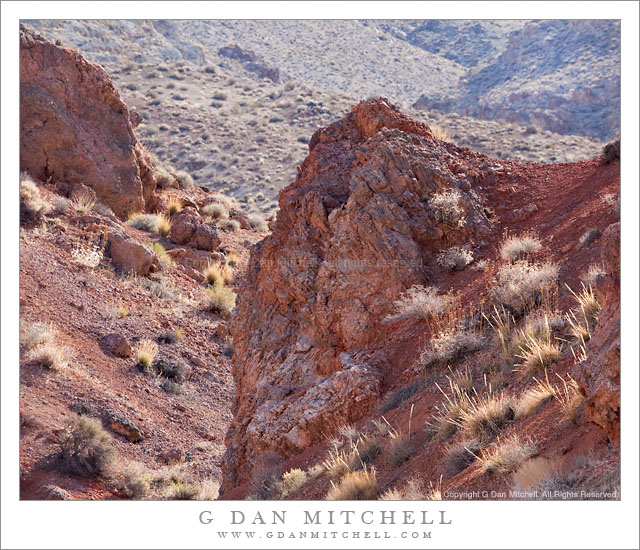
Red Rock and Desert Hills

Red Rock and Desert Hills. Death Valley National Park, California. March 29, 2011. © Copyright G Dan Mitchell – all rights reserved.

A red rock gully among the desert hills of the Panamint Range, Death Valley National Park.

This is anything but an iconic image, but I think that it is emblematic of a certain type of scene that is often seen in Death Valley National Park once you get out of the main Valley and up into the hills, especially during the brief spring season when the light can be a bit softer and the plants a bit (relatively speaking!) greener.

The photograph looks up a broad valley that is visible from along the road that rises from the main road through the Valley and climbs toward the Wildrose Canyon area. Here the elevation is high enough that the dry, sun-baked flat land of the Valley is nowhere to be found. Instead this is a country of large valleys and plateaus, cut in places (mostly at the bottom of canyons) but rocky outcroppings and gullies. This red rock gully is easily visible from the road, though the odds are that most people just drive right by. I had seen it on several drives past this spot before I thought to stop and photograph it, and I was fortunate to be there when the light seemed just right.

G Dan Mitchell Photography | Flickr | Twitter | Facebook | Email
Text, photographs, and other media are © Copyright G Dan Mitchell (or others when indicated) and are not in the public domain and may not be used on websites, blogs, or in other media without advance permission from G Dan Mitchell.