
Tag Archives: califoria

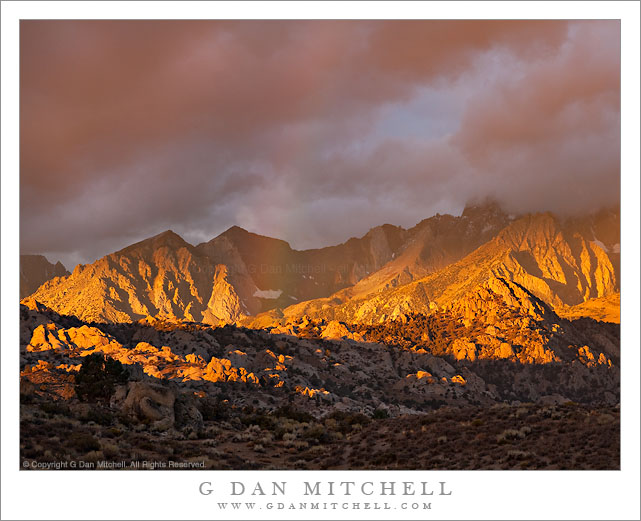
First Light Above the Buttermilks, Autumn Storm

First Light Above the Buttermilks, Autumn Storm

First Light Above the Buttermilks, Autumn Storm. Eastern Sierra, Owens Valley, California. October 3, 2010. © Copyright G Dan Mitchell – all rights reserved.

A faint rainbow briefly glows in dawn light on the eastern escarpment of the Sierra Nevada above the Buttermilks as an autumn storm builds.

Since I wrote previously about acting on a hunch to be in this spot in time to catch a few minutes of dawn light, I won’t recount the whole thing here – though I would like to describe the phenomenon a bit more and perhaps make a point or two about light and opportunities.

The photograph is of the eastern escarpment of the Sierra Nevada above Bishop, California and was made on an early autumn morning of a day that brought one of the first winter-like storms of the season. I found myself in this spot (as described at the link) for the very few minutes during which this light was present – and afterwards the light was simply gone and the rest of the day was overcast and rainy. The circumstances have me thinking about a few things about light and “being there” at the right moment.

Sometimes, even on a “poor light day” – though I like overcast conditions! – there can be a few brief moments of exceptional light. Catching them involves some combination of anticipating that these moments might occur, being there, and – let’s admit it! – dumb luck. In this case, all three were at work. I did not know that this light would occur, but I knew that the conditions offered a possibility. A clearing in the clouds along the eastern horizon allowed a horizontal beam of light to briefly hit the mountains right at dawn. It began by striking the clouds above the Sierra crest, soon hit the highest peaks, moved across the face of the range, and within minutes the show ended with light on the high desert. The band was so narrow that only one of these subjects was generally illuminated at a time – and the whole thing couldn’t have lasted more than five or ten minutes.

That description might make it sound like I’m saying that I’m just plain great at predicting such things and planning to be there. Not quite! If you had asked me a few minutes earlier, when I made the spontaneous decision to abandon my previous plans and high-tail it out to this spot, what the odds were that I’d see light like this I might have estimated them at perhaps 10% or less. In other words, if I repeated this little adventure 10 times, I’d guess that I’d fail to see light like this nine out of ten times. However, if I only go for “sure bets” (which I’ll take when I can get them!) I know that I’ll miss lots of special conditions that are not subject to prediction.

Which brings up the subject of luck. I often read that one should be able to know in advance what the photograph will look like, and that careful and full preparation will lead to good photographs. Well, sort of, but maybe not quite in the way that some imply. (There is an element of “preparation” in all of this that I’ll write about eventually, but that is a different thing.) Frankly, these subjects are too complex and too fleeting and too unpredictable to be subject to that sort of careful and precise planning in any sort of consistently useful way. The photographer cannot make that small band of open sky appear along the horizon on an autumn morning when a storm is building along the crest – but if everything goes right a photographer might be there at the right moment, prepared to make a photograph of it.

This photograph is not in the public domain and may not be used on websites, blogs, or in other media without advance permission from G Dan Mitchell.

G Dan Mitchell Photography | Twitter | Friendfeed | Facebook | Facebook Fan Page | Email
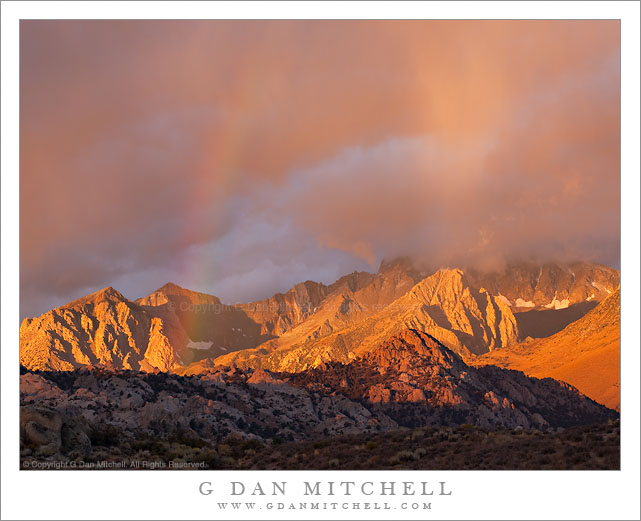
Sunrise Rainbow and Virga Above the Buttermilks

Sunrise Rainbow and Virga Above the Buttermilks

Sunrise Rainbow and Virga Above the Buttermilks. Sierra Nevada, California. October 3, 2010. © Copyright G Dan Mitchell – all rights reserved.

Brief sunrise light produces a rainbow and virga over the Buttermilks in the eastern Sierra Nevada above Bishop, California.

I have a story to tell about this photograph and how it came about. I’ve been in the Buttermilks — the rounded hills between Bishop, California and the actual Sierra Nevada — on a number of previous occasions. I’ve photographed there in the early morning when the first light hits these hills and the peaks of the Sierra, and I have some potential images filed away in my mind, waiting for a time when the light is right. I also know the Sierra well enough – though certainly not completely nor perfectly! – that I can pick up on developing conditions that might not apparent to someone less familiar with the range.

On this early October morning I was camped up in the Bishop Creek drainage. The forecast was for rain and wind and, sure enough, during the night the wind picked up and it began to rain. I woke before dawn and at the first light it was apparent that it would be overcast. This is not necessarily a bad thing for photographing fall color, but it can mean that subjects that would otherwise work at dawn might need to wait. I was thinking about how to modify my aspen photography plans when I noticed a bit of incipient color in the still-dim clouds, and it occurred to me that a special set of conditions might occur. Although I couldn’t see to the east from this campground, I know that sometimes clouds above the Sierra end a ways to the east over or beyond the White Mountains, and when this happens there is a narrow band of clear sky right above the horizon — and if everything works out just right a strip of dawn light shines through this gap, first hitting the clouds and then working its way down from the peaks to the lower foothills before quickly disappearing and leaving very bland light.

No sure thing at all, but I decided to dash down the road (past the steady stream of aspen photographers streaming up the road!) and see if I could get to the Buttermilks in time. I left the main road and headed up a side road that I know, somewhat resenting a (very reasonable!) 25mph speed limit near some roadside residences as I began to see the clouds above the crest starting to light up. As I hit the last section of gravel road the sky began to glow and I sped up, heading for a specific spot where I had photographed this scene before. With seconds I saw the light pick out a band of virga (rain that does not reach the ground) and a rainbow began to form in front of the eastern escarpment as I arrived at the hilltop where I planned to shoot. I quickly set up my tripod and mounted the 70-200mm lens (which I already knew would be the right one for this shot) and literally ran up a nearby knoll which I knew would put the foreground hill in a decent place in the composition. I was ready just as the soft light hit the foreground and I made this photograph. Within a minute the rainbow as gone!

Sometimes you just get lucky…

This photograph is not in the public domain and may not be used on websites, blogs, or in other media without advance permission from G Dan Mitchell.

G Dan Mitchell Photography | Twitter | Friendfeed | Facebook | Facebook Fan Page | Email

Aspen Grove, North Lake Road

Aspen Grove, North Lake Road

Aspen Grove, North Lake Road. Sierra Nevada, California. October 3, 2010. © Copyright G Dan Mitchell – all rights reserved.

Fallen leaves in an aspen grove along the road to North Lake, Sierra Nevada, California.

This photograph of a grove of large and small aspens with much undergrowth and fallen leaves was made on a morning of beautiful soft and diffused light as a weather front was moving in and light rain was starting. In this light the harsh highlights of the bright leaves are softened and the shadows open up (since the sky becomes one giant light box) so that details become more apparent and the colorful trees and leaves can almost glow.

This grove is beside a road used by many photographers to get to one of the most popular and iconic fall color locations in the eastern Sierra. As I worked alone, or nearly so, in this small grove on a gentle hillside, five minutes up the road perhaps 50 or 60 photographers were lined up side by side at the end of a lake to make the same photograph. In fairness, the subject of their photographs is a very beautiful and compelling one… but I urge photographers to look beyond the “same old, same old,” and to slow down and search out subjects and compositions that only become apparent with time and some contemplation.

This photograph is not in the public domain and may not be used on websites, blogs, or in other media without advance permission from G Dan Mitchell.

G Dan Mitchell Photography | Twitter | Friendfeed | Facebook | Facebook Fan Page | Email

Fall Color, Eastern Sierra Aspens

Fall Color, Eastern Sierra Aspens
“Fall Color, Eastern Sierra Aspens” — A grove of aspen trees along Bishop at the peak of their gaudy fall colors, Sierra Nevada, California.

On a week of brilliant fall color during an autumn when the color was exceptional in parts of the eastern Sierra, this little grove of aspens was almost absurdly colorful. I first saw them while driving away from a nearby shot – their fluorescent colors got my attention while I was looking in a completely different direction. The colors nearby were quite something, but they literally paled next to this grove. (I’ve heard trees like this referred to as Cheetos trees – and I think you can imagine why.)

Should you think that this color is simply something I’ve pumped up in post processing, take a look at the boulder in the lower part of the frame and see the tree trunks and the pale grasses at bottom right. The fact that I shot in over cast conditions, late in the day, and in a very light rain did intensify the colors a bit, but this is what they looked like.

These colors present some photographic challenges. The main one is that almost all of the light is in the red channel, and when shooting a digital camera it is easy to blow out (grossly overexpose) the red channel and not even realize it. I have found that with this subject it is critical to use the three-channel histogram display that shows the separate levels of red, green, and blue. The single luminosity histogram display averages the values of the three color channels, and if one is extremely hot (as is the red channel here) you can blow it out even if the histogram looks fine.

This photograph is not in the public domain and may not be used on websites, blogs, or in other media without advance permission from G Dan Mitchell.

G Dan Mitchell Photography | Twitter | Friendfeed | Facebook | Facebook Fan Page | Email