
Tag Archives: califoria

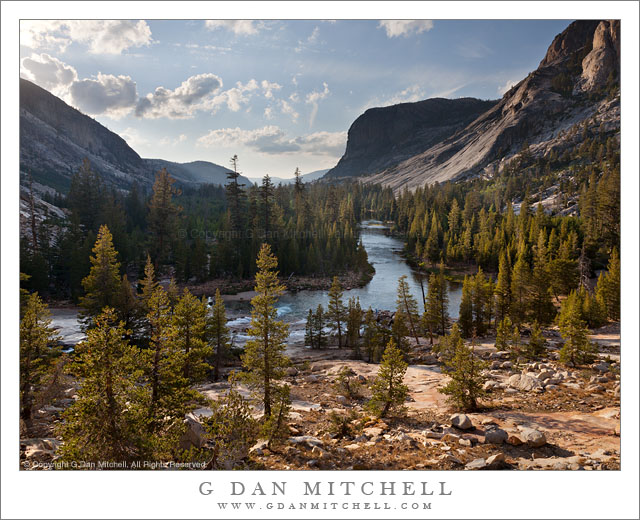
Tree, Granite Slabs, Evening Storm Clouds

Tree, Granite Slabs, Evening Storm Clouds

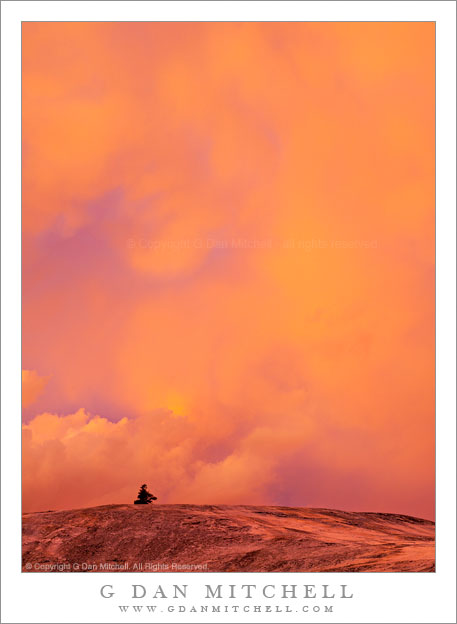
Tree, Granite Slabs, Evening Storm Clouds. Yosemite National Park, California. September 20, 2011. © Copyright 2011 G Dan Mitchell – all rights reserved.

A tree and granite slab are lit by brilliant sunset light from a dissipating evening thunderstorm, Yosemite National Park.

This was another of those sometimes-surprising bursts of evening Sierra color that results in effects so gaudy that they almost seem unreal – but this is real. I was camped down in a valley among trees so I wasn’t initially expecting much in the way of spectacular sunset photography. Instead, I planned to take advantage of the early shadows in the valley and get some evening photographs under soft light without any direct sun at all. I first worked some moving water where the nearby river flowed across granite slabs, and then I contemplated photographing some small plants in deeply cracked and patterned granite. As a worked my way across this granite, I remembered a small tree on the other side of the bowl that had looked like an interested photo subject a few days ago, so I walked over to that area where the tree stands in a shallow granite bowl.

Earlier in the afternoon I could see huge thunderheads building up to my east, but they did not move far enough west to affect me with anything more than a bit of gray sky. However, as the clouds built up to higher elevations, their tops began to take on the familiar “anvil” shape and the upper portions of the “anvils” began to spread to the west and out over my position. This is a classic setup for potentially spectacular evening sky color. Near sunset the clouds can pick up intense red/orange coloration from the sun setting in the west. At the same time, the storms begin to dissipate, creating semi-transparent “curtains” of virga (falling rain that doesn’t reach the ground), unusual shapes along the bottoms of the clouds, clouds emerging out of the gray murk as the sunset light picks them up.

As I arrived at my little tree, I quickly lost interest in that subject as the cloud light show began. First the bottom of the thunderhead began to turn brilliantly orange and red. Then the lower reaches of the small storm began to produce very unusual cloud shapes including mammatus clouds. Virga produced a brightly colored by semi-transparent scrim. It quickly became so bright that the red/orange colors began to wash the granite bowl, and I turned my camera from the little tree to the uphill granite surfaces and the clouds above.

In this vertical format image the tip of a small tree extends above the top of a dome-like area above me, and the brilliant light from the clouds washes the dome with color. The colors here have not been “amped up” in post – in fact, I’ve actually toned some of them down a bit!

G Dan Mitchell Photography
About | Flickr | Twitter | FacebookGoogle+ | 500px.com | LinkedIn | Email

Text, photographs, and other media are © Copyright G Dan Mitchell (or others when indicated) and are not in the public domain and may not be used on websites, blogs, or in other media without advance permission from G Dan Mitchell.
(Basic EXIF data may be available by “mousing over” large images in posts when this page is viewed on the web. Leave a comment if you want to know more.)

McGee Canyon and Mount Morgan

McGee Canyon and Mount Morgan

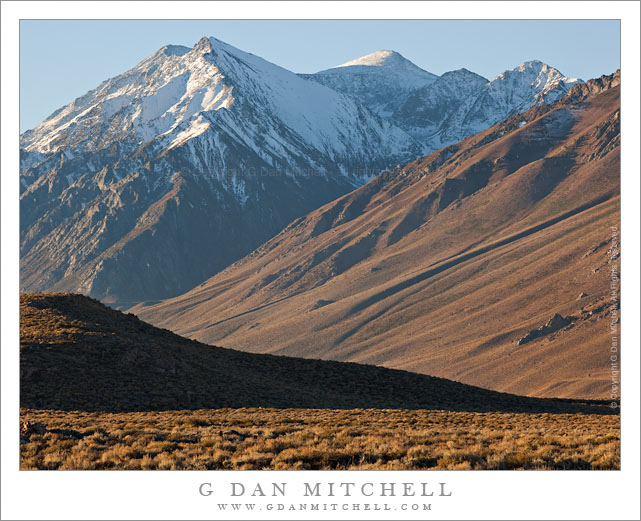
McGee Canyon and Mount Morgan. Owens Valley, California. October 10, 2010. © Copyright G Dan Mitchell – all rights reserved.

Snow crested Mount Morgan rises above McGee Canyon and the sagebrush-covered hills of Owens Valley in the eastern Sierra Nevada.

I’ve been traveling to the Sierra for many years. My first recollection of the range is a faint mental image of a shoreline park at Lake Tahoe when my family moved to California – I was four years old. My next memory is of staying at a small motel in El Portal next to the high water of the Merced River back in the days before the current mega-hotels were erected. One thing that all of my early Sierra experiences had in common is that I always approached the range from the west since I lived (and still live) in the San Francisco Bay Area. For the person whose orientation to the range is from the west, the Sierras are a range that begins almost imperceptibly in the Central Valley. Although you can see distant peaks from the Valley on clear days, it is hard to say where the range begins. As you head east you encounter some very small and rounded hills which gradually get larger. Eventually you are going up more than up and down as you  travel through oak and grass lands. At some point the road rises into forest, but the mountain tops are mostly rounded and forest covered. Keep going and a few rocky prominences begin to appear along the ridges and some distant granite peaks become visible. Only after a lot of driving do you find yourself in the higher reaches of the range, and this only in the few areas where roads cross from west to east. In most places you cannot even see the summit of the range close up from the west without walking a long ways.

It was only many years later that I first went over the summit of the range and saw it from the east side. The Sierra is (are?) completely different when approached this way. Instead of a long, gradual, and relatively gentle rise to high valleys and forests and meadows, the eastern escarpment of the Sierra rises abruptly – one might say violently – and directly, in most places, from the high desert sagebrush country of Owens Valley and similar places. This wall of peaks seems almost inaccessible, and I imagine that many people who only drive past on highway 395 must regard it that way.

This photograph was made from a spot just a mile or two east of highway 395, out an a gravel road that I know. I have photographed this shadowed foreground ridge and the peaks beyond in the past, so I had a fairly good idea of what I would find at this location before I made the photograph on an early October morning when fall storms had dusted the highest peaks with snow. I used a somewhat long lens and tight framing to emphasize the rise from the foreground desert to the very high peaks beyond.

This photograph is not in the public domain and may not be used on websites, blogs, or in other media without advance permission from G Dan Mitchell.
G Dan Mitchell Photography
Flickr | Twitter | Facebook Fan Page | Facebook | Friendfeed | Email

Abandoned Pier, Dusk

Abandoned Pier, Dusk
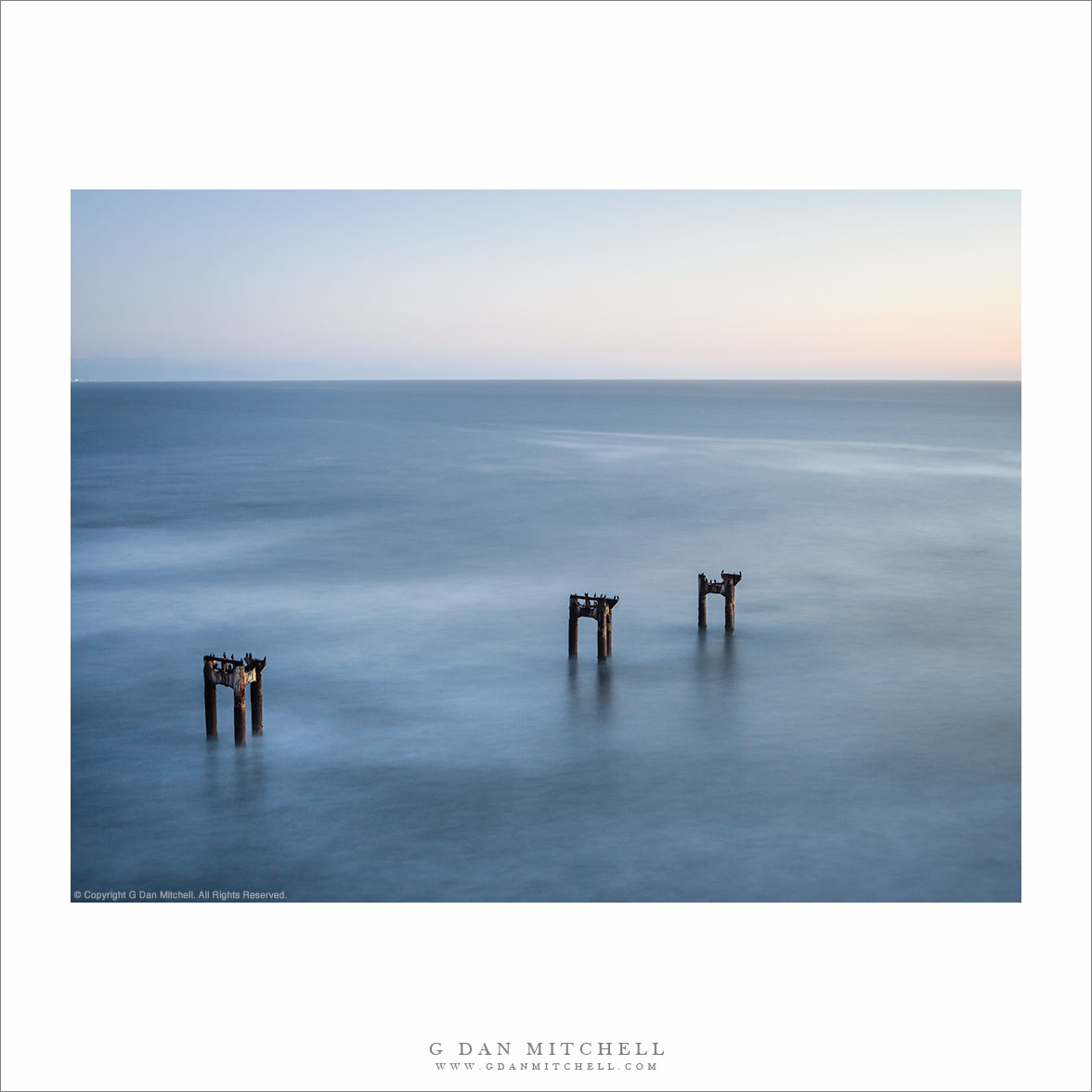
“Abandoned Pier, Dusk” — The pilings of a long-abandoned pier on the Pacific coast near Davenport, California.

Besides being a matter of hours from the Sierra Nevada and less than a day’s drive from places like Death Valley, I can be at the Pacific coast between San Francisco and Santa Cruz in barely more than a half hour. Yesterday it looked like evening conditions might be interesting so I headed over there in the late afternoon. As I crossed the mountains on my way there I was pleasantly surprised to see low clouds over the ridges and some higher clouds over towards the ocean, which got my hopes up for some sort of spectacular evening light. However, when I actually got the the coast the conditions were not as interesting – mostly clear with just a bit of cloudiness on the horizon, and no interesting haze or mist over the water. Either that or I just wasn’t “seeing it” this time. So, after stopping for a cup of coffee, I headed up the coast from Santa Cruz and stopped at several of the usual locations, but didn’t make a single exposure. At the northernmost point on my drive I stopped right by the water and it looked like interesting light might be five or ten minutes away… and then the sun dropped below some low clouds near the horizon and the light died!

I think I’ve learned to go with the flow when this happens. I react in several ways. One is to look around for subjects other than those that I thought I was there for. With that in mind I thought about photographing shore birds… but there was only one forlorn seagull down near the water. I saw an interesting pool of water on the beach and thought it might play into a seascape photograph, but the flat light and cloudless sky was not working. I remembered a spot a bit further south where I had once shot some shoreline shoals from the top of a steep cliff at sunset, so I quickly drove up that way… and couldn’t find them!

I had one final thought. On the way north I had seen a group of photographers on the bluff near the northern edge of Davenport. I had stopped, leaving my camera equipment in the car, and quickly dashed out to where they were set up to see what was so interesting. Below their position were the four remaining supports from an old pier that washed away many years ago. It looked interesting and I recognized the structure from photographs that others have made from down on the beach – but I hadn’t been up for the steep descent to the beach so I had driven on after making a mental note about a position from which I thought a photograph might be made. Now I realized that if I went straight there that I might be able to make some long exposures in the dying light and perhaps frame them so that they only contained the structures and the open sea. So, off I went.

I arrived just before the moment of sunset and, sure enough, the group of photographers I had seen earlier was still there. I grabbed my gear and quickly walked out to the point I had scoped out earlier, which was some distance from where they were set up. I framed up this composition and then photographed right though sunset until there wasn’t really enough light to keep shooting. (The group at one point looked like they thought the show was over and they were going to leave, but I think they saw me continuing to shoot and decided to stick around almost as long as I did.) The light just kept getting more interesting as it faded. Although it was too dark to really see the image as it appears here, I knew that this three minute exposure (intentionally lengthened by choosing a small aperture and low ISO) would smooth out the surface of the water but still show the shadows and reflections of the old pilings.


Leave a comment or question using the form. (If you are reading this on the home page, click the article title to see the full article and the comment form.

G Dan Mitchell is a California photographer and visual opportunist. His book, “California’s Fall Color: A Photographer’s Guide to Autumn in the Sierra” (Heyday Books) is available directly from him. Blog | Bluesky | Mastodon | Substack Notes | Flickr | Email

All media © Copyright G Dan Mitchell and others.

First Light Above the Buttermilks, Autumn Storm

First Light Above the Buttermilks, Autumn Storm

First Light Above the Buttermilks, Autumn Storm. Eastern Sierra, Owens Valley, California. October 3, 2010. © Copyright G Dan Mitchell – all rights reserved.

A faint rainbow briefly glows in dawn light on the eastern escarpment of the Sierra Nevada above the Buttermilks as an autumn storm builds.

Since I wrote previously about acting on a hunch to be in this spot in time to catch a few minutes of dawn light, I won’t recount the whole thing here – though I would like to describe the phenomenon a bit more and perhaps make a point or two about light and opportunities.

The photograph is of the eastern escarpment of the Sierra Nevada above Bishop, California and was made on an early autumn morning of a day that brought one of the first winter-like storms of the season. I found myself in this spot (as described at the link) for the very few minutes during which this light was present – and afterwards the light was simply gone and the rest of the day was overcast and rainy. The circumstances have me thinking about a few things about light and “being there” at the right moment.

Sometimes, even on a “poor light day” – though I like overcast conditions! – there can be a few brief moments of exceptional light. Catching them involves some combination of anticipating that these moments might occur, being there, and – let’s admit it! – dumb luck. In this case, all three were at work. I did not know that this light would occur, but I knew that the conditions offered a possibility. A clearing in the clouds along the eastern horizon allowed a horizontal beam of light to briefly hit the mountains right at dawn. It began by striking the clouds above the Sierra crest, soon hit the highest peaks, moved across the face of the range, and within minutes the show ended with light on the high desert. The band was so narrow that only one of these subjects was generally illuminated at a time – and the whole thing couldn’t have lasted more than five or ten minutes.

That description might make it sound like I’m saying that I’m just plain great at predicting such things and planning to be there. Not quite! If you had asked me a few minutes earlier, when I made the spontaneous decision to abandon my previous plans and high-tail it out to this spot, what the odds were that I’d see light like this I might have estimated them at perhaps 10% or less. In other words, if I repeated this little adventure 10 times, I’d guess that I’d fail to see light like this nine out of ten times. However, if I only go for “sure bets” (which I’ll take when I can get them!) I know that I’ll miss lots of special conditions that are not subject to prediction.

Which brings up the subject of luck. I often read that one should be able to know in advance what the photograph will look like, and that careful and full preparation will lead to good photographs. Well, sort of, but maybe not quite in the way that some imply. (There is an element of “preparation” in all of this that I’ll write about eventually, but that is a different thing.) Frankly, these subjects are too complex and too fleeting and too unpredictable to be subject to that sort of careful and precise planning in any sort of consistently useful way. The photographer cannot make that small band of open sky appear along the horizon on an autumn morning when a storm is building along the crest – but if everything goes right a photographer might be there at the right moment, prepared to make a photograph of it.

This photograph is not in the public domain and may not be used on websites, blogs, or in other media without advance permission from G Dan Mitchell.

G Dan Mitchell Photography | Twitter | Friendfeed | Facebook | Facebook Fan Page | Email