
Tag Archives: cliffs

Red Cliffs and Trees

Red Cliffs and Trees
“Red Cliffs and Trees” — Kolob Canyon red sandstone walls in morning light and shadow, Zion National Park.

There are plenty of people whose knowledge of the red rock sandstone formations of the Southwest exceeds mine. But I have observed tremendous variations in these rocks as I photographed in Utah. The rock generally comes in layers that vary significantly in color and texture. Sometimes they are thick, uniform, and massive. In other locations they are filled with textured sub-layers and contain curves and cracks.

The example in this photograph is one of those massive, solid layers. This cliff is in Zion National Park’s slightly-more-remote Kolob Canyon. It is in a location where you can get quite close to this impressive layer. I made the photograph on a morning with a bit of haze. The position of the sun in front and to the right of the camera produced rim light on the cliff’s edges.


Leave a comment or question using the form. (Click the title to see the full article and the comment form if you are reading it on the home page.

G Dan Mitchell is a California photographer and visual opportunist. His book, “California’s Fall Color: A Photographer’s Guide to Autumn in the Sierra” (Heyday Books) is available directly from him. Blog | Bluesky | Mastodon | Substack Notes | Flickr | Email

All media © Copyright G Dan Mitchell and others.

Red Rock Sunset

Red Rock Sunset
“Red Rock Sunset” — Sunset light on red rock formations near Fruita, Capitol Reef National Park.

This spot is obviously full of spectacular scenery, though it was a bit tricky to photograph near sunset. One of the “problems” actually turned out to be a plus. There was some overcast that muted the light, but the light was still strong enough to be softly directional, especially on the more distant cliffs. A second issue is geological. The area is on an inclined formation that rises to the west, so the sun actually drops behind the uplifted western horizon a bit earlier than true sunset.

The color was astonishingly red in this sunset light, especially since the soft light reduced harsh shadows and highlights. I don’t often include roads in my landscape photographs, but in this case, a) it was unavoidable and b) it produced a useful leading line heading toward the groves of trees and the campground at Fruita.


Leave a comment or question using the form. (If you are reading this on the home page, click the article title to see the full article and the comment form.

G Dan Mitchell is a California photographer and visual opportunist. His book, “California’s Fall Color: A Photographer’s Guide to Autumn in the Sierra” (Heyday Books) is available directly from him. Blog | Bluesky | Mastodon | Substack Notes | Flickr | Email

All media © Copyright G Dan Mitchell and others.
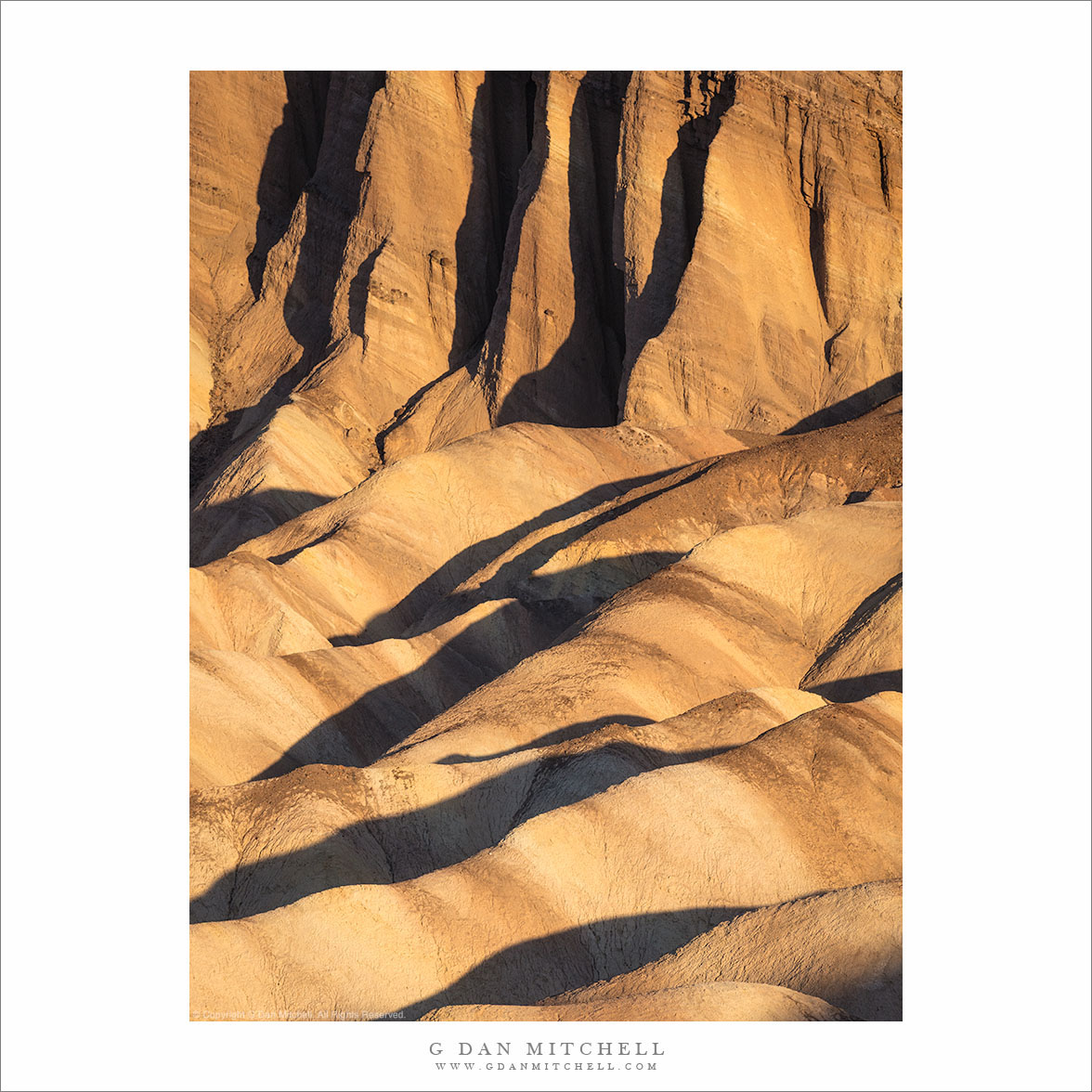
Base of the Red Cliffs

Base of the Red Cliffs. Death Valley
“Base of the Red Cliffs” — Gullies, folds, strata, and morning shadows at the base of the Red Cliffs.

The title says “Red Cliffs,” but you might be thinking, “They don’t look very red to me!” In more neutral light the formations in the upper part of the photograph, and even more so the formations above the margins of the photograph, do have the familiar red rock quality — though it would be fair to say that they are as much brown as red. But in this stark early morning light, just after sunrise, the colors are warmed so much that they are more yellow or orange.

In many ways the geology of Death Valley produces a blank canvas for photographers who want to work with varied light. For the most part, Death Valley’s colors are subtle. The lighter portions of the formations in this photograph are a sort of muted tan in midday light. But as with so many other subjects here, this muted, neutral quality allows them to pick up the colors of sunrise/sunset, twilight, colorful clouds, and reflections from nearby formations.

G Dan Mitchell is a California photographer and visual opportunist. His book, “California’s Fall Color: A Photographer’s Guide to Autumn in the Sierra” (Heyday Books) is available directly from him. Blog | Bluesky | Mastodon | Substack Notes | Flickr | Email

Join the discussion — you are welcome to leave a comment or question. (Comments are moderated and may not appear immediately.)

This site uses Akismet to reduce spam. Learn how your comment data is processed.

(All media © Copyright G Dan Mitchell and others.)

Gulllies and Strata, Morning Light

Gulllies and Strata, Morning Light, Death Valley
“Gulllies and Strata, Morning Light” — Highly eroded gullies and strata, Death Valley National Park.

Some geological formations in Death Valley National Park are simply otherworldly. The sparse vegetation lays these features bare — they are more visible than in places covered by forests and other vegetation. The landscape has been uplifted, split, warped, and eroded in remarkable ways. Here tilted strata emerge in deeply eroded land, and morning shadows add more contrast.

I’ve often noted the irony that this place, known for its dryness and heat, is one of the best places to clearly see the effects of water on the landscape. The material in these formations was laid down under water millennia ago. And the diagonal gullies were created by water erosion. If you have your eyes open, you’ll see that the evidence of water’s effect on the landscape is visible everywhere in this park.


G Dan Mitchell is a California photographer and visual opportunist. His book, “California’s Fall Color: A Photographer’s Guide to Autumn in the Sierra” (Heyday Books) is available directly from him.

G Dan Mitchell: Blog | Bluesky | Mastodon | Substack Notes | Flickr | Email


All media © Copyright G Dan Mitchell and others as indicated. Any use requires advance permission from G Dan Mitchell.