
Tag Archives: cliffs

Canyon Hikers

Canyon Hikers
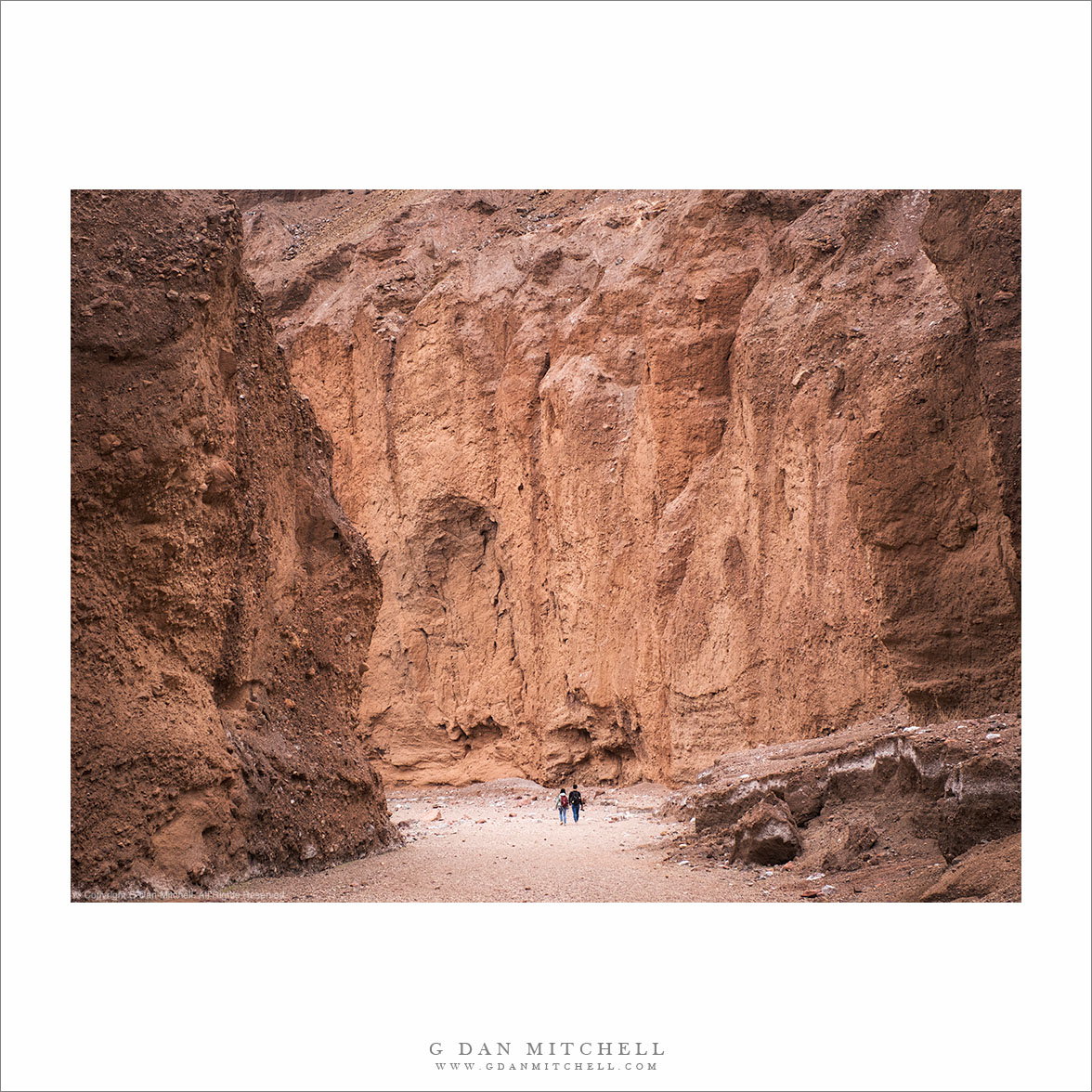
“Canyon Hikers” — Two hikers walk along a desert wash between high walls in a Death Valley canyon.

It seems to me that when most people think of Death Valley National Park, the first things that come to mind are familiar desert icons, the sand dunes, with features like salt flats close behind. But the park is remarkably diverse, with other features that would surprise those who don’t know of them. Among them are the park’s canyons, some of which — like this one — feature extremely high walls.

The weather often dictates what we do on any given Death Valley day. On this one we had clouds building towards evening rain, so the light on grand landscape subjects was not especially great. So we decided to visit a canyon or two. This one is fairly accessible so we were most certainly not alone. but at times the other visitors disappeared behind curves in the canyon. I decided to include these two hikers in order to illustrate the size of the canyon.


Leave a comment or question using the form. (Click the title to see the full article and to comment if you are viewing it on the home page.)

G Dan Mitchell is a California photographer and visual opportunist. His book, “California’s Fall Color: A Photographer’s Guide to Autumn in the Sierra” (Heyday Books) is available directly from him. Blog | Bluesky | Mastodon | Substack Notes | Flickr | Email

All media © Copyright G Dan Mitchell and others.
Red Cliffs and Trees

Red Cliffs and Trees
“Red Cliffs and Trees” — Kolob Canyon red sandstone walls in morning light and shadow, Zion National Park.

There are plenty of people whose knowledge of the red rock sandstone formations of the Southwest exceeds mine. But I have observed tremendous variations in these rocks as I photographed in Utah. The rock generally comes in layers that vary significantly in color and texture. Sometimes they are thick, uniform, and massive. In other locations they are filled with textured sub-layers and contain curves and cracks.

The example in this photograph is one of those massive, solid layers. This cliff is in Zion National Park’s slightly-more-remote Kolob Canyon. It is in a location where you can get quite close to this impressive layer. I made the photograph on a morning with a bit of haze. The position of the sun in front and to the right of the camera produced rim light on the cliff’s edges.


Leave a comment or question using the form. (Click the title to see the full article and the comment form if you are reading it on the home page.

G Dan Mitchell is a California photographer and visual opportunist. His book, “California’s Fall Color: A Photographer’s Guide to Autumn in the Sierra” (Heyday Books) is available directly from him. Blog | Bluesky | Mastodon | Substack Notes | Flickr | Email

All media © Copyright G Dan Mitchell and others.

Red Rock Sunset

Red Rock Sunset
“Red Rock Sunset” — Sunset light on red rock formations near Fruita, Capitol Reef National Park.

This spot is obviously full of spectacular scenery, though it was a bit tricky to photograph near sunset. One of the “problems” actually turned out to be a plus. There was some overcast that muted the light, but the light was still strong enough to be softly directional, especially on the more distant cliffs. A second issue is geological. The area is on an inclined formation that rises to the west, so the sun actually drops behind the uplifted western horizon a bit earlier than true sunset.

The color was astonishingly red in this sunset light, especially since the soft light reduced harsh shadows and highlights. I don’t often include roads in my landscape photographs, but in this case, a) it was unavoidable and b) it produced a useful leading line heading toward the groves of trees and the campground at Fruita.


Leave a comment or question using the form. (If you are reading this on the home page, click the article title to see the full article and the comment form.

G Dan Mitchell is a California photographer and visual opportunist. His book, “California’s Fall Color: A Photographer’s Guide to Autumn in the Sierra” (Heyday Books) is available directly from him. Blog | Bluesky | Mastodon | Substack Notes | Flickr | Email

All media © Copyright G Dan Mitchell and others.

Base of the Red Cliffs

Base of the Red Cliffs. Death Valley
“Base of the Red Cliffs” — Gullies, folds, strata, and morning shadows at the base of the Red Cliffs.

The title says “Red Cliffs,” but you might be thinking, “They don’t look very red to me!” In more neutral light the formations in the upper part of the photograph, and even more so the formations above the margins of the photograph, do have the familiar red rock quality — though it would be fair to say that they are as much brown as red. But in this stark early morning light, just after sunrise, the colors are warmed so much that they are more yellow or orange.

In many ways the geology of Death Valley produces a blank canvas for photographers who want to work with varied light. For the most part, Death Valley’s colors are subtle. The lighter portions of the formations in this photograph are a sort of muted tan in midday light. But as with so many other subjects here, this muted, neutral quality allows them to pick up the colors of sunrise/sunset, twilight, colorful clouds, and reflections from nearby formations.

G Dan Mitchell is a California photographer and visual opportunist. His book, “California’s Fall Color: A Photographer’s Guide to Autumn in the Sierra” (Heyday Books) is available directly from him. Blog | Bluesky | Mastodon | Substack Notes | Flickr | Email

2 responses to “Base of the Red Cliffs”

  1. Charlie Colladay Avatar
    Charlie Colladay

    Hi Dan,
    Here I am, wasting some time on a Sunday afternoon and I came back to this photo of yours. It has not lost any of the intrigue that originally caught my eye and led me to post a comment. Forgive me for diving deeper still into the details of the lighting, that for me, is the strength of this photo. Again, forgive me, but I have to take some issue with a comment of your’s re: the light falling on the foreground.

    You say…”The foreground light is coming from behind and above my camera position — a combination of more reflected light and light from the open sky.”
    I’ll accept that open sky is supplying some over all fill light, but it is much weaker than the main, semi-hard light coming from the left. The evidence of this can be seen in the delineation of the vertical striations on the rock face at the left side of the frame. Each individual striation has a highlight at its peak then a shadow in the depression to the right, in a repeating pattern. Whatever the source of illumination, the bulk of its directional quality can’t be coming from above and behind the camera position. That would produce a much flatter light than what is seen here. The result then would be the foreground rock’s striations being less textural, less visible, more boring without the contrast of the highlight/shadow repeating pattern.

    On that same foreground rock, the upper left and the lower right (the ankle and the toes of the “giant’s foot”) are both darker and flatter, the result of being lit only by the open sky, providing an omnidirectional, flatter and lower level of illumination.

    The overall, bottom line still exists…I love this shot! The above details are just an explanation of why it works so well for me. Thank you, Dan!

    1. G Dan Mitchell Avatar
      G Dan Mitchell

      Charlie,

      Thanks for taking the time to write a long post on this photograph. But I must admit that I’m a bit confused by your comment.

      You wrote:

      ”You say…”The foreground light is coming from behind and above my camera position — a combination of more reflected light and light from the open sky.

      But when I look at the text I wrote to accompany this photograph, in the post you replied to, I do not see that I wrote anything like that there. I wonder if you were looking at a different photograph than the one you commented on?

      In the photograph on this page — “Base of the Red Cliffs” — the sun is definitively behind and above my camera position. It is not straight behind me, but is coming from a slight angle over my right shoulder, which is why the shadows stretch towards the left.

      Let me know if you can figure out why your comment doesn’t seem align with this photograph or its descriptive text.

      Dan

Join the discussion — you are welcome to leave a comment or question. (Comments are moderated and may not appear immediately.)

This site uses Akismet to reduce spam. Learn how your comment data is processed.

(All media © Copyright G Dan Mitchell and others.)