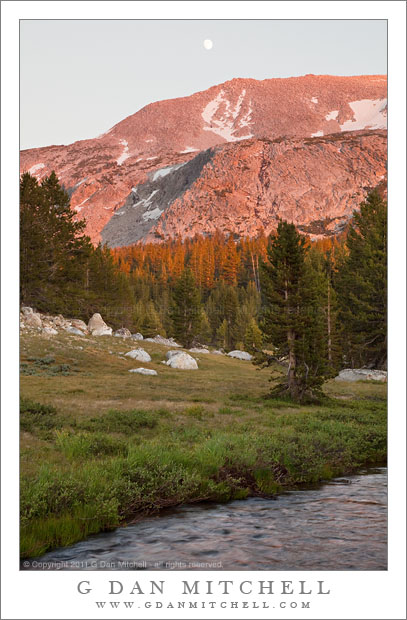
Pywiack Dome towers above Tenaya Creek as it floods surrounding meadows with spring snow melt, Yosemite National Park.
This little spot between Pywiack Dome and Tenaya Lake has interested me for some time. Driving past, I’ve been intrigued by the dome itself (of course!) but also by the small meadow below it where Tenaya Creek winds through a mixture of forest and meadow, and from which the outlet of Cathedral Lake is visible if you know just where to look. In the past, I’ve wandered about in this meadow a bit, trying to photograph lush growth of corn lily plants early in the season.
On this visit, as I drove by on the first day, I was struck by the amount of water flowing here – what I’m used to seeing as a meadow with a stream winding through it was filled from edge to edge with rushing water from snowmelt-swollen Tenaya Creek. I made a mental note to try to come back here the following morning when I thought that light might be interesting. And that’s just what I did on the second day of this visit during the weekend when the pass opened.
Clouds lit by alpenglow drift across the face of Mount Conness beyond the Tenaya Creek drainage, Yosemite National Park.
Earlier this week I posted another photograph of the same evening. This one was shot a bit earlier (believe it or not!) than the other photograph, as the intense and perhaps unexpected color display was just getting started. I’ll have more to write about the phenomenon in a future blog post that uses this evening as an example, but it almost seem like the sunset progressed backwards (oxymoron alert!) as it went on. It had begun with very boring and low contrast light, somewhat flattened by a haze that took on an increasingly ghastly blue-green hue as the light began to fade. Although the surroundings were spectacular on this opening day of Tioga Pass Road, the light and atmospheric conditions seemed to be conspiring to show them it their worst (literal and figurative) light.
But just at dusk a hint of pink appeared in some of the clouds ringing Mount Conness, the tall peak in the upper left. At first it was so faint that only those of us who were looking for it might have noticed, and we perhaps thought that we were simply trying to convince ourselves that something was going to happen. But the color increased, and as the more distant areas picked up better light, they shone through the foreground haze more clearly, and this haze faded in the same way that a scrim does in a theater when the front lights dim and the stage lights rise.
I find that this type of scene provides some of the most difficult technical and judgment challenges. So often the goal in an image, especially if it is going to be a print, is to try to get as much light into the scene as possible. A lot of the work in post-processing, at least for me, is done with the goal of trying to fill the image with light by means of various careful adjustments, often involving the use of masked curve layers. But here, the coloration depends upon not being overly bright – too much light either decreases the intensity of the pink and purple shadings or else sends them off into the land of the grotesque and gaudy. And the light in shadows – and there are a lot of shaded areas in this scene! – is very blue, much more so than the untrained eye would imagine when looking at the scene in person. This requires another set of tricky and subjective judgments – it would not look right to leave portions of the scene as blue “as they really were,” nor would it look right if the blue were diminished too much. But how much is right? There is no objective answer that I know of, so the goal (for example, on the large granite face of Polly Dome at the left) is to come up with a balance that seems blue enough but not too blue. A similar issue arises in these dark areas when it comes to deciding how bright is bright enough. Believe it or not, virtually nothing in this image is actually black, with the possible exception of a few very tiny areas in the lower left. The luminosity of the very dark areas had to be lifted a bit… but how much is just right? Again, a matter of personal judgment about which there is no objectively right answer.
All of that technical stuff aside, this evening provided one of the most glorious, albeit brief, displays of sublime light I have seen in the Sierra.
“Impossible Tree Falls” in full early season flow, fed by the runoff from a very heavy snowpack, Yosemite National Park.
I don’t know if this is really called Impossible Tree Falls, but I like the name and I’m going with it. My guess is that the reason for the name might be two-fold. First, the tree does grow right in the middle of this roadside water fall. It must be an interesting few weeks each spring when this tree wakes up to find itself in the middle of a raging water fall, since the rest of the year things are much calmer. Second, the trees seems to grow on nothing but bare rock. It is hard to see in this mist-covered and back-lit image, but it looks like the tree is rooted in solid rock.
For a person who likes to occasionally think of himself as something of a back-country photographer, it is almost embarrassing to admit that this waterfall is right next to Tioga Pass Road. I’ll be honest – I parked my car in a pull-out on the opposite side of the roadway and probably never moved more than 10 yards from there. To add insult to injury, at a couple of points I had to stop shooting while passing recreational vehicles interfered with the view! ;-)
But none of that makes the tumultuous little waterfall any less impressive. It appears above the road, where it seems to come out of a flatter forest area, and then it abruptly tumbles down a very steep rocky incline, twisting and turning around boulders – and one solitary tree.
A seasonal stream cascades over a granite ledge along Tioga Pass Road, Yosemite National Park.
This small cascade is one of hundreds seen along Tioga Pass Road on June 18 this year, the day the park service opened the road for the season. The opening date was later than usual due to the heavy snowpack, and there was water everywhere as the snow melt accelerated in the late spring weather. It was almost embarrassingly easy to find and photograph these subjects – this one was right next to the roadway.
This is part of a larger cascade, out of view to the right, that flows off the top of a granite area and drops quickly across granite cliffs. Here the water strikes a slanting ledge and bits of spray explode almost like Fourth of July fireworks. Obviously, the somewhat unusually long shutter speed was selected with this effect in mind. The reddish plants to the left, just beginning to come back to life after the long winter, hint at the early date in the season.
Photographer and visual opportunist. Daily photos since 2005, plus articles, reviews, news, and ideas.
Manage Consent
To provide the best experiences, we use technologies like cookies to store and/or access device information. Consenting to these technologies will allow us to process data such as browsing behavior or unique IDs on this site. Not consenting or withdrawing consent, may adversely affect certain features and functions.
Functional
Always active
The technical storage or access is strictly necessary for the legitimate purpose of enabling the use of a specific service explicitly requested by the subscriber or user, or for the sole purpose of carrying out the transmission of a communication over an electronic communications network.
Preferences
The technical storage or access is necessary for the legitimate purpose of storing preferences that are not requested by the subscriber or user.
Statistics
The technical storage or access that is used exclusively for statistical purposes.The technical storage or access that is used exclusively for anonymous statistical purposes. Without a subpoena, voluntary compliance on the part of your Internet Service Provider, or additional records from a third party, information stored or retrieved for this purpose alone cannot usually be used to identify you.
Marketing
The technical storage or access is required to create user profiles to send advertising, or to track the user on a website or across several websites for similar marketing purposes.