Tag Archives: granite

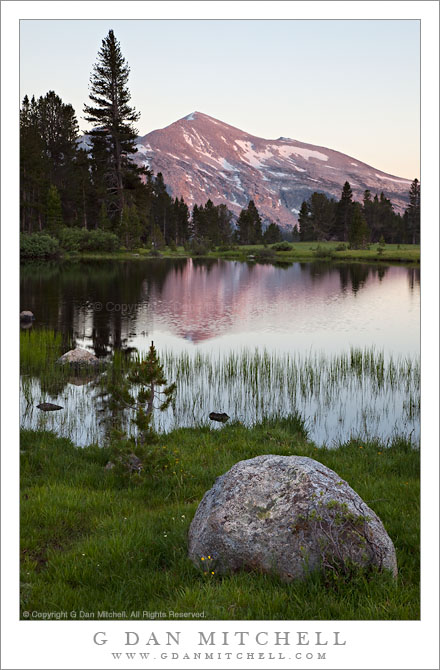
Alpenglow, Mammoth Peak

Alpenglow, Mammoth Peak

Alpenglow, Mammoth Peak. Yosemite National Park, California. July 22, 2010. © Copyright G Dan Mitchell – all rights reserved.

Alpenglow lights the face of Mammoth Peak beyond a small tarn near the summit of Tioga Pass, Yosemite National Park.

This was very close to the last exposure I made on this productive late-July day last year. After photographing for a few hours in the vicinity of Tioga Pass, I ended up right at the pass as the day came to an end. Braving hordes of mosquitos – comes with the territory! – I worked the area around the pass itself, building compositions out of juxtapositions of the water in the small meltwater ponds, shoreline meadow and boulders, grasses growing along the edge of the water, the surrounding pine forests, and the more distant peaks of Kuna Crest. In this photograph, what is very nearly the very last direct light of the day is bathing the slopes of Mammoth Peak, which still had a fair amount of snow on its flanks even in late July.

This scene posed a few technical challenges. First, there is obviously a great distance between the foreground granite boulder and the very distance mountain. I wanted the foreground to be in optimal sharpness, so I used a relatively small aperture to maintain sufficient sharpness on the far ridge. There was also a fairly large dynamic range in the scene, ranging from soft but direct light on the snow fields of the peak to the dark areas within the forest on the other side of the pond. I wasn’t certain that I’d be able to handle the full dynamic range in one exposure, so I made three – one longer exposure to get a bit more light from the shadows and another shorter one on the dark side to avoid blowing out the brighter areas of the sky. In post, I discovered that there was enough detail in the shadows that I could get everything I needed from a single exposure, though I had to do some work with curves to get create an image the conforms more closely to the way I saw the scene at the time.

G Dan Mitchell Photography | Flickr | Twitter (follow me) | Facebook (“Like” my page) | LinkedIn | Email
Text, photographs, and other media are © Copyright G Dan Mitchell (or others when indicated) and are not in the public domain and may not be used on websites, blogs, or in other media without advance permission from G Dan Mitchell.

Lodgepole Pine, Evening Shadows

Lodgepole Pine, Evening Shadows

Lodgepole Pine, Evening Shadows. Yosemite National Park, California. July 22, 2010. © Copyright G Dan Mitchell – all rights reserved.

The evening shadow cast by a nearby high ridge approaches a lone lodgepole pine and an old snag near Tioga Pass, Yosemite National Park.

One of my favorite kinds of light is that found at the edges of shadows from higher peaks as they move across lower terrain. (A secret: Among other “tricks,” I like to find and follow these margins when I shoot in Yosemite Valley, too.) Because this light most often happens during the relatively early and late hours of the day, the color quality of the light tends to be warm and the angle low. As the patterns of light and shadow move across the landscape, individual elements may get picked out the light and can often be isolated against darker backgrounds, as in this photograph.

The Sierra is full of trees pretty much like this one, and such meadows with the isolated small and large trees and scattered boulders are not hard to find. This particular tree is in one of the extensive meadow areas in the general area of Tioga Pass. The photograph was made in the very late afternoon as the tall ridge to the west was blocking the sun.

Despite the still and tranquil nature of the scene, this is an example of a sort of shot that reveals the wrongness of the idea that all landscape is done slowly and methodically and with all the time in the world to work. Sometimes that is the case, but when you work the margins of shadows (or many similar dynamic subjects) there may only be brief seconds when the light is where you want it. An observer might find it humorous to watch the photographer run to get into position and then work very quickly.

G Dan Mitchell Photography | Flickr | Twitter (follow me) | Facebook (“Like” my page) | LinkedIn | Email
Text, photographs, and other media are © Copyright G Dan Mitchell (or others when indicated) and are not in the public domain and may not be used on websites, blogs, or in other media without advance permission from G Dan Mitchell.

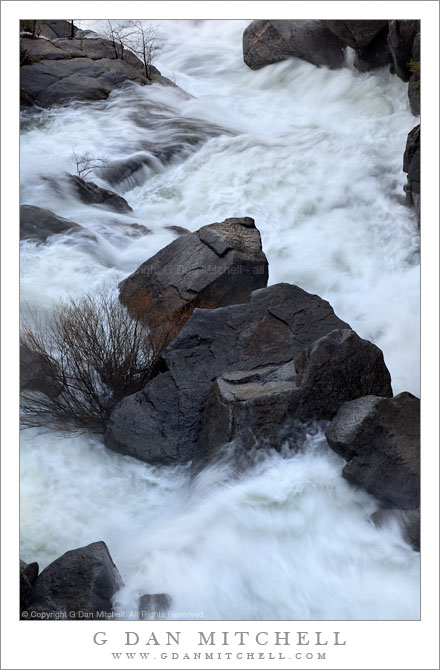
Boulders and Spring Torrent, Cascade Creek

Boulders and Spring Torrent, Cascade Creek
“Boulders and Spring Torrent, Cascade Creek” — Runoff from spring snow melt rushes over boulders of Cascade Creek, Yosemite National Park.

I recently posted the black and white version of this photograph of Cascade Creek in full spring flow.

The color version of this photograph posed a series of post-processing questions and problems that others who have worked with a scene like this one can probably imagine. The creek descends through a narrow, rocky gorge at this point and I photographed it early in the morning before any direct sunlight was able to reach the water. Benefits of shooting at this time included the softer light, which tends to both throw some light into the shadows and to soften the brightest highlights. This also permits a longer exposure which allows the water to blur a bit and express the wild motion of the creek. However, since the primary source of light was the open sky, the camera “sees” a very blue scene. (Our visual system compensates for this, so it doesn’t look as blue as it really is when you are on the scene.)

There are several ways to deal with the color balance issues that this situation creates. You could just “go with the blue,” and I’ve seen photographs done that way. I’ve even seen some in which the photograph amped up the saturation and ended up with something very blue. In general, that’s not my thing! I’m most often looking for something that seems “believable” – it may not be objectively accurate, but I intend it to be “subjectively accurate.” With this in mind, my first instinct was simply to warm the color balance in order to move away from the blue cast and toward a warmer one.

My immediate impression was that this was an improvement, and I worked with this interpretation for several days – but something about it didn’t sit quite right with me. (This is perhaps one reason that I also worked with the black and white rendition in the meantime.) Eventually I did some comparisons between the “warmed up” version and the original… and neither seemed like what I was after. The overly blue original looked garish but the overly warm version seemed artificial. I tried some other approaches and finally discovered that because the blue was so intense that I could simply desaturate it – more than you might think – and keep the “colder” coloration without letting it overwhelm the image.

G Dan Mitchell Photography | Flickr | Twitter (follow me) | Facebook (“Like” my page) | LinkedIn | Email
Text, photographs, and other media are © Copyright G Dan Mitchell (or others when indicated) and are not in the public domain and may not be used on websites, blogs, or in other media without advance permission from G Dan Mitchell.

Canon EOS 5D Mark II (at B&H)
Canon EF 70-200mm f/4 L USM at 126mm (at B&H)
ISO 100, f/16, 1/8 second


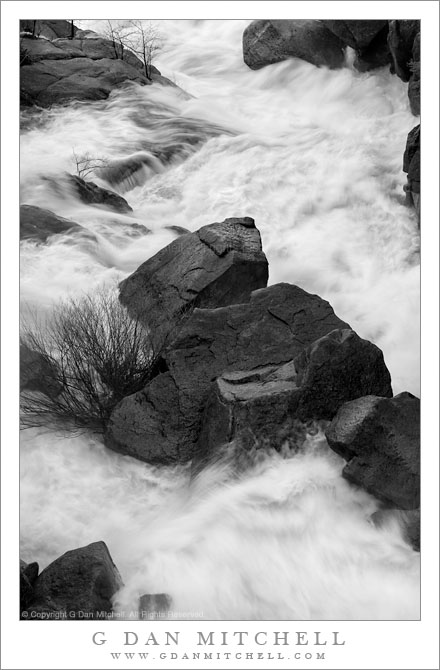
Boulders and Spring Torrent, Cascade Creek

Boulders and Spring Torrent, Cascade Creek

Boulders and Spring Torrent, Cascade Creek. Yosemite National Park, California. May 7, 2011. © Copyright G Dan Mitchell – all rights reserved.

Runoff from spring snow melt rushes over boulders of Cascade Creek, Yosemite National Park.

This is a subject that I return to several times each year – a particular section of creek that can be viewed from overhead and which can vary from nearly dry to a wild torrent depending upon the time of year and the character of each new year. During the past year I was inspired by Charles Cramer’s stunning photograph of this subject to look at it more closely and from some different perspectives. (A small bit of “Charlie’s scene” appears in this photograph. I wonder if you can find it? :-)

In some ways, the view of this scene is limited in that you can only see it from a particular range of positions – unless you have the skill of levitation! In another way it is hardly limiting at all since the larger view contains many possible smaller views of rocks and plants and water and light. I still have in mind a horizontal composition in this general area, but so far it hasn’t quite worked. Guess I’ll have to keep trying.

I made this photograph in the morning before any direct light had worked its way around the mountains and down into the stream bed. Beyond the stream, which drops precipitously into the Merced River far below, there was open sky and that is the light that reflects on some of the wet rocks. By playing around to find an appropriate combination of ISO values, aperture, and shutter speed, I tried to get the water to hold some detail but to also be blurred enough to reflect its wild motion as it tumbles down this rocky canyon.

As is sometimes the case, I still cannot decide for sure between this monochrome version and a color version that will appear here before long.

G Dan Mitchell Photography | Flickr | Twitter (follow me) | Facebook (“Like” my page) | LinkedIn | Email
Text, photographs, and other media are © Copyright G Dan Mitchell (or others when indicated) and are not in the public domain and may not be used on websites, blogs, or in other media without advance permission from G Dan Mitchell.