
Tag Archives: high

High Desert, Rock and Sage

High Desert, Rock and Sage

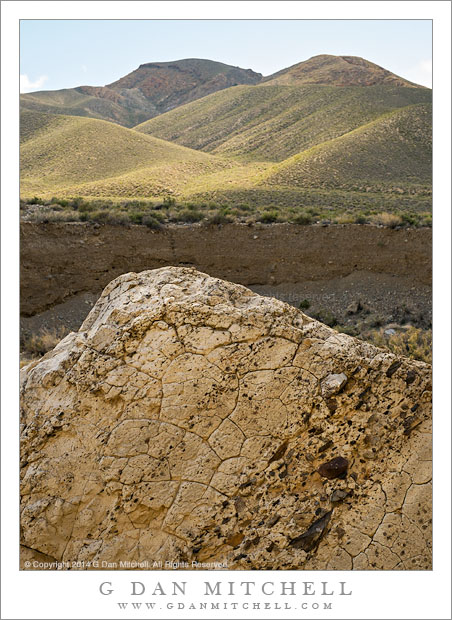
High Desert, Rock and Sage. Death Valley National Park, California. April 2, 2014. © Copyright 2014 G Dan Mitchell – all rights reserved.

An upturned boulder stands in a wash below high desert mountains, Death Valley National Park

This was not a day like most that you would expect to experience in Death Valley National Park, although in this spring transitional season such days are not completely unexpected. Early in the morning we had been at a very high promontory from which we had expansive views of a huge area of the desert mountain landscape, though an incoming storm muted the colors and blocked the sunrise light. Soon after that it began to snow, and we spent several hours photographing in desert mountain snow. Oddly, a portion of this time was spent photographing copious spring wildflowers!

By early afternoon the main body of the storm was passing and the clouds began to break in some places, and while it continued to rain or snow in other nearby mountains we had sun where we were. We took advantage of this to visit an old historic site high in the mountains, and then we began our drive back to the Valley itself, where I had an evening subject in mind. Along the way we pulled over at a spot where I often like to stop and look at and perhaps photograph certain things. While there I looked back across this valley, with hills briefly green from spring moisture, and noticed the juxtaposition of the shape of this layered rock in the foreground and those soft hills with moving cloud shadows in the distance.

G Dan Mitchell is a California photographer and visual opportunist whose subjects include the Pacific coast, redwood forests, central California oak/grasslands, the Sierra Nevada, California deserts, urban landscapes, night photography, and more.
Blog | About | Flickr | Twitter | FacebookGoogle+ | 500px.com | LinkedIn | Email

Text, photographs, and other media are © Copyright G Dan Mitchell (or others when indicated) and are not in the public domain and may not be used on websites, blogs, or in other media without advance permission from G Dan Mitchell.
Panamint Mountains, Spring

Panamint Mountains, Spring

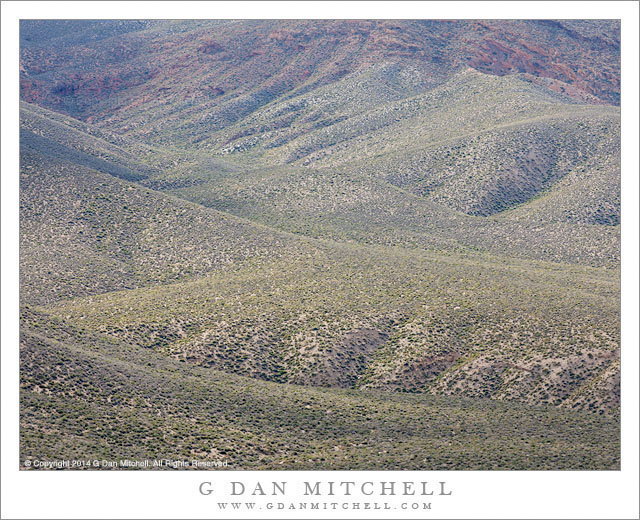
Panamint Mountains, Spring. Death Valley National Park, California. April 2, 2014. © Copyright 2014 G Dan Mitchell – all rights reserved.

Cloud shadows pass across valleys of spring-green high desert plants in the Panamint Mountains of Death Valley National Park

I like to think of this photograph as one that may offer a more truthful presentation of the character of Death Valley. As photographers, almost all of us to looking for the extraordinary—momentary instances of astonishing light, brilliant color towering clouds, dramatic light, and more. And, of course, there is nothing remotely wrong with that. It is these things that draw us to these places and which drive our search once we get there. We will often put up with, sometimes patiently and sometimes not, hours or days of what some call “blah” light in order to be able to photograph brief instance of something atypically powerful. But we must be aware that what we find and show in this brief slices of time is often special precisely because it is unusual.

A few years back I started thinking more about my relationship with the landscape of Death Valley and the surrounding terrain. I had been focusing on the extraordinary—and I still do—and on the way to such places I often passed through other areas, sometimes without taking the time to think about what I was seeing in those moments. I think that it was partially out of frustration that I arrived at the idea of trying to see these subjects more clearly and try to figure out how to photograph them. After all, I knew—at least once I stopped to think about it—that my love of this places was not limited to just the unusual and extraordinary moments, but that it also included midday quiet in the heat and subtle colors of sage country, a series of simple overlapping ridges, a bit of rock. And once I recognized this I started to think that these things, and not just sunrises and sunsets and impressive formations and unusual clouds, might make worthy subjects if I slowed down and tried to understand them. And this is one of those photographs. There is no single, impressive subject in this frame. Instead we have the almost uniform pale green of the arid mountain plants on an early spring day after rain, when the plants produce a subtle but surprising green coloration that varies as the land alternates between gullies and the tops of low hills and clouds from a cleaning storm move across the landscape.

G Dan Mitchell is a California photographer and visual opportunist whose subjects include the Pacific coast, redwood forests, central California oak/grasslands, the Sierra Nevada, California deserts, urban landscapes, night photography, and more.
Blog | About | Flickr | Twitter | FacebookGoogle+ | 500px.com | LinkedIn | Email

Text, photographs, and other media are © Copyright G Dan Mitchell (or others when indicated) and are not in the public domain and may not be used on websites, blogs, or in other media without advance permission from G Dan Mitchell.
Clearing Storm, Panamint Mountains

Clearing Storm, Panamint Mountains

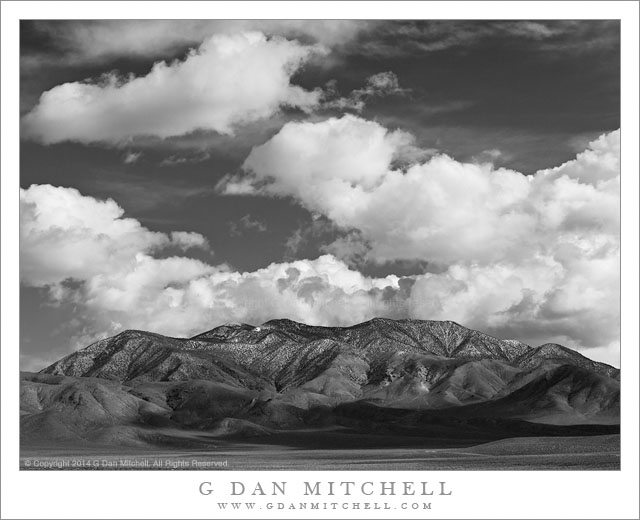
Clearing Storm, Panamint Mountains. Death Valley National Park, California. April 2, 2014. © Copyright 2014 G Dan Mitchell – all rights reserved.

The remnant clouds of a spring storm clear over the snow-dusted peaks of the Panamint Mountains, Death Valley National Park

This was one of the most interesting and varied days I’ve spent in Death Valley, in terms of everything from the weather to photographic subjects. (It probably wasn’t the most varied day—that might be a story for another post sometime.) As is typical, the day began well before dawn with an early wake-up call and a long drive in the dark. In this case, the objective was to be at a high place with a panoramic view before sunrise. We arrived there in the early pre-dawn light to find that clouds were moving in. There was a brief moment of photographable sunrise light, and then the scene went relatively gray, though still with some interesting possibilities. As we left this spot we saw snow flurries on the peaks around us. We then photographed some old remnants of the mining activities in these mountains as the snow increased, at one point coming down fast enough that we decided to beat a retreat to a lower elevation. Intermittently things would clear a bit, and we took advantage of the soft light to make midday photographs of the abundant spring wildflowers.

Eventually the weather began to break up a bit and we had some sun. By this time in the afternoon what had been more or less universal cloudiness and snow in these mountains had transformed into scattered cells of precipitation, but mostly into beautiful blue sky interrupted by billowing, sunlit clouds, whose shadows raced across the high desert landscape. Here, as we returned from investigating what was at the end of a gravel back-country road and were about to return to the paved highway, we stopped to take one last look back towards the higher peaks of the Panamint Mountains.

G Dan Mitchell is a California photographer and visual opportunist whose subjects include the Pacific coast, redwood forests, central California oak/grasslands, the Sierra Nevada, California deserts, urban landscapes, night photography, and more.
Blog | About | Flickr | Twitter | FacebookGoogle+ | 500px.com | LinkedIn | Email

Text, photographs, and other media are © Copyright G Dan Mitchell (or others when indicated) and are not in the public domain and may not be used on websites, blogs, or in other media without advance permission from G Dan Mitchell.

Snag and Talus Field

Snag and Talus Field

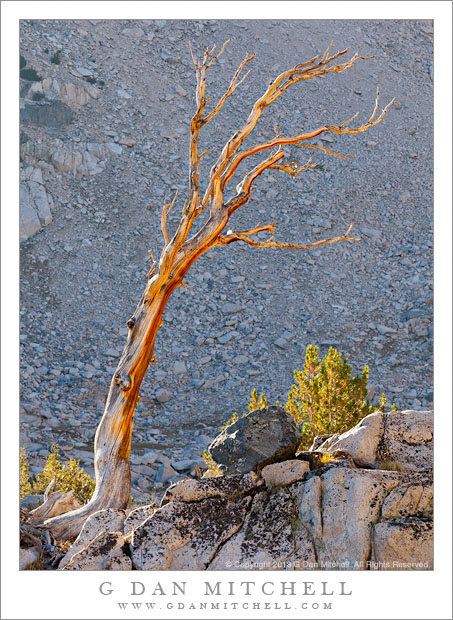
Snag and Talus Field. Kings Canyon National Park, California. September 16, 2013. © Copyright 2014 G Dan Mitchell – all rights reserved.

An old snag stands atop a rocky outcropping and in front of a huge talus field, Kings Canyon National Park

During our mid-September 9-day expedition into the Sierra Nevada high country of Kings Canyon National Park we spent the better part of a week camped in this 11,000′ basin full of lakes and trees and rocks. We camped near the outlet stream of a lake located in a narrow section of the valley, with many more lakes beyond our location and a string of them ascending the valley to our south. Each day, from early morning until after dark, was largely spent exploring this landscape and making photographs.

The valley of lakes to our south, of which our lake was the lowest, was plainly visible to us from our camp site, which was situated on a rise above this lowest lake. From here we could look up the canyon across “our lake” and see a string of several other lakes along this creek. A few were easy to see while others further up the valley revealed themselves primarily by surrounding rock and by breaks in the vegetation. Every day, no matter what else we were doing and where else we photographed, we did at least some work around these closest lakes, and I developed a sort of “daily rounds” taking me up one side of the valley to the upper lake and then back down the other, with occasional detours across the middle of the valley. Is I recall, I was making one of those detours when I photographed this tree, located on top of a small rocky knoll in the middle of the upper valley and backed by the tremendous talus field descending from the surrounding ridges high above.

G Dan Mitchell is a California photographer and visual opportunist whose subjects include the Pacific coast, redwood forests, central California oak/grasslands, the Sierra Nevada, California deserts, urban landscapes, night photography, and more.
Blog | About | Flickr | Twitter | FacebookGoogle+ | 500px.com | LinkedIn | Email

Text, photographs, and other media are © Copyright G Dan Mitchell (or others when indicated) and are not in the public domain and may not be used on websites, blogs, or in other media without advance permission from G Dan Mitchell.